FYfalse00008823613http://fasb.org/srt/2025#ChiefExecutiveOfficerMember16.6716.6716.670000882361none:HanmiLoanAgreementMember2024-01-012024-12-310000882361srt:MaximumMember2025-12-310000882361us-gaap:RetainedEarningsMember2023-12-310000882361none:TwoThousandTwentyFiveATMFacilityMember2025-02-120000882361none:AmendedFacilityAgreementMember2025-01-012025-12-310000882361none:SupplyAgreementMember2025-12-310000882361us-gaap:ForeignCountryMemberus-gaap:InternalRevenueServiceIRSMember2025-12-310000882361none:AllianceGlobalPartnersMembernone:NovemberTwoThousandTwentyFourPublicOfferingMember2024-11-250000882361none:SeriesAWarrantsMemberus-gaap:MeasurementInputExpectedTermMember2024-12-310000882361none:CommittedEquityFacilityMembernone:InitialCommitmentSharesMember2023-05-250000882361us-gaap:CommonStockMembernone:HanmiPharmaceuticalsCoLtdMemberus-gaap:PrivatePlacementMember2024-01-300000882361none:HanmiPharmaceuticalsCoLtdMember2025-12-310000882361srt:ScenarioForecastMember2026-06-012026-06-300000882361none:InterestOnRelatedPartyLoanPayableMember2024-12-310000882361us-gaap:MeasurementInputPriceVolatilityMembernone:ACPWarrantsMember2024-12-310000882361us-gaap:RetainedEarningsMember2024-01-012024-12-310000882361us-gaap:MeasurementInputExercisePriceMembernone:JanuaryTwoThousandTwentyFourInvestorWarrantsMember2024-12-310000882361none:OptionsWithThreeYearVestingMemberus-gaap:ShareBasedCompensationAwardTrancheOneMember2024-01-012024-12-310000882361us-gaap:MeasurementInputSharePriceMembernone:NewbridgeWarrantsMember2024-12-310000882361us-gaap:ForeignCountryMemberus-gaap:CanadaRevenueAgencyMember2025-12-310000882361none:NovemberTwoThousandTwentyFourPublicOfferingMember2024-11-252024-11-250000882361none:HanmiFacilityAgreementMember2025-09-220000882361none:JanuaryTwoThousandTwentyFourInvestorWarrantsMemberus-gaap:MeasurementInputExpectedTermMember2024-12-310000882361none:TuspetinibLicensingAgreementMember2021-11-040000882361none:HanmiPrivatePlacementMember2025-01-012025-12-310000882361us-gaap:FairValueInputsLevel1Membernone:LoanPayableToRelatedPartyMember2025-12-310000882361us-gaap:PrivatePlacementMembernone:SeriesAWarrantsMember2024-06-030000882361us-gaap:MeasurementInputExpectedTermMembernone:ACPWarrantsMember2024-12-310000882361none:CommittedEquityFacilityMembernone:KeystoneMember2024-12-310000882361us-gaap:EmployeeStockOptionMember2024-01-012024-12-310000882361none:NovemberTwoThousandTwentyFourInvestorWarrantsMemberus-gaap:MeasurementInputExercisePriceMember2024-12-310000882361none:HanmiLoanAgreementMember2025-01-012025-12-310000882361us-gaap:MeasurementInputPriceVolatilityMembernone:NovemberTwoThousandTwentyFourInvestorWarrantsMember2024-12-3100008823612025-02-262025-02-260000882361none:PreFundedWarrantsMembernone:RegisteredDirectOfferingMember2024-06-032024-06-030000882361none:HanmiLoanAgreementMember2024-08-272024-08-270000882361us-gaap:FairValueInputsLevel3Membernone:InterestOnRelatedPartyLoanPayableMember2025-12-310000882361none:RegisteredDirectOfferingMembernone:HCWainwrightMember2024-06-032024-06-030000882361us-gaap:FairValueInputsLevel2Member2025-12-310000882361none:HanmiSecondAmendedFacilityAgreementMemberus-gaap:SubsequentEventMember2026-03-032026-03-030000882361us-gaap:MeasurementInputExercisePriceMembernone:SeriesAWarrantsMember2024-12-310000882361none:KeystoneMembernone:CommittedEquityFacilityMember2024-04-010000882361none:AllianceGlobalPartnersMembernone:NovemberTwoThousandTwentyFourPublicOfferingMember2024-11-252024-11-250000882361us-gaap:MeasurementInputExpectedDividendRateMembernone:ACPWarrantsMember2024-12-310000882361none:HanmiFacilityAgreementMember2025-12-310000882361none:SeriesBWarrantsMemberus-gaap:PrivatePlacementMember2024-06-0300008823612024-12-310000882361none:HanmiPharmaceuticalsCoLtdMember2025-01-012025-12-310000882361none:NovemberTwoThousandTwentyFourInvestorWarrantsMemberus-gaap:MeasurementInputSharePriceMember2024-12-310000882361us-gaap:FairValueInputsLevel3Membernone:InterestOnRelatedPartyLoanPayableMember2024-12-310000882361us-gaap:LeaseholdImprovementsMember2025-12-310000882361us-gaap:FairValueInputsLevel3Membernone:LoanPayableToRelatedPartyMember2024-12-310000882361none:KeystoneMembernone:CommittedEquityFacilityMember2023-05-250000882361us-gaap:ShareBasedCompensationAwardTrancheTwoMembernone:OptionsWithFourYearVestingMember2024-01-012024-12-310000882361us-gaap:MeasurementInputRiskFreeInterestRateMembernone:NewbridgeWarrantsMember2024-12-310000882361none:HanmiPrivatePlacementMember2024-01-012024-12-310000882361none:PublicOfferingMembernone:HanmiPharmaceuticalsCoLtdMember2024-01-302024-01-300000882361us-gaap:FurnitureAndFixturesMember2025-12-310000882361none:June2024RegisteredDirectOfferingMember2024-01-012024-12-310000882361none:CommittedEquityFacilityMembernone:KeystoneMembernone:CommitmentSharesMember2024-01-012024-12-310000882361none:JanuaryTwoThousandAndTwentyFourPublicOfferingMember2025-01-012025-12-310000882361none:The2022AtmOfferingMember2024-01-012024-05-300000882361none:HanmiPharmaceuticalsCoLtdMemberus-gaap:PrivatePlacementMember2024-01-300000882361none:NovemberTwoThousandTwentyFourInvestorWarrantsMemberus-gaap:MeasurementInputExpectedTermMember2024-12-310000882361none:HanmiLoanAgreementMember2024-09-022024-09-020000882361us-gaap:CommonStockMember2024-01-012024-12-310000882361us-gaap:GeneralAndAdministrativeExpenseMember2025-01-012025-12-310000882361none:JanuaryThirtyOneThousandAndTwentyNineMember2025-12-310000882361us-gaap:AdditionalPaidInCapitalMember2023-12-310000882361srt:ChiefExecutiveOfficerMembernone:Short-TermAdvanceFromCEOMember2025-12-3100008823612024-01-012024-12-310000882361none:KeystoneMembernone:CommittedEquityFacilityMember2024-01-012024-12-310000882361none:NovemberTwoThousandAndTwentyFourPublicOfferingMember2024-01-012024-12-3100008823612025-11-180000882361none:NovemberTwoThousandAndTwentyFourPublicOfferingMemberus-gaap:CommonStockMember2024-01-012024-12-310000882361none:HanmiSecondAmendedFacilityAgreementMemberus-gaap:SubsequentEventMember2026-03-272026-03-270000882361none:NovemberTwoThousandAndTwentyFourPublicOfferingMember2025-01-012025-12-310000882361none:JanuaryTwoThousandTwentyFourInvestorWarrantsMemberus-gaap:MeasurementInputSharePriceMember2024-12-310000882361none:September2024CommonShareIssuanceMember2024-09-110000882361us-gaap:MeasurementInputExpectedDividendRateMembernone:SeriesAWarrantsMember2024-12-310000882361us-gaap:MeasurementInputPriceVolatilityMembernone:HanmiWarrantsMember2024-12-310000882361us-gaap:MeasurementInputExpectedDividendRateMembernone:SeriesBWarrantsMember2024-12-310000882361srt:ChiefExecutiveOfficerMembernone:Short-TermAdvanceFromCEOMember2025-06-172025-06-1700008823612023-12-310000882361none:JuneTwoThousandAndTwentyFourPreFundedWarrantMember2025-01-012025-12-310000882361none:CommittedEquityFacilityMembernone:FirstBackEndCommitmentSharesMember2023-05-250000882361none:MeasurementInputIssueDateFairValueMembernone:SeriesAWarrantsMember2024-12-310000882361none:TwoThousandTwentyFiveCommittedEquityFacilityMember2025-02-070000882361none:JanuaryTwoThousandAndTwentyFourPublicOfferingMemberus-gaap:CommonStockMember2024-01-012024-12-310000882361none:SupplyAgreementMember2024-01-012024-12-310000882361us-gaap:ForeignCountryMemberus-gaap:InvestmentCreditMemberus-gaap:CanadaRevenueAgencyMember2025-12-310000882361us-gaap:MeasurementInputRiskFreeInterestRateMembernone:NovemberTwoThousandTwentyFourInvestorWarrantsMember2024-12-310000882361none:JanuaryTwoThousandAndTwentyFourPublicOfferingMemberus-gaap:AdditionalPaidInCapitalMember2024-01-012024-12-310000882361none:SeriesAWarrantsMemberus-gaap:PrivatePlacementMembersrt:MaximumMember2024-06-030000882361none:TwoThousandTwentyFiveATMFacilityMember2025-02-032025-02-120000882361none:The2022AtmOfferingMember2022-12-090000882361none:SupplyAgreementMember2021-11-042025-12-3100008823612025-10-012025-12-310000882361none:HanmiLoanAgreementMember2024-08-270000882361none:TwoThousandTwentyFiveATMFacilityMember2025-02-030000882361us-gaap:WarrantMember2025-01-012025-12-310000882361us-gaap:BankTimeDepositsMember2024-12-310000882361none:HanmiPharmaceuticalsCoLtdMemberus-gaap:PrivatePlacementMember2024-01-302024-01-300000882361none:CommittedEquityFacilityMembernone:FirstBackEndCommitmentSharesMember2023-05-252023-05-250000882361none:SeriesBWarrantsMemberus-gaap:MeasurementInputSharePriceMember2024-12-310000882361none:OptionsWithThreeYearVestingMember2024-01-012024-12-310000882361none:KeystoneMembernone:CommittedEquityFacilityMembernone:CommitmentSharesMember2023-05-252024-04-300000882361us-gaap:CommonStockMember2024-12-310000882361none:SharebasedPaymentArrangementTrancheFourMembernone:OptionsWithFourYearVestingMember2024-01-012024-12-310000882361none:JuneTwoThousandAndTwentyFourRegisteredDirectOfferingMemberus-gaap:AdditionalPaidInCapitalMember2024-01-012024-12-310000882361none:PublicOfferingMember2024-01-302024-01-300000882361none:HanmiSecondAmendedFacilityAgreementMemberus-gaap:SubsequentEventMember2026-02-232026-02-230000882361none:JanuaryThirtyTwoThousandAndTwentyNineMember2025-12-310000882361none:CommittedEquityFacilityMembernone:InitialCommitmentSharesMember2023-05-252023-05-250000882361none:TuspetinibLicensingAgreementMember2021-11-042021-11-040000882361none:The2025ATMOfferingMemberus-gaap:CommonStockMember2025-01-012025-12-310000882361us-gaap:FurnitureAndFixturesMember2024-12-310000882361none:PreFundedWarrantsMember2024-01-012024-12-310000882361us-gaap:SoftwareAndSoftwareDevelopmentCostsMember2025-12-310000882361none:HanmiPharmaceuticalsCoLtdMember2024-01-012024-12-310000882361srt:MinimumMember2025-12-310000882361none:MeasurementInputIssueDateFairValueMembernone:NovemberTwoThousandTwentyFourInvestorWarrantsMember2024-12-310000882361none:DebtConversionAgreementMember2025-03-182025-03-180000882361none:NovemberTwoThousandTwentyFourPublicOfferingMember2024-11-250000882361none:PublicOfferingMembernone:NewbridgeWarrantsMember2024-01-300000882361none:SeriesBWarrantsMemberus-gaap:MeasurementInputPriceVolatilityMember2024-12-310000882361srt:ScenarioForecastMember2026-06-300000882361us-gaap:CommonStockMember2025-01-012025-12-310000882361us-gaap:MeasurementInputPriceVolatilityMembernone:SeriesAWarrantsMember2024-12-310000882361us-gaap:MeasurementInputSharePriceMembernone:SeriesAWarrantsMember2024-12-310000882361us-gaap:MeasurementInputRiskFreeInterestRateMembernone:JanuaryTwoThousandTwentyFourInvestorWarrantsMember2024-12-310000882361us-gaap:FairValueInputsLevel2Memberus-gaap:BankTimeDepositsMember2024-12-310000882361us-gaap:AdditionalPaidInCapitalMember2024-01-012024-12-310000882361us-gaap:FairValueInputsLevel2Member2024-12-310000882361us-gaap:WarrantMember2024-12-310000882361none:EmployeeStockPurchasePlanMember2025-01-012025-12-310000882361us-gaap:SoftwareAndSoftwareDevelopmentCostsMember2024-12-310000882361us-gaap:MeasurementInputExercisePriceMembernone:ACPWarrantsMember2024-12-310000882361none:JuneTwoThousandAndTwentyFourPreFundedWarrantMember2024-01-012024-12-310000882361us-gaap:FairValueInputsLevel1Member2024-12-310000882361us-gaap:AdditionalPaidInCapitalMember2025-01-012025-12-310000882361us-gaap:AccumulatedOtherComprehensiveIncomeMember2023-12-310000882361none:TwoThousandTwentyFiveCommittedEquityFacilityMembernone:CommitmentSharesMember2025-02-072025-02-070000882361none:HanmiPharmaceuticalsCoLtdMember2024-06-180000882361us-gaap:FairValueInputsLevel1Memberus-gaap:BankTimeDepositsMember2024-12-310000882361none:HanmiPharmaceuticalsCoLtdMember2021-11-040000882361us-gaap:BankTimeDepositsMember2025-12-310000882361none:MarchFiveTwoThousandAndTwentySixMember2025-12-310000882361us-gaap:AdditionalPaidInCapitalMember2024-12-310000882361us-gaap:EmployeeStockOptionMember2025-01-012025-12-310000882361us-gaap:AdditionalPaidInCapitalMember2025-12-310000882361none:NovemberTwoThousandAndTwentyFourPublicOfferingMemberus-gaap:AdditionalPaidInCapitalMember2024-01-012024-12-310000882361none:LoanPayableToRelatedPartyMember2024-12-310000882361none:InterestOnRelatedPartyLoanPayableMember2025-12-310000882361none:HanmiWarrantsMemberus-gaap:MeasurementInputSharePriceMember2024-12-310000882361us-gaap:AccumulatedOtherComprehensiveIncomeMember2025-12-310000882361none:RegisteredDirectOfferingMember2024-06-030000882361us-gaap:OverAllotmentOptionMember2024-01-300000882361us-gaap:CommonStockMembernone:TwoThousandTwentyThreeCommittedEquityFacilityMember2024-01-012024-12-310000882361us-gaap:CommonStockMember2025-12-310000882361none:TwoThousandTwentyFiveCommittedEquityFacilityMembersrt:MaximumMember2025-02-070000882361us-gaap:InvestmentCreditMemberus-gaap:DomesticCountryMemberus-gaap:CanadaRevenueAgencyMember2025-12-310000882361us-gaap:CommonStockMembernone:PreFundedWarrantsMember2024-01-012024-12-310000882361none:The2022AtmOfferingMember2024-01-012024-12-310000882361us-gaap:PrivatePlacementMember2024-01-302024-01-300000882361none:September2024CommonShareIssuanceMember2024-09-050000882361none:NovemberTwentyFiveTwoThousandTwentyNineMember2025-12-310000882361us-gaap:FairValueInputsLevel3Memberus-gaap:BankTimeDepositsMember2024-12-310000882361us-gaap:FairValueInputsLevel2Membernone:LoanPayableToRelatedPartyMember2024-12-310000882361none:CommittedEquityFacilityMembernone:KeystoneMember2023-05-252024-04-300000882361none:KeystoneMembernone:CommittedEquityFacilityMember2024-04-300000882361us-gaap:FairValueInputsLevel3Memberus-gaap:BankTimeDepositsMember2025-12-310000882361us-gaap:MeasurementInputExpectedDividendRateMembernone:JanuaryTwoThousandTwentyFourInvestorWarrantsMember2024-12-310000882361none:The2022AtmOfferingMember2025-12-310000882361none:TwoThousandTwentyThreeCommittedEquityFacilityMember2024-01-012024-12-310000882361none:HanmiSecondAmendedFacilityAgreementMemberus-gaap:SubsequentEventMember2026-02-230000882361us-gaap:CommonStockMembernone:JuneTwoThousandAndTwentyFourRegisteredDirectOfferingMember2024-01-012024-12-310000882361us-gaap:WarrantMember2024-01-012024-12-310000882361us-gaap:GeneralAndAdministrativeExpenseMember2024-01-012024-12-310000882361us-gaap:FairValueInputsLevel2Memberus-gaap:BankTimeDepositsMember2025-12-310000882361none:RegisteredDirectOfferingMembernone:HCWainwrightMember2024-06-030000882361none:The2022AtmOfferingMember2025-01-012025-12-310000882361none:HanmiSecondAmendedFacilityAgreementMemberus-gaap:SubsequentEventMember2026-03-032026-03-270000882361us-gaap:FairValueInputsLevel3Membernone:LoanPayableToRelatedPartyMember2025-12-310000882361none:The2022AtmOfferingMember2024-05-300000882361us-gaap:MeasurementInputExpectedDividendRateMembernone:NovemberTwoThousandTwentyFourInvestorWarrantsMember2024-12-310000882361none:JuneThreeTwoThousandAndTwentyNineMember2025-12-310000882361none:MeasurementInputIssueDateFairValueMembernone:NewbridgeWarrantsMember2024-12-310000882361us-gaap:WarrantMember2025-12-310000882361none:HanmiFacilityAgreementMember2025-06-180000882361none:SeptemberFiveTwoThousandTwentyNineMember2025-12-310000882361us-gaap:ResearchAndDevelopmentExpenseMember2025-01-012025-12-310000882361none:TwoThousandTwentyThreeCommittedEquityFacilityMember2025-01-012025-12-310000882361none:DebtConversionAgreementMember2025-03-180000882361us-gaap:MeasurementInputPriceVolatilityMembernone:JanuaryTwoThousandTwentyFourInvestorWarrantsMember2024-12-310000882361none:CommittedEquityFacilityMember2023-05-252023-05-250000882361none:The2022AtmOfferingMember2022-12-092024-05-300000882361none:SupplyAgreementMember2025-01-012025-12-310000882361us-gaap:CommonStockMembernone:PublicOfferingMembernone:NewbridgeWarrantsMember2024-01-300000882361us-gaap:MeasurementInputSharePriceMembernone:ACPWarrantsMember2024-12-310000882361none:PreFundedWarrantsMemberus-gaap:AdditionalPaidInCapitalMember2024-01-012024-12-310000882361us-gaap:CommonStockMember2023-12-310000882361none:OptionsWithThreeYearVestingMemberus-gaap:ShareBasedCompensationAwardTrancheThreeMember2024-01-012024-12-310000882361us-gaap:MeasurementInputExpectedTermMembernone:NewbridgeWarrantsMember2024-12-310000882361none:SeriesBWarrantsMemberus-gaap:MeasurementInputRiskFreeInterestRateMember2024-12-310000882361us-gaap:FairValueInputsLevel1Member2025-12-310000882361us-gaap:FairValueInputsLevel1Memberus-gaap:BankTimeDepositsMember2025-12-310000882361us-gaap:FairValueInputsLevel3Member2025-12-310000882361none:RegisteredDirectOfferingMember2024-06-032024-06-030000882361us-gaap:FairValueInputsLevel3Member2024-12-3100008823612026-03-310000882361none:OptionsWithFourYearVestingMember2024-01-012024-12-310000882361us-gaap:ShareBasedCompensationAwardTrancheTwoMembernone:OptionsWithThreeYearVestingMember2024-01-012024-12-310000882361us-gaap:MeasurementInputExpectedDividendRateMembernone:HanmiWarrantsMember2024-12-310000882361us-gaap:ShareBasedCompensationAwardTrancheOneMembernone:OptionsWithFourYearVestingMember2024-01-012024-12-310000882361us-gaap:RetainedEarningsMember2024-12-310000882361us-gaap:SubsequentEventMembernone:HanmiFacilityAgreementMember2026-01-222026-01-220000882361none:HanmiFacilityAgreementMember2025-06-182025-06-180000882361none:JanuaryThirtyTwoThousandAndTwentyEightMember2025-12-310000882361us-gaap:MeasurementInputExpectedDividendRateMembernone:HCWWarrantsMember2024-12-310000882361us-gaap:FairValueInputsLevel1Membernone:InterestOnRelatedPartyLoanPayableMember2024-12-310000882361none:HanmiFacilityAgreementMember2025-01-012025-12-310000882361none:HanmiWarrantsMemberus-gaap:MeasurementInputRiskFreeInterestRateMember2024-12-310000882361us-gaap:MeasurementInputRiskFreeInterestRateMembernone:ACPWarrantsMember2024-12-310000882361us-gaap:CommonStockMembernone:The2022AtmOfferingMember2024-01-012024-12-310000882361none:HCWWarrantsMemberus-gaap:MeasurementInputExpectedTermMember2024-12-310000882361none:PublicOfferingMember2024-01-300000882361none:MeasurementInputIssueDateFairValueMembernone:JanuaryTwoThousandTwentyFourInvestorWarrantsMember2024-12-310000882361none:HanmiLoanAgreementMember2024-09-300000882361us-gaap:MeasurementInputRiskFreeInterestRateMembernone:HCWWarrantsMember2024-12-310000882361none:LoanPayableToRelatedPartyMember2025-12-310000882361us-gaap:WarrantMember2024-01-012024-12-310000882361us-gaap:ComputerEquipmentMember2025-12-310000882361us-gaap:MeasurementInputPriceVolatilityMembernone:HCWWarrantsMember2024-12-310000882361us-gaap:ShareBasedCompensationAwardTrancheThreeMembernone:OptionsWithFourYearVestingMember2024-01-012024-12-310000882361us-gaap:CommonStockMembernone:PublicOfferingMember2024-01-300000882361us-gaap:MeasurementInputExercisePriceMembernone:HCWWarrantsMember2024-12-310000882361none:The2025ATMOfferingMember2024-01-012024-12-310000882361none:September2024CommonShareIssuanceMember2024-09-112024-09-110000882361none:HCWWarrantsMemberus-gaap:MeasurementInputSharePriceMember2024-12-310000882361us-gaap:FairValueInputsLevel2Membernone:LoanPayableToRelatedPartyMember2025-12-310000882361us-gaap:MeasurementInputExercisePriceMembernone:NewbridgeWarrantsMember2024-12-310000882361none:JuneTwoThousandAndTwentyFourRegisteredDirectOfferingMember2024-01-012024-12-310000882361none:MeasurementInputIssueDateFairValueMembernone:HCWWarrantsMember2024-12-310000882361none:DebtConversionAgreementMember2025-01-012025-12-310000882361none:MeasurementInputIssueDateFairValueMembernone:HanmiWarrantsMember2024-12-310000882361none:SeriesBWarrantsMemberus-gaap:MeasurementInputExercisePriceMember2024-12-310000882361us-gaap:ComputerEquipmentMember2024-12-310000882361none:The2025ATMOfferingMember2025-01-012025-12-310000882361us-gaap:FairValueInputsLevel1Membernone:LoanPayableToRelatedPartyMember2024-12-3100008823612024-06-280000882361none:JanuaryTwoThousandAndTwentyFourPublicOfferingMember2024-01-012024-12-3100008823612025-01-012025-12-310000882361us-gaap:MeasurementInputExpectedDividendRateMembernone:NewbridgeWarrantsMember2024-12-310000882361srt:MaximumMembernone:NovemberTwoThousandTwentyFourPublicOfferingMember2024-11-250000882361none:MeasurementInputIssueDateFairValueMembernone:ACPWarrantsMember2024-12-310000882361none:SeriesBWarrantsMembersrt:MaximumMemberus-gaap:PrivatePlacementMember2024-06-030000882361us-gaap:MeasurementInputRiskFreeInterestRateMembernone:SeriesAWarrantsMember2024-12-310000882361us-gaap:RetainedEarningsMember2025-01-012025-12-310000882361country:US2025-01-012025-12-310000882361us-gaap:WarrantMember2025-01-012025-12-310000882361none:SeriesBWarrantsMemberus-gaap:MeasurementInputExpectedTermMember2024-12-310000882361country:US2024-01-012024-12-310000882361us-gaap:FairValueInputsLevel2Membernone:InterestOnRelatedPartyLoanPayableMember2024-12-310000882361us-gaap:LeaseholdImprovementsMember2024-12-310000882361none:June2024RegisteredDirectOfferingMember2025-01-012025-12-310000882361none:HanmiWarrantsMemberus-gaap:MeasurementInputExpectedTermMember2024-12-310000882361us-gaap:OverAllotmentOptionMember2024-01-302024-01-300000882361us-gaap:RetainedEarningsMember2025-12-310000882361none:MeasurementInputIssueDateFairValueMembernone:SeriesBWarrantsMember2024-12-310000882361us-gaap:MeasurementInputPriceVolatilityMembernone:NewbridgeWarrantsMember2024-12-310000882361us-gaap:ResearchAndDevelopmentExpenseMember2024-01-012024-12-310000882361us-gaap:AccumulatedOtherComprehensiveIncomeMember2024-12-310000882361none:HanmiWarrantsMemberus-gaap:MeasurementInputExercisePriceMember2024-12-3100008823612025-12-310000882361none:SupplyAgreementMember2024-12-310000882361none:EmployeeStockPurchasePlanMember2024-01-012024-12-310000882361none:PreFundedWarrantsMembernone:RegisteredDirectOfferingMember2024-06-03xbrli:purenone:Segmentxbrli:sharesiso4217:CADnone:Advanceiso4217:USDiso4217:USDxbrli:shares


UNITED STATES

SECURITIES AND EXCHANGE COMMISSION

Washington, D.C. 20549


FORM 10-K


(Mark One)

ANNUAL REPORT PURSUANT TO SECTION 13 OR 15(d) OF THE SECURITIES EXCHANGE ACT OF 1934

For the fiscal year ended December 31, 2025

OR

TRANSITION REPORT PURSUANT TO SECTION 13 OR 15(d) OF THE SECURITIES EXCHANGE ACT OF 1934 FOR THE TRANSITION PERIOD FROM TO

Commission File Number 001-32001


Aptose Biosciences Inc.

(Exact name of Registrant as specified in its Charter)


Canada

98-1136802

(State or other jurisdiction of

incorporation or organization)

(I.R.S. Employer

Identification No.)

66 Wellington Street West

Suite 5300, TD Bank Tower Box 48

Toronto, Ontario, Canada

M5K 1E6

(Address of principal executive offices)

(Zip Code)

Registrant’s telephone number, including area code: (647) 479-9828


Securities registered pursuant to Section 12(b) of the Act:


Title of each class


Trading

Symbol(s)


Name of each exchange on which registered

None


N/A


N/A

Securities registered pursuant to Section 12(g) of the Act: None

Indicate by check mark if the Registrant is a well-known seasoned issuer, as defined in Rule 405 of the Securities Act. Yes ☐ No

Indicate by check mark if the Registrant is not required to file reports pursuant to Section 13 or 15(d) of the Act. Yes ☐ No

Indicate by check mark whether the Registrant: (1) has filed all reports required to be filed by Section 13 or 15(d) of the Securities Exchange Act of 1934 during the preceding 12 months (or for such shorter period that the Registrant was required to file such reports), and (2) has been subject to such filing requirements for the past 90 days. Yes ☒ No

Indicate by check mark whether the Registrant has submitted electronically every Interactive Data File required to be submitted pursuant to Rule 405 of Regulation S-T (§232.405 of this chapter) during the preceding 12 months (or for such shorter period that the Registrant was required to submit such files). Yes ☒ No

Indicate by check mark whether the registrant is a large accelerated filer, an accelerated filer, a non-accelerated filer, smaller reporting company, or an emerging growth company. See the definitions of “large accelerated filer,” “accelerated filer,” “smaller reporting company,” and “emerging growth company” in Rule 12b-2 of the Exchange Act.


Large accelerated filer

Accelerated filer


Non-accelerated filer

Smaller reporting company


Emerging growth company


If an emerging growth company, indicate by check mark if the registrant has elected not to use the extended transition period for complying with any new or revised financial accounting standards provided pursuant to Section 13(a) of the Exchange Act.

Indicate by check mark whether the registrant has filed a report on and attestation to its management’s assessment of the effectiveness of its internal control over financial reporting under Section 404(b) of the Sarbanes-Oxley Act (15 U.S.C. 7262(b)) by the registered public accounting firm that prepared or issued its audit report.

If securities are registered pursuant to Section 12(b) of the Act, indicate by check mark whether the financial statements of the registrant included in the filing reflect the correction of an error to previously issued financial statements.

Indicate by check mark whether any of those error corrections are restatements that required a recovery analysis of incentive-based compensation received by any of the registrant’s executive officers during the relevant recovery period pursuant to §240.10D-1(b).

Indicate by check mark whether the Registrant is a shell company (as defined in Rule 12b-2 of the Exchange Act). Yes No

The aggregate market value of the voting stock and nonvoting common equity held by non-affiliates computed by reference to the price at which the common equity was last sold, or the average bid and asked prices of such common equity, as of June 28, 2024 was $22,075,799.

As of March 31, 2026, the registrant had 2,552,429 Common Shares outstanding.

DOCUMENTS INCORPORATED BY REFERENCE


TABLE OF CONTENTS


PART I.

2


ITEM 1. BUSINESS

2


ITEM 1A. RISK FACTORS

24


ITEM 1B. UNRESOLVED STAFF COMMENTS

45


ITEM 1C. CYBERSECURITY

46


ITEM 2. PROPERTIES

47


ITEM 3. LEGAL PROCEEDINGS

47


ITEM 4. MINE SAFETY DISCLOSURES

47


PART II.

48


ITEM 5. MARKET FOR REGISTRANT’S COMMON EQUITY, RELATED STOCKHOLDER MATTERS AND ISSUER PURCHASES OF EQUITY SECURITIES

48


ITEM 6. RESERVED

48


ITEM 7 - MANAGEMENT’S DISCUSSION AND ANALYSIS OF FINANCIAL CONDITION AND RESULTS OF OPERATIONS

49


ITEM 7A. QUALITATIVE AND QUANTITATIVE DISCLOSURES ABOUT MARKET RISK

71


ITEM 8. FINANCIAL STATEMENTS AND SUPPLEMENTARY DATA

71


ITEM 9. CHANGES IN AND DISAGREEMENTS WITH ACCOUNTANTS ON ACCOUNTING AND FINANCIAL DISCLOSURE

71


ITEM 9A. CONTROLS AND PROCEDURES

71


ITEM 9B. OTHER INFORMATION

72


ITEM 9C. DISCLOSURE REGARDING FOREIGN JURISDICTIONS THAT PREVENT INSPECTIONS

72


PART III.


ITEM 10. DIRECTORS, EXECUTIVE OFFICERS AND CORPORATE GOVERNANCE

73


ITEM 11. EXECUTIVE COMPENSATION

79


ITEM 12. SECURITY OWNERSHIP OF CERTAIN BENEFICIAL OWNERS AND MANAGEMENT AND RELATED STOCKHOLDER MATTERS

88


ITEM 13. CERTAIN RELATIONSHIPS AND RELATED TRANSACTIONS, AN DIRECTOR INDEPENDENCE

97


ITEM 14. PRINCIPAL ACCOUNTING FEES AND SERVICES

98


PART IV.

99


ITEM 15. EXHIBITS, FINANCIAL STATEMENT SCHEDULES

99


ITEM 16. FORM 10-K SUMMARY

101


i


This Annual Report on Form 10-K contains certain forward-looking statements within the meaning of Section 27A of the Securities Act of 1933, as amended, and Section 21E of the Securities Exchange Act of 1934, as amended (the “Exchange Act”), and is subject to the safe harbor created by those sections. For more information, see “Part I. Item 1. Business — Cautionary Note Regarding Forward-Looking Statements.”

As used in this report, the terms “Aptose,” “Aptose Biosciences,” the “Company,” "the "Corporation," “we,” “us,” “our” and similar references refer to Aptose Biosciences Inc. (formerly known as Lorus Therapeutics Inc.) and our consolidated subsidiaries, and the term “Common Shares” refers to our common shares, no par value.

Aptose had historically qualified as a “foreign private issuer” for purposes of reporting under the Exchange Act, and filing registration statements under the Securities Act of 1933, as amended. Effective December 31, 2018, however, Aptose ceased qualifying as a foreign private issuer and began filing reports with the United States Securities and Exchange Commission ("SEC") as a “domestic issuer.” As a result, Aptose changed the accounting standards by which it prepares its financial statements from International Financial Reporting Standards to generally accepted accounting principles in the United States, or “U.S. GAAP.” All financial statements contained in this Annual Report are presented in accordance with U.S. GAAP. This report contains the following trademark, trade name and service mark of ours: Aptose. This report also contains trademarks, trade names and service marks that are owned by other persons or entities. All references to “dollar” or the use of the symbol “$” are to United States dollars, unless otherwise indicated.

PART I.

Item 1. Business

Overview

Aptose is a science-driven clinical stage biotechnology company dedicated to developing and commercializing precision medicines that address unmet clinical needs in oncology, with an initial focus on hematology. The Company’s small molecule cancer therapeutics pipeline includes products designed to deliver single-agent efficacy and to boost the effectiveness of other anti-cancer therapies and regimens without overlapping toxicities. The Company’s executive offices are located in San Diego, California, and its head office is based in Toronto, Canada.

Proposed Plan of Arrangement

On November 18, 2025, the Company entered into a definitive arrangement agreement (the “Arrangement Agreement”) with Hanmi Pharmaceutical Co. Ltd. ("Hanmi") and HS North America Ltd., a wholly owned subsidiary of Hanmi (“Hanmi Purchaser” and together with Hanmi, the "Hanmi Purchasers") pursuant to a plan of arrangement of the Company under the Canada Business Corporations Act (the "Arrangement") whereby Hanmi Purchaser will acquire all of the issued and outstanding common shares of the Company ("Common Shares") that are not currently owned or controlled by the Hanmi Purchasers or their respective affiliates. Pursuant to the Arrangement, each shareholder of the Company will receive an amount in cash equal to C$2.41 for each common share of the Company held by such shareholder. All incentive securities and warrants of the Company, whether vested or unvested, outstanding on the effective date of the Arrangement shall be deemed (i) cancelled and/or (ii) surrendered and cancelled and each holder of options, RSUs or warrants shall cease to be a holder of such options, RSUs or warrants. Following the completion of the Arrangement, the Company’s securities will be delisted from the Toronto Stock Exchange.

On February 23, 2026, the Arrangement Agreement was amended and restated to among other things, extend the outside date for completing the Arrangement from March 15, 2026 to June 30, 2026 (the amended and restated Arrangement Agreement is referred to as the Arrangement Agreement). On March 31, 2026, shareholders of the Company approved the Arrangement at a special meeting of shareholders held for such purpose. In connection with the Arrangement, the Company will continue from the Canada Business Corporations Act to the Business Corporations Act (Alberta). The Arrangement is expected to close in the first half of 2026, subject to the satisfaction of customary closing conditions.

We expect to devote significant time and resources to the completion of the transactions contemplated by the Arrangement Agreement. However, there are no assurances when or if the Arrangement will be completed. The completion of the Arrangement is subject to the satisfaction or waiver of a number of conditions as set forth in the

2


Arrangement Agreement, including, among others (i) approval of the Arrangement Agreement by the shareholders of the Company, (ii) obtaining certain regulatory and governmental approvals, and (iii) the absence of legal restraints prohibiting the completion of the Arrangement. While the Aptose Board of Directors unanimously recommends voting FOR the Arrangement, there can be no assurance as to when these conditions will be satisfied or waived, if at all, or that other events will not intervene to delay or result in the failure to close the Arrangement. A substantial delay in obtaining satisfactory approvals or the imposition of unfavorable terms or conditions in any government or regulatory approvals could have an adverse effect on the business or financial condition of the Company. In addition, if for any reason the conditions to the Arrangement are not satisfied or waived or if the Arrangement is not completed for any reason, the Company’s ongoing business and financial results may be adversely affected, the market price of the Company’s common shares may be adversely affected, and the Company may need to consider insolvency.

Our Programs

We are advancing oral targeted agents to treat life-threatening hematologic cancers that require immediate treatment. We have one clinical-stage oral kinase inhibitor under active development for the treatment of hematologic malignancies: tuspetinib (HM43239). Two other molecules, luxeptinib (CG-806) and APTO-253, are not undergoing active clinical development at this time and will not be discussed further.

Tuspetinib, Aptose’s lead asset, is being developed for frontline combination therapy (tuspetinib + the BCL-2 inhibitor venetoclax + hypomethylating agent; TUS+VEN+HMA) in newly diagnosed AML patients to unlock the most significant patient impact and greatest commercial opportunity. Tuspetinib is a once-daily oral kinase inhibitor, targeting a select group of kinases operative in myeloid malignancies, such as acute myeloid leukemia ("AML") and the higher risk myelodysplastic syndromes ("hr-MDS"), and known to be involved in tumor proliferation, resistance to therapy, and differentiation. However, tuspetinib avoids kinases that typically cause toxicities associated with other kinase inhibitors and is consequently a well-tolerated antileukemic agent.

Tuspetinib-based triple drug (triplet) frontline combination therapy (tuspetinib + the BCL-2 inhibitor venetoclax + the hypomethylating agent azacitidine; TUS+VEN+AZA) currently is being investigated in newly diagnosed AML patients in the Phase 1/2 TUSCANY clinical study. Aptose has reported data from the 40, 80, 120, and 160 mg TUS cohorts that have demonstrated safety, complete remissions (CRs) and minimal residual disease (MRD) negativity across patients with diverse mutations, including patients with difficult-to-treat mutations in TP53, RAS and FLT3 genes.

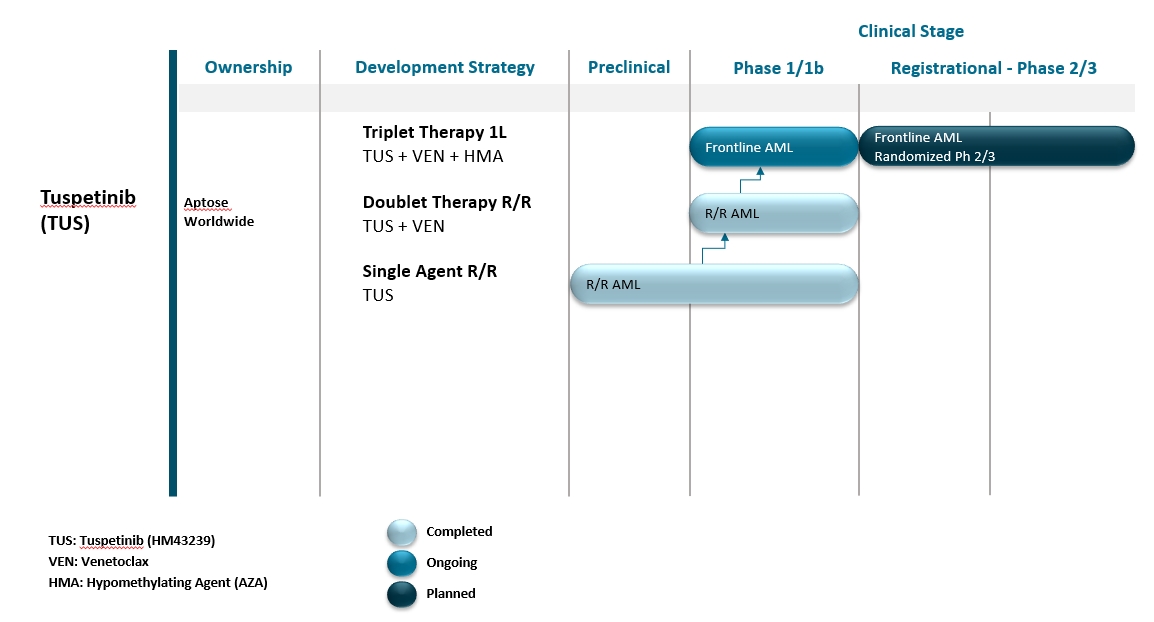
The clinical development path with the tuspetinib-based TUS+VEN+HMA triplet combination therapy in newly diagnosed AML patients began with demonstration of safety and activity of tuspetinib as a single agent ("TUS") and then with the TUS+VEN doublet combination therapy in relapsed or refractory ("R/R") AML patients in whom frontline therapies have previously failed.

Tuspetinib monotherapy dose escalation and dose exploration activities have been completed as part of an international Phase 1/2 clinical trial designed to assess safety, tolerability, pharmacokinetics, pharmacodynamic responses, and efficacy of TUS as a single agent in patients with R/R AML. Complete responses (“CRs”) without dose limiting toxicities were achieved at four dose levels across a broad diversity of mutationally-defined AML populations and with a highly favorable safety profile. Tuspetinib monotherapy to date has demonstrated a favorable safety profile and has caused no drug-related QTc prolongations, liver or kidney toxicities, muscle damage, differentiation syndrome, and no myelosuppression with continuous dosing of patients in remission. A recommended phase 2 dose ("RP2D") of 80 mg tuspetinib once daily as an oral tablet was selected and approved by the U.S. FDA for use as a single agent in patients with R/R AML. At the RP2D, tuspetinib demonstrated notable response rates in R/R AML patients that had never been treated with venetoclax (VEN-naive AML): CR/CRh=36% among all-comers, CR/CRh=50% among patients with mutated FLT3, and CR/CRh=25% in patients with wildtype FLT3.

Following completion of the single agent dose escalation and exploration trial, tuspetinib advanced into the APTIVATE expansion trial of the Phase 1/2 program in R/R AML patient populations treated with tuspetinib combined with the BCL-2 inhibitor venetoclax (TUS+VEN doublet), with the intent to position tuspetinib for triple combination studies in frontline therapy for newly diagnosed AML patients. The TUS+VEN doublet combination therapy (with both 40mg and 80mg TUS) maintained a favorable safety profile: no new or unexpected safety signals

3


were observed, and there were no reported drug-related adverse events of QTc prolongation, differentiation syndrome, or deaths. Also, the TUS/VEN doublet combination (with 80mg TUS) achieved responses in heavily pretreated R/R AML patients, including those with wildtype or mutated FLT3, and those who failed prior therapy with venetoclax (Prior-VEN) or FLT3 inhibitors (Prior-FLT3i).

Based on the safety and efficacy profile of tuspetinib, we believe that tuspetinib, if approved, could 1) become the preferred kinase inhibitor for inclusion in triplet combination for front line AML patients with wild type FLT3 and with difficult-to-treat patients harboring mutations in the FLT3, RAS or TP53 genes, 2) become the preferred kinase inhibitor for inclusion in combination with venetoclax for second line AML patients, 3) serve as an effective agent for maintenance therapy to prevent relapse in patients who achieved a complete remission through a stem cell transplant or through drug-based therapy, 4) serve as an effective agent for the treatment of third line FLT3 mutated patients failed by prior therapy with other FLT3 inhibitors and 5) serve in front line triplet combinations, second line doublet combinations, and maintenance therapy for hr-MDS patients. These beliefs related to the potential commercial opportunity are based on management’s current assumptions and estimates, which are subject to change, and there can be no assurance that tuspetinib will ever be approved or successfully commercialized and, if approved and commercialized, that it will ever generate significant revenues. See our “Risk Factors – “We are an early-stage development company with no revenues from product sales.” and “We have a history of operating losses. We expect to incur net losses and we may never achieve or maintain profitability.” in this Annual Report on Form 10-K.

The following figure presents the clinical stage agents in our pipeline and their respective stages of development.

img33891112_0.jpg


Tuspetinib Program

Licensing Overview

On November 4, 2021, we entered into a licensing agreement (the "Tuspetinib Licensing Agreement") with the South Korean company Hanmi Pharmaceutical Co Ltd. (“Hanmi”) for the clinical and commercial development of tuspetinib (formerly HM43239). Under the terms of the Tuspetinib Licensing Agreement, Hanmi granted us exclusive worldwide rights to tuspetinib for all indications. Hanmi received an upfront payment of $12.5 million, including $5.0 million in cash and $7.5 million in Common Shares. Also pursuant to the Tuspenitib Licensing Agreement, Hanmi is entitled to receive up to $407.5 million in future milestone payments, which are contingent upon achieving certain clinical, regulatory and sales milestones across several potential indications, as well as tiered royalties on net sales. The term of the Tuspenitib Licensing Agreement will continue on a product-by-product and country-by-country basis

4


until the expiration of the royalty period for such product in such country. The licenses granted to us will survive and become non-exclusive, perpetual, irrevocable and fully paid-up on a product-by-product and country-by-country basis, upon their natural expiration under the terms of the Tuspenitib Licensing Agreement.

Preclinical Profile

Tuspetinib is an oral, once-daily, highly potent myeloid kinome inhibitor designed to target key kinases operative in myeloid malignancies. In preclinical studies, tuspetinib demonstrated potent in vitro and in vivo activity against FLT3 ITD mutated as well as D835 and gatekeeper (F691) tyrosine kinase domain ("TKD") mutated AML that confer resistance to other agents. Additionally, tuspetinib inhibited phosphorylation of the SYK kinase, known to be highly activated in AML and associated with resistance to FLT3 targeted therapy. Tuspetinib also was designed to inhibit several kinases involved in tumor cell proliferation and/or differentiation, including mutant forms of c-KIT, JAK1, JAK2, and RSK, all with half maximal inhibitory concentration ("IC50") values < 10 nM.

Tuspetinib induced in vitro cytotoxicity in AML and Ba/F3 cell lines expressing FLT3 WT, ITD, and/or TKD point mutations. Tuspetinib showed greater inhibitory activity compared to quizartinib on Ba/F3 cells expressing resistance-conferring ITD/TKD double mutations (ITD/F691L and ITD/D835Y). Thus, tuspetinib may overcome clinically relevant ITD/TKD double mutations, which may result from sustained FLT3 inhibition. Moreover, target modulation was shown as tuspetinib inhibited FLT3 phosphorylation and downstream signaling molecules such as phospho-ERK and phospho-STAT5.

The in vivo anti-tumor efficacy of tuspetinib was demonstrated in murine xenograft models using MV-4-11 and MOLM-13 human AML cells having the ITD mutant form of FLT3 and using the MOLM-14 model having the ITD and F691L dual mutations of FLT3 with dosing regimens that match those currently under investigation. Tuspetinib exhibited dose-dependent tumor growth inhibition of models of FLT3 ITD mutant AML with complete tumor regression observed in some groups, and no change in body weight. Of note, tuspetinib produced greater tumor growth inhibition in the MOLM-14 FLT3-ITD/F691L model compared to gilteritinib, or entospletinib (SYK inhibitor) as single agents, and comparable activity to the gilteritinib plus entospletinib combination.

Latest Clinical Update and Program Status

On December 6, 2025, Aptose presented additional data from the ongoing TUSCANY trial of tuspetinib in combination with venetoclax and azacitidine (TUS+VEN+AZA) in a poster at the 67th American Society of Hematology (ASH) Annual Meeting in Orlando, Florida. Aptose reported that the TUS+VEN+AZA triplet frontline therapy shows high efficacy and MRD-negative remissions in newly diagnosed AML patients with diverse mutations. They also highlighted that safety remains a key feature of TUS-based therapies, with a 100% response rate (CR/CRh) at the higher dose levels (80 and 120 mg TUS). Complete responses (CR/CRh) were observed in FLT3 wildtype patients, who make up about 70% of AML cases, and also in AML patients with TP53/complex karyotype, RAS, and MDS-related mutations.

Key Messages included:


In newly diagnosed AML patients, TUS+VEN+AZA shows promising safety, tolerability and resilient efficacy, including MRD-negative remissions across a broad mutational spectrum
High quality clinical responses (CR/CRh):
o
90% across 40, 80 and 120 mg dose levels
o
100% at the higher 80 mg and 120 mg dose levels
o
Observed in FLT3-WT, FLT3-ITD, and NPM1c genetic subgroups
o
Observed in biallelic TP53/complex karyotype and RAS adverse genetic subgroups
o
Observed in AML with MDS-related mutations
MRD negativity: 78% by central flow cytometry in responding subjects

5


TUS targets VEN resistance mechanisms; inhibits kinase-driven abnormal signaling
Two subjects transitioned to stem cell transplantation, and both returned for TUS maintenance
TUS+VEN+AZA triplet therapy was well tolerated with no dose-limiting toxicities (DLTs) across all evaluable TUS dose levels
o
No DLTs including no prolonged myelosuppression for subjects in remission in Cycle 1
o
No drug-related deaths, differentiation syndrome, QTc prolongation, or CPK elevation reported
o
8/10 evaluable subjects experienced red cell and platelet transfusion independence for > 8 weeks after their best response
o
Febrile neutropenia was reported in 2 subjects (16.7%), with 1 subject related to TUS
At the recently enrolled 160 mg dose level, preliminary findings show patients achieving early blast clearance with MRD-negativity and formal responses in the first few weeks of treatment (not included in poster data cut)

On October 16, 2025, Aptose announced that Tuspetinib exceeded expectations when combined with standard of care treatment across diverse populations of newly diagnosed AML patients. Aptose announced that data from the ongoing TUSCANY trial of tuspetinib in combination with venetoclax and azacitidine (TUS+VEN+AZA) were presented in a poster presentation, entitled “TUSCANY Study of Safety and Efficacy of Tuspetinib plus Standard of Care Venetoclax and Azacitidine in Study Participants with Newly Diagnosed AML Ineligible for Induction Chemotherapy,” at the European School of Haematology (ESH) 7th International Conference on Acute Myeloid Leukemia “Molecular and Translational”: Advances in Biology and Treatment, being held from October 16-18, 2025 in Estoril, Portugal. Data to date from 10 patients in the TUSCANY trial across all three cohorts, 40 mg, 80 mg or 120 mg TUS dose in TUS+VEN+AZA, reveal promising clinical safety and antileukemic activity and support the use of TUS with standard of care treatment across a broad range of AML populations, including those carrying adverse mutations regardless of FLT3 mutation status.

Key Messages included:

TUS in combination with standard dosing of VEN+AZA has been well tolerated with no DLT, no treatment-related deaths, no differentiation syndrome, no QTc prolongation, no prolonged myelosuppression after remission in Cycle 1, and no CPK elevations reported at any dose levels to date in these newly diagnosed AML patients.
Addition of TUS to VEN+AZA achieved CR/CRh responses in 6/6 (100%) patients treated at the higher dose levels of 80 mg and 120 mg TUS, exceeding the 66% rate expected from VEN+AZA alone.
Overall, TUS+VEN+AZA CR/CRh responses were observed in 9/10 (90%) patients.
7 of 8 (88%) CR/CRh responses in FLT3 wildtype AML, representing 70% of AML population.
TUS+VEN+AZA MRD-negativity noted in 7/9 (78%) responding patients by central flow cytometry.
CR/CRh responses achieved across diverse mutational subtypes, including: unmutated FLT3, FLT3-ITD, NPM1c, biallelic TP53 with complex karyotype, RAS, and myelodysplasia-related mutations.
Dosing at the TUS 160 mg level is now ongoing.

On August 6, 2025, Aptose announced that the Cohort Safety Review Committee (the "CSRC") monitoring Aptose’s Phase 1/2 TUSCANY trial of TUS in combination with standard of care dosing of venetoclax and azacitidine (TUS+VEN+AZA triplet) has approved escalating from 120 mg TUS dose to 160 mg TUS dose based on its favorable review of safety and efficacy data from patients in the first three cohorts (40 mg, 80 mg, and 120 mg TUS dose levels) of the trial. Enrollment is open for dosing subjects at the 160 mg TUS dose level.


Key Messages included:

Safety Review Committee endorses escalation to 160 mg TUS dosing.
Cohorts with 120 mg, 80 mg, 40 mg TUS dosing completed with no dose-limiting toxicities.

6


Excellent safety and complete remissions (CRs) in some of the most difficult-to-treat AML populations.
No dose reductions required to the standard-of-care VEN/AZA with TUS dose cohorts.
TUS+VEN+AZA triplet continues to achieve CRs and minimal residual disease (MRD)-negativity with favorable safety in newly diagnosed AML patients.


On June 12, 2025, Aptose presented clinical data on safety, response, and MRD-negativity from the TUSCANY Phase 1/2 clinical trial of Tuspetinib triplet therapy in newly diagnosed AML patients during an oral presentation at the European Hematology Association Congress (EHA 2025), held from June 12-15, 2025, in Milan, Italy. The title of the presentation was “TUSCANY Study of Safety and Efficacy of Tuspetinib Plus Standard of Care Venetoclax and Azacitidine in Study Participants with Newly Diagnosed AML Ineligible for Induction Chemotherapy”. Dr. Gabriel Mannis, Associate Professor of Medicine, Stanford University School of Medicine, key opinion leader (KOL) in the treatment of AML, and an investigator in the TUSCANY study, delivered the oral presentation and reported safety and efficacy data from the first two dose cohorts at 40 mg of TUS or 80 mg of TUS in the TUS+VEN+AZA triplet. Dr. Mannis also noted that three patients were rapidly enrolled on the third dose cohort of 120 mg TUS in the TUS+VEN+AZA triplet, and that no DLTs have been observed to date. The oral presentation also included minimal residual disease (MRD-negativity) assessments and a longer duration of follow-up.

The TUS+VEN+AZA triplet is being developed as a mutation-agnostic frontline therapy to treat large, mutationally diverse populations of newly diagnosed AML patients who are ineligible to receive induction chemotherapy. The data presented reveal complete responses across patients with diverse mutations, including TP53-mutated/CK AML and FLT3-wildtype AML patients. TUS could have a significant commercial opportunity in the largest markets and the most challenging of AML cases, following regulatory clearance.


Key Messages included:

Addition of TUS to the standard of care VEN+AZA creates a well-tolerated and mutation-agnostic frontline triple drug therapy for newly diagnosed AML patients.
AML patients with diverse mutations, including TP53-mutated/CK and FLT3-wildtype, safely achieved complete remissions and MRD negativity.
Ten AML patients dosed across 40 mg, 80mg, and 120 mg TUS with TUS+VEN+AZA triplet.


Key Findings included:

As of June 30, 2025, ten newly diagnosed AML patients received the TUS+VEN+AZA combination:
o
Four received the 40 mg dose of TUS, three received the 80 mg dose of TUS, and three received the 120 mg dose of TUS
At the initial dose of 40 mg TUS (n=4), with patients on the longest duration of drug:
o
Three subjects achieved CRs and were MRD-negative, including
Patient with FLT3-ITD
Patient with FLT3-WT
Patient with TP53/CK
At the 80 mg TUS dose level (n=3):
o
All three patients (100%) achieved composite complete remissions (CR and CRi)
o
A TP53-mutated/CK AML patient achieved an CRh
o
Too early in treatment for final MRD assessment
At the 120 mg TUS dose level (n=3):
o
All three patients at the 120 mg TUS dose level remain on therapy

7


o
All three patients (100%) already achieved composite complete remissions (CR and CRi)
o
Too early in treatment for formal MRD assessments
Regardless of mutation status, TUS is active in newly diagnosed AML patients
o
MRD-negative responses achieved across diverse genetic populations, including adverse TP53 mutations and CK
o
Responses continue to evolve, and the triplet continues to be well tolerated with no DLTs
TUS can be administered safely with standard-of-care dosing of VEN/AZA
o
TUS PK properties not altered by VEN, AZA, antifungals or food
o
No prolonged myelosuppression in Cycle 1 in the absence of AML
o
No treatment-related deaths; 9 out of 10 enrolled subjects remain on study
o
No treatment-related QTc prolongation, CPK elevations, or differentiation syndrome


On February 20, 2025, Aptose announced that the CSRC monitoring Aptose’s Phase 1/2 TUSCANY trial of tuspetinib in combination with standard of care dosing of venetoclax and azacitidine (TUS+VEN+AZA triplet) has unanimously approved escalating from a 40 mg dose of TUS to an 80 mg dose of TUS based on its favorable review of data from the first four patients in the trial. No significant safety concerns or dose-limiting toxicities (DLTs) have been reported, including no prolonged myelosuppression of subjects in remission. All four subjects treated in the 40 mg cohort remain on study, while enrollment is open for the 80 mg dose cohort.

Key Findings and Messages included:

To date, four newly diagnosed AML patients have received the lowest dose of TUS (40 mg) as part of the (TUS+VEN+AZA) combination.
Three patients with unmutated (wild-type) FLT3 (FLT3-WT) completed Cycle 1 of treatment with no dose-limiting toxicities (DLTs) or TUS dose adjustments.
o
Two FLT3-WT patients achieved complete remissions (CR and CRh) by the end of Cycle 1.
o
Notably, a patient with biallelic TP53 mutations and a complex karyotype obtained CR.
o
The third FLT3-WT patient experienced significant reductions in bone marrow leukemic blasts during Cycle 1 and remains on therapy in Cycle 2.
The fourth patient, harboring FLT3-ITD and NPM1 mutations, is currently dosing in Cycle 1 and is not yet eligible for response evaluation.
Pharmacokinetic (PK) analyses of TUS show that plasma levels are unaffected by the addition of AZA, providing predictability and avoiding the need for dose alterations due to PK interactions.
Similarly, VEN plasma levels in Cycle 1 are consistent with published results and the prior TUS/VEN APTIVATE study in R/R AML, indicating no clinically significant interactions with TUS.


On February 12, 2025, Aptose reported early safety and response results from Aptose’s Phase 1/2 TUSCANY trial with a 40 mg dose of tuspetinib in combination with standard of care dosing of venetoclax and azacitidine (TUS+VEN+AZA triplet) in mutationally diverse populations of newly diagnosed AML patients who are ineligible to receive induction chemotherapy.


Key Findings and Messages included:

In January 2025, Aptose announced the initiation of the TUSCANY trial and dosing in the first cohort of newly-diagnosed AML patients with the lowest starting dose (40 mg) of TUS as part of the TUS+VEN+AZA triplet, and the early data reveal promising clinical safety and antileukemic activity.

8


Four newly diagnosed AML patients have received the lowest dose of TUS (40 mg) as part of the (TUS+VEN+AZA) combination.
Three patients with unmutated (wild-type) FLT3 (FLT3-WT) completed Cycle 1 of treatment with no dose-limiting toxicities (DLTs) and no dose adjustments.
o
Two FLT3-WT patients achieved complete remissions (CR and CRh) by the end of Cycle 1.
o
Notably, a patient with biallelic TP53 mutations and a complex karyotype obtained CR.
o
The third FLT3-WT patient experienced significant reductions in bone marrow leukemic blasts during Cycle 1 and remains on therapy in Cycle 2.
The fourth patient, harboring FLT3-ITD and NPM1 mutations, is currently dosing in Cycle 1 and is not yet eligible for response evaluation.
Pharmacokinetic (PK) analyses for TUS show that plasma levels are unaffected by the addition of AZA, providing predictability and avoiding the need for dose adjustments due to PK interactions.


On January 20, 2025, Aptose announced that the CSRC monitoring Aptose’s Phase 1/2 TUSCANY trial of tuspetinib in combination with standard of care dosing of venetoclax and azacitidine (TUS+VEN+AZA triplet) has unanimously approved escalating from 40 mg TUS to 80 mg TUS based on its favorable review of data from the first four patients in the trial. No significant safety concerns or dose limiting toxicities (DLTs) have been reported, including no prolonged myelosuppression of subjects in remission. All four subjects treated in the 40 mg cohort remain on study while enrollment is open for the 80 mg cohort.

Key Findings and Messages included:

To date, four newly diagnosed AML patients have received the lowest dose of TUS (40 mg) as part of the (TUS+VEN+AZA) combination.
Three patients with unmutated (wildtype) FLT3 (FLT3-WT) completed Cycle 1 of treatment with no dose-limiting toxicities (DLTs) and no TUS dose adjustments.
o
Two FLT3-WT patients achieved complete remissions (CR and CRh) by the end of Cycle 1.
o
Notably, a patient with biallelic TP53 mutations and a complex karyotype obtained CR.
o
The third FLT3-WT patient experienced significant reductions in bone marrow leukemic blasts during Cycle 1 and remains on therapy in Cycle 2.
The fourth patient, harboring FLT3-ITD and NPM1 mutations, is currently dosing in Cycle 1 and is not yet eligible for response evaluation.
Pharmacokinetic (PK) analyses for TUS show plasma levels unaffected by the addition of AZA, providing predictability and avoiding the need for dose alterations due to PK interactions.
Similarly, VEN plasma levels in Cycle 1 are consistent with published results and the prior TUS/VEN APTIVATE study in R/R AML, indicating no clinically significant interactions with TUS.


On January 9, 2025, Aptose announced dosing the first set of patients in the TUSCANY Phase 1/2 study with tuspetinib (TUS) in combination with venetoclax (VEN) and azacitidine (AZA) as a frontline triple drug combination (triplet) therapy for patients newly diagnosed with acute myeloid leukemia, or AML.

On January 12, 2025, Aptose announced promising early safety and response results from newly diagnosed acute myeloid leukemia (AML) patients dosed in Aptose’s Phase 1/2 TUSCANY trial with a 40 mg dose of tuspetinib in combination with standard of care dosing of venetoclax and azacitidine (TUS+VEN+AZA triplet). The TUS+VEN+AZA triplet is being developed as a frontline therapy to treat large, mutationally diverse populations of newly diagnosed AML patients who are ineligible to receive induction chemotherapy.

9


In December 2024, Aptose attended the 66th Annual American Society of Hematology (ASH) Meeting and Exposition in San Diego, California, and presented a poster entitled “Phase 1 Safety and Efficacy of Tuspetinib Plus Venetoclax Combination Therapy in Study Participants with Relapsed or Refractory Acute Myeloid Leukemia (AML) Support Exploration of Triplet Combination Therapy of Tuspetinib Plus Venetoclax and Azacitidine for Newly Diagnosed AML”.

Key Findings and Messages included:

TUS+VEN+AZA triplet trial is proceeding in newly diagnosed AML patients
TUS+VEN retains activity in the difficult-to-treat prior-VEN AML population
TUS+VEN is active in FLT3 wildtype, representing ~70% of AML patients
TUS+VEN is well tolerated and can be safely co-administered
TUS+VEN is active across broad populations of R/R AML
Combination of TUS with VEN may avoid VEN resistance
TUS+VEN+AZA triplet may establish a more effective, mutation agnostic standard of care for chemotherapy ineligible AML patients

Highlights of the ASH poster presentation included:

TUS as Single Agent (n= 93 Patients)

60% and 42% CR/CRh with 80 mg TUS in FLT3 mutated and all-comer VEN-naïve AML
33% CRc & 42% ORR (CR, CRp, CRh, CRi or PR) in FLT3 mutated and VEN-naïve patients
o
Includes 40, 80, 120, and 160 mg TUS dose as a single agent
o
Includes those who failed prior therapy with venetoclax
o
Includes those with mutated or unmutated FLT3, those who failed prior-HSCT, priorFLT3i, prior-chemotherapy, prior-HMA
o
TUS once daily orally as a single agent achieved CR/CRh responses at four different dose levels (40, 80, 120, and 160 mg) with no dose limiting toxicities (no DLTs)
o
TUS showed a favorable safety profile with no DLTs through 160 mg per day, and no drug related discontinuations, no QTc, no differentiation syndrome, and no deaths

TUS/VEN Combination Therapy (n= 79 Patients)

40% ORR with 80 mg TUS + 400 mg VEN in FLT3 mutated patients
83% (5/6) had failed prior-VEN treatment and 50% (3/6) had failed both prior-VEN and FLT3i treatment
TUS+VEN achieved responses among diverse R/R AML with adverse mutations in VEN-naïve, prior-VEN, FLT3WT, FLT3MUT, prior-FLT3
TUS+VEN showed favorable safety and tolerability with no new or unexpected safety

On December 3, 2024, the Company announced that the National Cancer Institute (NCI), part of the National Institutes of Health, and the Company had entered into a Cooperative Research and Development Agreement (“CRADA”). Under the CRADA, the NCI and Aptose will collaborate on the clinical development of Aptose’s proprietary lead clinical-stage compound tuspetinib (TUS), an inhibitor of key signaling kinases involved in myeloid malignancies, in the NCI Cancer Therapy Evaluation Program (CTEP) sponsored MyeloMATCH trials employing combinations of targeted therapy for the treatment of molecularly defined acute myeloid leukemia (AML) and myelodysplastic syndromes (MDS) populations. These trials will be conducted by NCI's National Clinical Trials

10


Network (NCTN), with the participation of the NCI Community Oncology Research Program (NCORP) in the U.S. and Canada. The MyeloMATCH precision medicine trials (NCT05564390), funded by the NCI, were officially launched on May 16, 2024. MyeloMATCH aims to expedite the development of tailored drug combination treatments for patients with newly diagnosed AML and MDS and to treat patients with these aggressive cancers of the blood and bone marrow from diagnosis throughout their treatment journey.

On June 14, 2024, Aptose presented tuspetinib (TUS) clinical findings as a clinical poster presentation and preclinical findings as a e-poster at the European Hematology Association (EHA) 2024 Hybrid Congress in Madrid, Spain.

Highlights of the findings include:

Tuspetinib Monotherapy (TUS) and Tuspetinib + Venetoclax (TUS+VEN) Doublet Therapy Show Broad Clinical Activity and Strong Safety Data in relapsed or refractory (R/R) Acute Myeloid Leukemia (AML) and Differentiate TUS from other Investigational Drugs in AML
TUS Monotherapy and TUS+VEN Doublet Therapy Active in Difficult-to-treat Genetic Subgroups, FLT3 Wildtype AML
TUS Shown to Target VEN Resistance Mechanisms and Retain Activity on VEN-Resistant AML Cells in Preclinical Study
Tuspetinib + Venetoclax + Azacitidine (TUS+VEN+AZA) Triplet Trial to Treat Newly Diagnosed AML Patients; Clinical Sites Being Activated

Our APTIVATE clinical trial of Tuspetinib as a monotherapy (TUS) and in combination treatment with Venetoclax (TUS+VEN) in a very ill AML patient population, yielded excellent and consistent safety findings and demonstrated clinical activity across a broad range of AML – including many with highly adverse genetic mutations. These findings supported the advancement of Tuspetinib as an ideal third agent to add to a venetoclax and hypomethylating agent regimen for the frontline treatment of Newly Diagnosed AML patients. Conclusions from the clinical poster, entitled “Safety and Efficacy of Tuspetinib as Monotherapy and Combined with Venetoclax in a Phase 1/2 Trial of Patients with Relapsed or Refractory (R/R) Acute Myeloid Leukemia” include:

Extensive dose exploration was performed with TUS (93 patients) and TUS+VEN (79 patients) in highly treatment-experienced R/R AML patients (prior VEN, FLT3i, HMA, chemotherapy, HSCT)
TUS monotherapy achieved complete remissions at 40, 80, 120, and 160 mg with no DLT, achieved a 42% CRc and 50% ORR in VEN naïve and FLT3-mutation harboring patients, and achieved responses in patients harboring highly adverse genetics (TP53MUT, RASMUT, other)
TUS+VEN Doublet remained safe and well tolerated (40mg TUS + 400mg VEN | 80mg TUS + 400mg VEN), and achieved bone marrow blast reductions and responses among diverse R/R AML patients with adverse mutations and prior failure of VEN
TUS targets known VEN resistance mechanisms in vitro and is clinically active in both FLT3MUT & FLT3WT R/R AML populations even after prior VEN exposure.

The greatest unmet medical need in AML is for an improved frontline therapy in Newly Diagnosed AML patients. Tuspetinib is now being developed as the TUS+VEN+HMA to establish a new standard of care for the treatment of these Newly Diagnosed AML patients that may increase response rates, extend survival, safely improve quality of life, treat a broad spectrum of genetically unique AML patient populations, and blunt the development of resistance to venetoclax.

Progress has been made with VEN+HMA in 1L therapy but 1/3 do not respond and median OS <15 months with <25% alive at 3-years.
Response rates and OS need improvement, especially in adverse genetic subgroups

11


Emergence of VEN resistance via RAS/MAPK, TP53, and FLT3 clonal expansion, among other mechanisms, leads to relapse or refractory (R/R) AML that does not respond well to subsequent salvage therapies in R/R setting.
A 3rd agent is needed to boost responses with VEN+HMA standard of care therapy.
We believe Tuspetinib is the ideal 3rd Agent for Addition to VEN+AZA to Treat Newly Diagnosed AML
TUS has excellent safety alone and in combination with VEN when co-administered
TUS has broad activity across genetic subgroups including TP53, RAS/MAPK, & FLT3 mutants
TUS mechanism may minimize drug resistance to VEN via inhibition of key AML kinases
TUS can be administered with or without food allowing co-administration with VEN
Preliminary PK data suggest no clinically meaningful interaction between TUS and VEN requiring dose modification for co-administration

In addition to the Tuspetinib clinical poster, a separate preclinical abstract was published as a poster publication at EHA, entitled “Tuspetinib Retains Nanomolar Potency Against AML Cells Engineered to Express the NRAS G12D Mutation or Selected for Resistance to Venetoclax’. The study demonstrated that TUS targets known venetoclax (VEN) resistance mechanisms, retaining nanomolar potency against AML cells engineered to express the NRAS-G12D mutation or selected for resistance to VEN, and in combination with VEN, could prevent the emergence of resistance to both agents. TUS resistant cells showed hypersensitivity to VEN such that treatment with both drugs could also interfere with the emergence of TUS resistance.

On March 26, 2024, Aptose announced that more than 170 patients to date received TUS alone or in combination with the BCL-2 inhibitor venetoclax (VEN) during the Phase 1/2 clinical program in the very ill relapsed or refractory (R/R) AML patient population. At the single-agent 80 mg dose, TUS demonstrated a favorable safety profile and an impressive response rate among patients naive to VEN. The safety profile of TUS remained favorable when combined with VEN in R/R AML patients, and responses were observed in both patients naive to VEN and those who had failed prior VEN therapy. TUS avoids many typical toxicities observed with other agents and achieves broad activity across AML patients with a diversity of adverse genetic abnormalities.

On December 9, 2023, Aptose featured tuspetinib in an oral presentation at the 65th American Society of Hematology ("ASH") Annual Meeting and Exposition and announced that a growing body of clinical data for Aptose’s lead compound tuspetinib, demonstrates significant benefit as a single agent and in combination with venetoclax (VEN) in patients with R/R AML in the ongoing APTIVATE Phase 1/2 study. Data was presented in an oral presentation by lead investigator Naval G. Daver, M.D., Professor, Director Leukemia Research Alliance Program, Department of Leukemia, The University of Texas MD Anderson Cancer Center, Houston, TX.

Dr. Daver reported data from more than 100 relapsed/refractory patients from multiple international clinical sites, who had failed prior therapy and then were treated with TUS as a single agent or the TUS+VEN doublet. Both TUS and the TUS+VEN doublet delivered multiple composite complete remissions ("CRc") in this very ill AML population, while maintaining a favorable safety profile across all treated patients. The data demonstrated that tuspetinib as a single agent (TUS) is active and well tolerated in one of the most challenging and heterogeneous disease settings in oncology – relapsed and refractory AML. Tuspetinib demonstrated broad activity, including in patients with FLT3 wild-type AML (accounting for more than 70% of the AML population), FLT3-mutated AML, NPM1-mutated AML, and in patients with mutations historically associated with resistance to targeted therapy. Most notably, TUS targets VEN resistance mechanisms, enabling the TUS+VEN combination therapy to uniquely treat the very ill prior-VEN AML population, including both FLT3-mutant and FLT3-wildtype disease. From a broader perspective, the growing body of antileukemic activity and continued favorable safety profile support the advancement of tuspetinib as the TUS+VEN+HMA triplet combination therapy for the treatment of frontline newly diagnosed AML patients.

12


Dr. Daver also pointed out that while patients on the TUS+VEN therapy are early in their treatment cycles, most patients achieving a response remained on treatment and that responses have begun to mature as dosing continues. Highlights of Dr. Daver’s ASH oral presentation include:

As a single agent at therapeutic doses of 80-160 mg in 68 evaluable patients, TUS was more active in VEN-naive patients, with an overall CRc rate of 29% (8/28). This included a 42% CRc rate (5/12) in FLT3-mutated patients and a 19% CRc rate (3/16) in FLT3-unmutated, or wildtype, AML patients. Responses and blood counts improved with continuous dosing, many patients bridged to an allogeneic stem cell transplant (HSCT), durability was observed when HSCT was not performed, and 80 mg was selected as the RP2D. Overall, tuspetinib showed a favorable safety profile with only mild adverse events (AEs) and no dose-limiting toxicities (DLTs) up to 160 mg per day, and no drug discontinuations from drug-related toxicity.
In the TUS+VEN doublet study, 49 patients were dosed with 80 mg of tuspetinib and 200 mg of venetoclax, with 36 evaluable (and 13 patients too early to assess). Patients were heavily exposed to Prior-VEN and Prior-FLT3 inhibitor treatment. TUS+VEN was active in both VEN-naive and Prior-VEN R/R AML patients. TUS demonstrated compelling composite complete remission (CRc) rates. Among all evaluable patients, TUS+VEN demonstrated a CRc rate of 25% (9/36); 43% (3/7) in VEN-naive patients, and 21% (6/29) in Prior-VEN patients. Among FLT3 wildtype patients, TUS+VEN demonstrated an overall CRc rate of 20% (5/25); 33% (2/6) in VEN-naive patients, and 16% (3/19) in Prior-VEN patients. Among FLT3 mutant patients, TUS+VEN demonstrated an overall CRc rate of 36% (4/11); a complete response in a VEN-naive patient (1/1); a 30% (3/10) in Prior-VEN patients; and 44% (4/9) in patients treated prior with a FLT3 inhibitor.

Clinical data from tuspetinib in AML was presented at the ASH Annual Meeting in December 2022 and during a Corporate Comprehensive Clinical Update Call held December 11, 2022. Data presented demonstrated that tuspetinib delivers single agent responses without prolonged myelosuppression or life-threatening toxicities in these very ill and heavily pretreated relapsed or refractory AML patients. Responses were observed in a broad range of mutationally-defined populations, including those with mutated forms of NPM1, MLL, TP53, NRAS, KRAS, DNMT3A, RUNX1, wild-type FLT3, ITD or TKD mutated FLT3, various splicing factors, and other genes. As of October 6, 2022, 60 heavily pretreated R/R AML patients were enrolled at multiple centers and treated at doses escalating from 20 mg to 200 mg, with further dose exploration at the 40 mg, 80 mg, 120 mg and 160 mg dose levels. Tuspetinib delivered multiple CRs at 40 mg, 80 mg, 120 mg and 160 mg dose levels in which no DLTs were observed. Tuspetinib demonstrated clinically meaningful benefit in all responders, by either bridging successfully to HSCT or leading to a durable response, as well as a favorable safety profile. In addition to 5 CRcs and 1 PR reported at ASH 2021, 4 new CRcs and 3 new PRs were generated in 2022. New responses during 2022 were achieved with 160 mg, 120 mg, 80 mg, and 40 mg. Among efficacy-evaluable patients treated with 80 mg, 120 mg, or 160 mg, response rates ranging from 19% to 75% were observed in specific genotypic subpopulations of R/R AML patients. Significant bone marrow leukemic blast reductions were observed broadly in FLT3+ and FLT3 wildtype patients across multiple dose levels, comparable to reported gilteritinib data, except that the patients treated with tuspetinib were more heavily pre-treated relapsed and refractory AML patients than those treated with gilteritinib. Vignettes of patient experiences highlight the potency and breadth of tuspetinib in delivering complete remissions across several mutationally defined populations with diverse adverse mutations. Tuspetinib continued to show a favorable safety profile with only mild AEs and no DLTs up to 160 mg per day, and no drug discontinuations from drug-related toxicity. No drug-related SAE, drug-related deaths, differentiation syndrome, AE of QT prolongation or DLT were observed through the 160 mg level. Tuspetinib avoids many of the typical toxicities observed with other tyrosine kinase inhibitors. We identified a safe therapeutic range with a broad therapeutic window, spanning the dose levels of 40, 80, 120 and 160 milligrams. We also announced that enrollment had been initiated in the APTIVATE expansion trial for monotherapy and drug combination therapy with tuspetinib. For the APTIVATE expansion trial, we selected 120 mg as the initiating single agent expansion dose and 80 mg as the initiating dose selected for combination with venetoclax.

On January 30, 2023, we announced the dosing of patients in the APTIVATE Phase 1/2 clinical trial of tuspetinib, and that another clinical response has been achieved by a R/R AML patient receiving 40 mg tuspetinib once daily orally in the original dose exploration trial, the second response at the recently launched low-dose 40 mg cohort. In addition, we elucidated a rationale for the superior safety profile of tuspetinib. While several kinase inhibitors require high exposures to elicit responses by nearly completely suppressing a single target, they often cause

13


additional toxicity because they also extensively inhibit that target in normal cells. In contrast, tuspetinib simultaneously suppresses a small suite of kinase-driven pathways critical for leukemogenesis. Consequently, tuspetinib achieves clinical responses at lower exposures with less overall suppression of each pathway, thereby avoiding many toxicities observed with competing agents

Concurrent with the European Hematology Association (EHA) Annual Congress held June 8-11, 2023, Aptose held an interim clinical update webcast on June 10, 2023, to present highlights from the ongoing clinical development of tuspetinib. Aptose reported completion of the tuspetinib dose escalation and dose exploration Phase 1/2 trial in 77 R/R AML patients, tuspetinib demonstrated a favorable safety profile, and tuspetinib delivered monotherapy responses across four dose levels with no dose-limiting toxicity in mutationally diverse and difficult to treat R/R AML populations, including patients with highly adverse mutations that typically do not respond to monotherapy or combination therapy: TP53-mutated patients with a CR/CRh = 20% and RAS-mutated patients with a CR/CRh = 22%. Aptose also reported completion of a successful End of Phase 1 Meeting with the US FDA for tuspetinib, that a monotherapy RP2D was selected as 80mg daily, and that all development paths remain open, including the single arm accelerated path. Following completion of the dose escalation and dose exploration phases of the Phase 1/2 clinical program, Aptose focused attention on the tuspetinib APTIVATE expansion trial. The APTIVATE trial sought to identify patient populations that may serve as development paths for R/R AML patients sensitive to the TUS+VEN doublet and that can support accelerated and full approvals. We reported that patient enrollment in the APTIVATE expansion trial has been brisk and preliminary CR activity had already been reported in patients receiving the TUS+VEN doublet who previously failed therapy with venetoclax.

On October 29, 2023, Aptose presented two posters related to the clinical and preclinical activity of tuspetinib at the European School of Haematology 6th International Conference: Acute Myeloid Leukemia "Molecular and Translational": Advances in Biology and Treatment, held October 29-31, 2023, in Estoril, Portugal. Clinical findings included 1) data from the APTO-TUS-HV01 clinical trial (the "Food Effect Study") evaluating the pharmacokinetic (PK) properties of tuspetinib in healthy human volunteers in which tuspetinib was administered with or without food, and 2) from an international Phase 1/2 study of tuspetinib as a single agent and in combination with venetoclax in patients with R/R AML from across clinical centers in the United States, South Korea, Spain, Australia and other sites. Data from the Food Effect Study in healthy human volunteers demonstrated tuspetinib can be administered with or without food and foresee no clinically meaningful difference in exposure. This is an important finding for patient convenience, as venetoclax is dosed with food and tuspetinib can now be simultaneously administered with the venetoclax rather than require staggered dosing. Findings from the Phase 1/2 clinical trial demonstrated tuspetinib as a single agent was well-tolerated and highly active among R/R AML patients with a diversity of adverse genotypes and delivered a 42% CR/CRh cross-evaluable venetoclax-naive patients at the 80mg daily RP2D. The TUS+VEN doublet has been well tolerated in the APTIVATE international Phase 1/2 expansion trial in R/R AML patients and achieved multiple responses in patients who previously failed venetoclax ("Prior-VEN failure AML"), including Prior-VEN failure patients who also previously failed FLT3 inhibitors, all of whom represent emerging populations of high unmet medical need. Notably, tuspetinib targets mechanisms of venetoclax resistance that may re-sensitize patients with prior venetoclax failure to venetoclax.

Separate from the clinical studies, the preclinical study (entitled: “Tuspetinib Oral Myeloid Kinase Inhibitor Creates Synthetic Lethal Vulnerability to Venetoclax”) presented by Aptose during the ESH Conference investigated the effects of tuspetinib on key elements of the phosphokinome and apoptotic proteome in both parental and TUS-resistant AML cells. In parental cells, tuspetinib inhibits key oncogenic signaling pathways and shifts the balance of pro- and anti-apoptotic proteins in favor of apoptosis, suggesting that it may generate vulnerability to venetoclax. Indeed, acquired resistance in the AML cells to tuspetinib generated a synthetic lethal vulnerability to venetoclax of unusually high magnitude. Concurrent administration of TUS+VEN therefore may discourage the emergence of resistance to tuspetinib during treatment. In conjunction with poster presentations at the ESH Conference, on October 30, 2023, Aptose held a “Clinical Update and KOL Data Review of AML Drug Tuspetinib” that was webcast and featured Dr. Naval Daver, MD, Professor, Director Leukemia Research Alliance Program, Department of Leukemia, The University of Texas MD Anderson Cancer Center, Houston, Texas. Dr. Daver is the lead investigator on Aptose’s APTIVATE trial and is recognized for significant achievements in the development of novel AML treatments, including several combination therapies. Aptose presented data in 49 patients who received the TUS+VEN doublet, showing an overall response rate (ORR) of 48% among all patients that had achieved an evaluable stage, as well as a 44% ORR among Prior-VEN failure AML patients, including FLT3-unmutated (wildtype) patients (43% ORR) and FLT3-mutated patients (60% ORR), some of whom also had failed prior therapy with FLT3 inhibitors. The TUS+VEN

14


doublet was well tolerated with no unexpected safety signals. The TUS/VEN doublet may serve the Prior-VEN failure R/R AML patients that represent a rapidly growing population that is highly refractory to any salvage therapy with response rates in the 4-15% range. The compelling data with the TUS+VEN doublet in R/R AML patients suggest a TUS+VEN+HMA triplet may serve the needs of frontline (1L) newly diagnosed AML patients.

Competitive Conditions

The biotechnology and pharmaceutical industries are characterized by rapidly evolving technology and intense competition. There are numerous companies in these industries that are focusing their efforts on activities similar to ours. Some of these are companies with established positions in the pharmaceutical industry and may have substantially more financial and technical resources, more extensive research and development capabilities, and greater marketing, distribution, production, and human resources than us. In addition, we face competition from other companies for opportunities to enter partnerships with biotechnology and pharmaceutical companies and academic institutions.

Competition with our potential products may include chemotherapeutic agents, monoclonal antibodies, antisense therapies, small molecules, immunotherapies, vaccines, and other biologics with novel mechanisms of action. These drugs may kill cancer cells indiscriminately, or through a targeted approach, and some have the potential to be used in non-cancer indications. We also expect that we will experience competition from established and emerging pharmaceutical and biotechnology companies that have other forms of treatment for the cancers that we target, including drugs currently in development for the treatment of cancer that employ a number of novel approaches for attacking these cancer targets. Cancer is a complex disease with more than 100 indications requiring drugs for treatment. The drugs in competition with our potential drugs have specific targets for attacking the disease, targets which are not necessarily the same as ours. These competitive drugs, however, could potentially also be used together in combination therapies with our drugs to manage the disease. Other factors that could render our potential products less competitive may include the stage of development, where competitors’ products may achieve earlier commercialization, as well as superior patent protection, better safety profiles, or a preferred cost-benefit profile.

Intellectual Property

We believe that our issued patents and pending applications are important in establishing and maintaining a competitive position with respect to our products and technology.

Tuspetinib (HM43239)

In November 2021, we licensed the exclusive rights to research, develop, and commercialize tuspetinib (the "Tuspetinib Licensing Agreement"). Under the terms of the Tuspetinib Licensing Agreement, Hanmi granted Aptose exclusive worldwide rights to tuspetinib for all indications. Aptose is now the exclusive licensee of the composition of matter and use patents covering tuspetinib, and tuspetinib analogs. Aptose believes that it now owns rights to a strong and defensive intellectual property position.

As of December 31, 2025, Aptose owned rights in 59 issued patents, including 4 issued U.S. patents, and 23 patents validated in European countries that are in force and cover the tuspetinib compound or analog compounds. These patents are expected to provide protection until 2038 through 2039. Patent applications are also pending in the United States and in contracting states to the Patent Cooperation Treaty for coverage of tuspetinib and analog compounds, with expected expiry dates between 2038 and 2044.

15


The Company’s research and development activities involve the controlled use of hazardous and radioactive materials and, accordingly, the Company is subject to federal, provincial and local laws and regulations in the United States and Canada governing the use, manufacture, storage, handling and disposal of such materials and certain waste products. To the knowledge of the Company, compliance with such environmental laws and regulations does not and will not have any significant impact on its capital spending, profits or competitive position within the normal course of its operating activities. There can be no assurance, however, that the Company will not be required to incur significant costs to comply with environmental laws and regulations in the future or that its operations, business or assets will not be materially adversely affected by current or future environmental laws or regulations.

Employees

As of December 31, 2025, we employed 14 full-time persons in research and drug development and administration activities. Three of our employees hold Ph.D.s, one holds an M.D, and numerous others hold degrees and designations such as M.Sc., B.Sc., C.P.A., and M.B.A. To encourage a focus on achieving long-term performance, employees and members of the board of directors of the Company (the “Board”) have the ability to acquire an ownership interest in the Company through Aptose’s share option and alternative compensation plans.

The business of the Company requires personnel with specialized oncology skills and knowledge. Researchers must be able to design and implement studies to assess the efficacy of anticancer drugs. Specialized knowledge and skills relating to chemistry and formulation process development are also needed. Such knowledge and skills are needed to develop product-specific analytical methods and formulation processes. The Company’s business also requires clinical and regulatory expertise. The Company has trained scientists and personnel with broad experience in these fields.

None of our employees are unionized, and we consider our relations with our employees to be good.

Government Regulation

Overview

Our overall regulatory strategy is to work with the appropriate government departments that regulate the use and sale of therapeutic drug products. This includes the FDA in the United States, Health Canada in Canada, the European Medicines Agency (“EMA”) in Europe, and other local regulatory agencies with oversight of preclinical studies, clinical trials and marketing of therapeutic products. Where possible, we intend to take advantage of opportunities to accelerate the development of drugs designed to treat rare and serious or life-threatening diseases. We also intend to pursue priority evaluation of any application for marketing approval filed in Canada, the United States or the European Union and to file additional drug applications in other markets where commercial opportunities exist. We may not be able to successfully pursue these opportunities.

Regulations by government authorities in the United States, Canada, and the European Union are significant factors in guiding our current research and drug development activities. To clinically test, manufacture and market drug products for therapeutic use, we must be in compliance with guidance and regulations established by the regulatory agencies in the countries in which we currently operate or intend to operate.

The laws of most of these countries require the licensing of manufacturing facilities, carefully controlled research and the extensive testing of products. Biotechnology companies must establish the safety and efficacy of their new products in clinical trials; they must establish and comply with current good manufacturing practices ("cGMPs") for the manufacturing of the product and control over marketing activities before being allowed to market a product. The safety and efficacy of a new drug must be demonstrated through human clinical trials conducted in accordance with the guidance and regulations established by local and federal regulatory agencies.

The process of completing clinical trials and obtaining regulatory approval for a new drug takes several years and requires substantial resources. Once a new drug or product license application is submitted, regulatory agencies may not review it in a timely manner or approve the product. Even after a New Drug Application (“NDA”) submission has occurred and/or approval has been obtained, further studies, including post-marketing studies, may be required to provide additional data on the efficacy and safety necessary to confirm the approved indication or to gain approval for

16


the use of the new drug as a treatment for clinical indications other than those for which the new drug was initially tested. Regulatory agencies also require post-marketing surveillance programs to monitor a new drug’s side effects, safety and long-term effects of the product. A serious safety or effectiveness problem involving an approved new drug may result in a regulatory agency mandating its withdrawal from the market and possible civil action. We may encounter such difficulties or high costs in securing the necessary approvals, which could delay or prevent us from manufacturing or marketing our products.

In addition to the regulatory product approval framework, biotechnology companies, including Aptose, are subject to regulation under local, provincial, state and federal law, including requirements regarding occupational safety, laboratory practices, environmental protection and hazardous substance control, and may be subject to other present and future local, provincial, state, federal and foreign regulation, including possible future regulation of the biotechnology industry.

Approval of New Drugs in Canada

In Canada, the manufacture and sale of new drugs are controlled by Health Canada. New drugs must pass through several testing stages, including pre-clinical testing and human clinical trials. Pre-clinical testing involves testing the new drug’s chemistry, pharmacology and toxicology in vitro and in vivo. Successful results (that is, potentially valuable pharmacological activity combined with an acceptable level of toxicity) enable the developer of the new drug to file a clinical trial application to initiate clinical trials in humans.

To study a drug in Canadian patients, a clinical trial application submission must be filed with Health Canada. The clinical trial application submission must contain specified information, including the results of the pre-clinical tests completed at the time of the submission and any available information regarding use of the drug in humans. In addition, since the method of manufacture may affect the efficacy and safety of a new drug, information on manufacturing methods and standards and the stability of the drug substance and dosage form must be presented. Production methods and quality control procedures must be in place to ensure an acceptably pure product, essentially free of contamination and uniformity across all quality aspects.

In addition, all federally regulated trials must be approved and monitored by an independent committee of doctors, scientists, advocates and others to ensure safety and ethical standards, Institutional Review Boards (“IRBs”) or Ethics Review Boards (“ERBs”). The review boards study and approve all study-related documents before a clinical trial begins and also carefully monitor data to detect benefit or harm, and the validity of results.

Provided that Health Canada does not reject the clinical trial application and IRB or ERB approval has been obtained, clinical trials can begin. Clinical trials for product candidates in Canada, as in the United States, are generally carried out in three phases. Phase 1 involves studies to evaluate toxicity and ideal dose levels in healthy humans. The new drug is administered to human patients who have met the clinical trial entry criteria to determine pharmacokinetics, human tolerance and prevalence of any adverse side effects. Phases 2 and 3 involve therapeutic studies. In Phase 2, efficacy, dosage, side effects and safety are established in a small number of patients who have the disease or disorder that the new drug is intended to treat. In Phase 3, there are controlled clinical trials in which the new drug is administered to a large number of patients who are likely to receive benefit from the new drug. In Phase 3, the effectiveness of the new drug in patients is compared with that of standard accepted methods of treatment to provide sufficient data for statistical proof of safety and efficacy for the new drug.

If clinical studies establish that a new drug is safe and effective, the manufacturer submits a new drug submission application to Health Canada for marketing approval. The new drug submission contains all known information known about the new drug, including the results of pre-clinical testing and clinical trials. Information about a substance contained in a new drug submission includes its proper name, its chemical name, and details on its method of manufacturing and purification, and its biological, pharmacological, and toxicological properties. The new drug submission also provides information about the dosage form of the new drug, including a quantitative listing of all ingredients used in its formulation, its method of manufacture, manufacturing facility information, packaging and labeling, the results of stability tests, and its diagnostic or therapeutic claims and side effects, as well as details of the clinical trials to support the safety and efficacy of the new drug. Furthermore, for biological products, an on-site evaluation is completed to assess the production process and manufacturing facility. It is required prior to the issuance of a notice of compliance. All aspects of the new drug submission are critically reviewed by Health Canada. If a new

17


drug submission is found satisfactory, a notice of compliance is issued permitting the new drug to be sold for the approved use. In Canada, an establishment license must be obtained prior to marketing the product.

Health Canada has a policy of prioritizing the evaluation of new drug submissions for all drugs intended for serious or life-threatening diseases for which no drug product has received regulatory approval in Canada and for which there is reasonable scientific evidence indicating that the proposed new drug is safe and may provide effective treatment.

An exception to the foregoing requirements relating to the manufacture and sale of a new drug is the limited authorization that may be available for the sale of new drugs for emergency treatment. Under the special access program, Health Canada may authorize the sale of a quantity of a new drug for human use to a specific practitioner for the emergency treatment of a patient under the practitioner’s care. Prior to authorization, the practitioner must supply Health Canada with information concerning the medical emergency for which the new drug is required, such data as is in the possession of the practitioner with respect to the use, safety and efficacy of the new drug, the names of the institutions at which the new drug is to be used and such other information as may be requested by Health Canada. In addition, the practitioner must agree to report to both the drug manufacturer and Health Canada the results of the new drug’s use in the medical emergency, including information concerning adverse reactions, and must account to Health Canada for all quantities of the new drug made available.

The Canadian regulatory approval requirements for new drugs outlined above are similar to those of other major pharmaceutical markets. While testing carried out in Canada is often acceptable for regulatory submissions in other countries, individual regulatory authorities may request supplementary testing during their assessment of any submission. Therefore, the clinical testing conducted under Health Canada authorization or the approval of regulatory authorities of other countries may not be accepted by regulatory authorities outside Canada or other countries.

Approval of New Drugs in the United States

In the United States, the FDA regulates and investigates the manufacturing, testing and sale of new drugs. New drugs require FDA approval of an NDA prior to commercial sale. For certain biological products, a Biological License Application (“BLA”) must be obtained prior to marketing and batch release. As in Canada, to obtain marketing approval, data from adequate and well-controlled human clinical trials, demonstrating to the FDA’s satisfaction a new drug’s safety and effectiveness for its intended use, are required. Data are generated in studies conducted pursuant to an investigational new drug (“IND”) submission, similar to that required for a clinical trial application in Canada. Clinical trials with human subjects are classified as Phase 1, Phase 2, Phase 3 or a combination thereof. In a marketing application, the manufacturer must also demonstrate the identity, potency, quality, and purity of the new drug's active ingredients, and the stability of those ingredients. Further, the manufacturing facilities, equipment, processes and quality controls for the new drug must comply with the FDA’s current cGMP regulations for drugs both in a pre-licensing inspection before product licensing and in subsequent periodic inspections after licensing. An establishment license grants the sponsor permission to fabricate, package, label, distribute, import, wholesale or test the newly approved drug.

Federally regulated trials must be approved and monitored by an independent committee of doctors, scientists, advocates, and others to ensure safety and ethical standards, IRBs or ERBs. The review boards study and approve all study-related documents before a clinical trial begins and also carefully monitor data to detect benefit or harm, and validity of results.

Post-Approval Regulation

The monitoring of a new drug does not cease once it is on the market. For example, a manufacturer of a new drug must report any new information received concerning serious side effects, as well as the failure of the new drug to produce desired effects. If Health Canada determines it to be in the interest of public health, a notice of compliance for a new drug may be suspended and the new drug may be removed from the market.

18


A post surveillance program involves clinical trials conducted after a drug is marketed (referred to as Phase 4 studies in the United States) and is an important source of information on as yet undetected adverse outcomes, especially in populations that may not have been involved in the premarketing trials (e.g., children, the elderly, pregnant women) and the drug’s long-term morbidity and mortality profile. Regulatory authorities may require companies to conduct Phase 4 studies as a condition of market approval. Companies often conduct post-marketing studies in the absence of a regulatory mandate.

The foregoing description summarizes the requirements for a new drug to be approved for marketing in North America. The EMA and the Japanese Pharmaceuticals and Medical Devices Agency are also important regulatory authorities in drug development. Together with the FDA, they are the three International Conference on Harmonization parties that oversee the three largest markets for drug sales.

Information About Our Executive Officers

Aptose’s leadership team comprises accomplished industry, financial and clinical research professionals who are dedicated to building a comprehensive anticancer drug pipeline and clinical development programs focused on targeted therapeutics directed against dysregulated oncogenic processes in patients with life. The team includes our President, Chairman and Chief Executive Officer, our Senior Vice President, Chief Financial Officer and Chief Business Officer, and our Chief Medical Officer.

William G. Rice, Ph.D., age 67, joined Aptose as Chairman, President and Chief Executive Officer in October 2013. Dr. Rice brings more than 25 years of C-level executive, operational, business development, financial, and R&D experience in the biotech industry to Aptose. Prior to joining Aptose, Dr. Rice served as the President, Chief Executive Officer and Chairman of the board of Cylene Pharmaceuticals, Inc., a private biotechnology company, from 2003 to 2013. Prior to Cylene, Dr. Rice was the founder, President, Chief Executive Officer and Director of Achillion Pharmaceuticals, Inc. from 1998 to 2003. He also served as Senior Scientist and Head of the Drug Mechanism Laboratory at the National Cancer Institute-Frederick National Laboratory for Cancer Research from 1992 to 1998 and served as a faculty member in the division of Pediatric Hematology and Oncology at Emory University School of Medicine from 1989 to 1992. Dr. Rice performed his postdoctoral training in the Division of Hematology/Oncology in the Department of Internal Medicine at the University of Michigan Medical Center, prior to which he earned his Ph.D. in Biochemistry from Emory University Department of Biochemistry.

Fletcher Payne, age 63, joined Aptose as Senior Vice President, Chief Business Officer, Chief Financial Officer (“CFO”) and Corporate Secretary in June 2022. With over 25 years of experience in the healthcare sector, Mr. Payne has held several CFO and senior management positions at biotech companies, as well as roles in finance and accounting. He has overseen legal, corporate development, and licensing functions. Throughout his career, he has successfully executed a diverse range of business transactions totaling more than $3.7 billion, with a focus on clinical testing, oncology, neurological conditions, and orphan disease indications. Mr. Payne most recently served as CFO of Syapse, where he successfully completed several financing transactions and oversaw the company’s accounting, finance, corporate development, and legal functions. Previously, he served as CFO at Catalyst Biosciences, a publicly traded biotech company. Mr. Payne has also held CFO roles and senior financial positions at CytomX Therapeutics, Plexxikon Inc., Rinat Neuroscience Corporation, Dynavax Technologies Corporation, and Cell Genesys, among others. He earned a Bachelor of Science in Finance from the Haas School of Business at the University of California, Berkeley.

Rafael Bejar, M.D, Ph.D., age 54, joined Aptose as Senior Vice President and Chief Medical Officer in January 2020. Dr. Bejar is an internationally recognized physician scientist with extensive research and clinical experience in the area of hematologic malignancies. Dr. Bejar joined Aptose from UC San Diego (“UCSD”) where he began working in 2012. He continues to serve at UCSD as an Associate Professor of Clinical Medicine, caring for patients and maintaining a research laboratory focused on translational studies of myeloid malignancies and also serves and is an independent consultant as an advisor and Chair of Independent Data Monitoring Committees for other pharmaceutical companies. At UCSD, he founded the MDS Center of Excellence and led the Hematology Disease Team from 2017 to 2019. There he has directed several clinical studies and served as an advisor for numerous companies including Celgene (now BMS), Takeda, AbbVie, Astex, Genoptix (now NeoGenomics), Keros, Servier, Geron, Forty Seven (now Gilead), PersImmune, Epizyme (now Ipsen) and Daiichi-Sankyo. Outside UCSD, Dr. Bejar sits on the Scientific Advisory Board for the MDS Foundation, is a prior member of the National Comprehensive Cancer Network

19


Guidelines Committee and has led projects for the International Working Group for MDS. He is frequently invited to speak at national and international meetings and has published articles in a variety of journals including The New England Journal of Medicine, Journal of Clinical Oncology, Leukemia (where he is an Associate Editor), Blood, and Blood Advances. Dr. Bejar completed his fellowship in the Massachusetts General Hospital Cancer Center/Dana-Farber Cancer Institute program and has been board certified in Internal Medicine, Hematology, and Oncology. He completed his internship in Internal Medicine at the University of Chicago followed by his residency at the Brigham and Women’s Hospital in Boston where he later served as a Medical Chief Resident and an Instructor in Hematology. He holds an M.D. degree and a Neuroscience Ph.D. from UCSD and a B.S. in Physics from MIT.

Corporate Information

Our headquarters are located at 66 Wellington Street West, Suite 5300, TD Bank Tower Box 48, Toronto, Ontario, MK5 1E6, Canada, and our executive offices are located at 12770 High Bluff Drive, Suite 120, San Diego, CA 92130 (telephone: 858-926-2730).

We file annual, quarterly, current reports, proxy statements and other information with the SEC. The SEC maintains an Internet site that contains our public filings and other information regarding the Company, at www.sec.gov. We make these reports available free of charge at our website http://www.aptose.com (under the “Investors — Financial Information” caption).

We are also a reporting issuer under the securities laws of every province of Canada.

Cautionary Note Regarding Forward-Looking Statements and Risk Factor Summary

This Annual Report on Form 10-K contains forward-looking statements within the meaning of the United States Private Securities Litigation Reform Act of 1995 and “forward-looking information” within the meaning of applicable Canadian securities law. We refer to such forward-looking statements and forward-looking information collectively as “forward-looking statements”. These statements relate to future events or future performance and reflect our expectations and assumptions regarding our growth, results of operations, performance and business prospects and opportunities. Such forward-looking statements reflect our current beliefs and are based on information currently available to us. In some cases, forward-looking statements can be identified by terminology such as “may”, “would”, “could”, “will”, “should”, “expect”, “plan”, “intend”, “anticipate”, “believe”, “estimate”, “predict”, “potential”, “continue” or the negative of these terms or other similar expressions concerning matters that are not historical facts. The forward-looking statements in this Annual Report on Form 10-K include, among others, statements regarding our future operating results, economic performance and product development efforts and statements in respect of:

the proposed Arrangement and its expected terms, benefits, timing and closing, including receipt of required approvals, and satisfaction of other customary closing conditions, and the anticipated timing thereof;
our ability to obtain the capital we require to fund research and operations and to continue as a going concern;
our business strategy;
our clinical development plans;
our plans to conduct clinical trials and preclinical programs;
our ability to accrue appropriate numbers and types of patients;
our reliance on external contract research/manufacturing organizations for certain activities;
our plans to secure and maintain strategic partnerships to assist in the further development of our product candidates and to build our pipeline;
our ability to file and maintain intellectual property to protect our pharmaceutical assets;
potential exposure to legal actions and potential need to take action against other entities;

20


our expectations regarding the progress and the successful and timely completion of the various stages of our drug discovery, drug synthesis and formulation, preclinical and clinical studies and the regulatory approval process;
our plans, objectives, expectations, and intentions; and
other statements including words such as “anticipate,” “contemplate,” “continue,” “believe,” “plan,” “estimate,” “expect,” “intend,” “will,” “should,” “may,” and other similar expressions.

The forward-looking statements contained in this Annual Report on Form 10-K reflect our current views with respect to future events, are subject to significant risks and uncertainties, and are based upon a number of estimates and assumptions that, while considered reasonable by us, are inherently subject to significant business, economic, competitive, political and social uncertainties and contingencies. Forward-looking statements contained in this Annual Report on Form 10-K are made as of the date of this Annual Report on Form 10-K.

Except as required under applicable securities legislation, we undertake no obligation to publicly update or revise forward-looking statements, whether as a result of new information, future events or otherwise.

Risk Factor Summary

Many factors could cause our actual results, performance or achievements to be materially different from any future results, performance, or achievements that may be expressed or implied by such forward-looking statements, including, among others:

possibility that the Arrangement will not be completed on the terms and conditions, or on the timing, currently contemplated, and that it may not be completed at all, due to a failure to obtain or satisfy, in a timely manner or otherwise;
the failure to complete the Arrangement, which could negatively impact the price of the Common Shares or otherwise affect the business of the Company;
the possibility that Aptose and Hanmi may be the targets of legal claims, securities class actions, derivative lawsuits and other claims and negative publicity related to the Arrangement;
the dedication of significant resources to pursuing the Arrangement and the restrictions imposed on the Corporation while the Arrangement is pending;
the uncertainty surrounding the Arrangement could adversely affect the Company’s retention of business partners and key employees;
the payment by the Company of an expense fee if the Arrangement Agreement is terminated in certain circumstances;
CCAA Plan if the Arrangement is not completed;
certain directors and executive officers of the Company may have interests in the Arrangement that may be different from, or in addition to, the interests of shareholders generally;
our ability to continue as a going concern;
our lack of product revenues;
our need to raise substantial additional capital in the near future and that we may be unable to raise such funds when needed and on acceptable terms;
our early stage of development, particularly the inherent risks and uncertainties associated with (i) developing new drug candidates generally, (ii) demonstrating the safety and efficacy of these drug candidates in clinical studies in humans, and (iii) obtaining regulatory approval to commercialize these drug candidates;
further equity financing, which may substantially dilute the interests of our existing shareholders;

21


clinical studies and regulatory approvals of our drug candidates are subject to delays, and may not be completed or granted on expected timetables, if at all, and such delays may increase our costs and could substantially harm our business;
our reliance on external contract research/manufacturing organizations for certain activities and if we are subject to quality, cost, or delivery issues with the preclinical and clinical grade materials supplied by contract manufacturers, our business operations could suffer significant harm;
clinical studies are long, expensive and uncertain processes and the United States Food and Drug Administration, or “FDA”, or other similar foreign regulatory agencies that we are required to report to, may ultimately not approve any of our product candidates;
our ability to comply with applicable regulations and standards;
our inability to achieve our projected development goals in the time frames we announce and expect;
difficulties in enrolling patients for clinical trials may lead to delays or cancellations of our clinical trials;
impact of government spending cuts;
our reliance on third parties to conduct and monitor our preclinical studies;
our ability to attract and retain key personnel, including key executives and scientists;
any misconduct or improper activities by our employees;
our exposure to exchange rate risk;
our ability to commercialize our business attributed to negative results from clinical trials;
the marketplace may not accept our products or product candidates due to the intense competition and technological change in the biotechnical and pharmaceuticals, and we may not be able to compete successfully against other companies in our industries and achieve profitability;
our ability to obtain and maintain patent protection;
our ability to afford substantial costs incurred with defending our intellectual property;
our ability to protect our intellectual property rights and not infringe on the intellectual property rights of others;
our business is subject to potential product liability and other claims;
potential exposure to legal actions and potential need to take action against other entities;
commercialization limitations imposed by intellectual property rights owned or controlled by third parties;
our ability to maintain adequate insurance at acceptable costs;
our ability to find and enter into agreements with potential partners;
extensive government regulation;
data security incidents and privacy breaches could result in increased costs and reputational harm;
our Common Share price has been and is likely to continue to be volatile;
future sales of our Common Shares by us or by our existing shareholders could cause our Common Share price to drop;
changing global market and financial conditions;
difficulties by non-Canadian investors to obtain and enforce judgments against us because of our Canadian incorporation and presence;
any failures to maintain an effective system of internal control may result in material misstatements of our financial statements, or cause us to fail to meet our reporting obligations or fail to prevent fraud;

22


our broad discretion in how we use the proceeds of the sale of Common Shares, if any;
our ability to expand our business through the acquisition of companies or businesses; and
other risks detailed from time-to-time in our on-going filings with the SEC and Canadian securities regulators, and those which are discussed in Item 1A. Risk Factors in this Annual Report on Form 10-K.

Should one or more of these risks or uncertainties materialize, or should the assumptions described in the Item 1A. Risk Factors in this Annual Report on Form 10-K underlying those forward-looking statements prove incorrect, actual results may vary materially from those described in the forward-looking statements.

Although we have attempted to identify factors that could cause actual actions, events or results to differ materially from those described in forward-looking statements, there may be other factors that cause actions, events or results not anticipated, estimated or intended. Forward-looking statements are based upon our beliefs, estimates and opinions at the time they are made and we undertake no obligation to update forward-looking statements if these beliefs, estimates and opinions or circumstances should change, except as required by applicable law. There can be no assurance that forward-looking statements will prove to be accurate, as actual results and future events could differ materially from those anticipated in such statements. Accordingly, readers should not place undue reliance on forward-looking statements.

We qualify all the forward-looking statements contained in this Annual Report on Form 10-K by the foregoing cautionary statements.

23


ITEM 1A. RISK FACTORS

Risk Factors and Uncertainties

Any of the risks and uncertainties described below could significantly and negatively affect our business, prospects, financial condition, operating results, or credit ratings, which could cause the trading price of our Common Shares to decline. Additional risks and uncertainties not presently known to us, or risks that we currently consider immaterial, could also impair our business operations or financial condition. The following discussion of risk factors contains “forward-looking” statements, as discussed above.

Risks Related to the Plan of Arrangement

There is no assurance when or if the Arrangement will be completed.

The completion of the Arrangement is subject to the satisfaction or waiver of a number of conditions as set forth in the Arrangement Agreement, including, among others (i) approval of the Arrangement Agreement by the shareholders of the Company, (ii) obtaining certain regulatory and governmental approvals, and (iii) the absence of legal restraints prohibiting the completion of the Arrangement. There can be no assurance as to when these conditions will be satisfied or waived, if at all, or that other events will not intervene to delay or result in the failure to close the Arrangement. A substantial delay in obtaining satisfactory approvals or the imposition of unfavorable terms or conditions in any government or regulatory approvals could have an adverse effect on the business or financial condition of the Company. In addition, if for any reason the conditions to the Arrangement are not satisfied or waived or if the Arrangement is not completed for any reason, the Company’s ongoing business and financial results may be adversely affected, the market price of the Common Shares may be adversely affected.


Failure to complete the Arrangement could negatively impact the market price of the Company's Common Shares and the Company's future business and financial results.

If the Arrangement is not completed for any reason, the Company’s ongoing business and financial results may be adversely affected. In addition, if the Arrangement is not completed, the Company will be subject to a number of additional risks, including the following:

Under the terms of the Arrangement Agreement, in certain circumstances, if the Arrangement is not completed by reason of certain circumstances attributable to the Company, the Company may be required to pay a termination fee;
The price of the Common Shares may decline to the extent that the current market price of the Common Shares reflects a market assumption that the Arrangement will be completed and that the related benefits will be realized, or as a result of the market’s perceptions that the Arrangement was not consummated due to an adverse change in the Company’s business or financial condition; and
Whether or not the Arrangement is completed, the pending Arrangement could adversely affect the Company’s operations because matters relating to the Arrangement require substantial commitments of time and resources by the Company’s management and employees which could otherwise have been devoted to other opportunities that may have been beneficial to the Company.

The Company cannot guarantee when, or whether, the Arrangement will be completed, that there will not be a delay in the completion of the Arrangement or that all or any of the anticipated benefits of the Arrangement will be obtained. If the Arrangement is not completed or is delayed, the Company may experience the risks discussed above which may adversely affect the Company’s business, financial results and share price.


The application of interim operating covenants may restrict the Company's ability to pursue certain opportunities.

Pursuant to the Arrangement Agreement, the Company has agreed to certain interim operating covenants intended to ensure that the Company carries on business in the ordinary course consistent with past practice, except as required or expressly authorized by the Arrangement Agreement or any applicable law. These operating covenants

24


cover a broad range of activities and business practices. Consequently, it is possible that a business opportunity will arise that is out of the ordinary course or is not consistent with past practices, and that the Company will not be able to pursue or undertake the opportunity due to its covenants in the Arrangement Agreement.


Aptose and Hanmi may be the targets of legal claims, securities class actions, derivative lawsuits and other claims and negative publicity related to the Arrangement.

Aptose and Hanmi may be the target of lawsuits that could delay or prevent the Arrangement from being consummated or result in significant additional costs. Securities class action lawsuits and derivative lawsuits are often brought against companies that have entered into an agreement to acquire a public company or to be acquired. Third parties may also attempt to bring claims against Aptose or Hanmi in an attempt to delay or block the consummation of the Arrangement or to seek other remedies, including additional monetary compensation. Even if the lawsuits are unsuccessful or meritless, significant financial resources and attention from management can be required to defend against these claims and proceedings may result in a delay to closing the Arrangement. Such proceedings, among other events, could also subject Aptose to negative press coverage or public scrutiny that could impact the ability of Aptose and Hanmi to consummate the Arrangement, as well as negatively impacting the Company’s existing business performance and operations.

Lawsuits that may be brought against Aptose, Hanmi or their respective directors which could seek, among other things, injunctive relief or other equitable relief, including a request to rescind parts of the Arrangement Agreement already implemented and to otherwise enjoin the parties from consummating the Arrangement. One of the conditions to the closing of the Arrangement is that no law (including injunction or judgments) is in effect that makes the Arrangement illegal or enjoins or prohibits Aptose or Hanmi from consummating the Arrangement. Consequently, if a plaintiff is successful in obtaining an injunction prohibiting completion of the Arrangement, that injunction may delay or prevent the Arrangement from being completed within the expected timeframe or at all, which may adversely affect Aptose’s and Hanmi’s respective business, financial position, results of operations and cash flows.

No Equity Interest in the Company Following the Arrangement

Following the Arrangement, shareholders of Aptose will no longer hold any of the Common Shares. Shareholders will forgo any future increase in value that might result from future growth and the potential achievement of the Company’s long-term plans, including, but not limited to, future royalty or related payments related to in-licensing of our product candidates


The Diversion of the Attention of Management

The pendency of the Arrangement could cause the attention of Management to be diverted from the day-to-day operations of the Company. These disruptions could be exacerbated by any delay in the completion of the Arrangement and could have an adverse effect on the business, operating results or prospects of the Company.

Parties with which we and Hanmi do business may experience uncertainty associated with the Arrangement, including with respect to current or future business relationships with us, Hanmi or the combined company. Our and Hanmi’s relationships may be subject to disruption as customers, suppliers and other persons with whom we and Hanmi have a business relationship may delay or defer certain business decisions or might decide to seek to terminate, change or renegotiate their relationships with us or Hanmi, as applicable, or consider entering into business relationships with parties other than us or Hanmi. In addition, our current and prospective associates may experience uncertainty about their future roles, which might adversely affect our ability to attract and retain key personnel and key management and other employees may be difficult to retain or may become distracted from day-to-day operations because matters related to the Arrangement may require substantial commitments of their time and resources. These disruptions could have an adverse effect on the results of operations, cash flows and financial position of us, Hanmi or the combined company following the completion of the Arrangement, including an adverse effect on our ability to realize the expected benefits of the Arrangement. The risk, and adverse effect, of any disruption could be exacerbated by a delay in the completion of the Arrangement or the termination of the Arrangement Agreement.


Uncertainty Surrounding the Arrangement

25


The Arrangement is dependent upon satisfaction of various conditions, and as a result, its completion is subject to uncertainty. In response to this uncertainty, the Company’s business and clinical trial partners may delay or defer decisions concerning the Company. Uncertainty surrounding the Arrangement could also adversely affect the retention of key employees of the Company. Any change, delay or deferral of those decisions by business and clinical partners and any loss of key employees could negatively impact the Company’s business, operations and prospects, regardless of whether the Arrangement is ultimately completed.


The Company will incur costs and may have to pay an Expense Fee.

Certain costs relating to the Arrangement, such as certain legal, accounting and financial advisor fees, must be paid by the Company even if the Arrangement is not completed. If the Arrangement is not completed for certain reasons, the Company may also be required to pay an expense fee of C$300,000 to Hanmi. If the Company is required to pay this expense fee, the financial condition and ability of the Corporation to fund current operations could be materially adversely affected.

CCAA Plan in the Event Arrangement is not Completed

If the Arrangement Agreement is terminated in certain circumstances, the Corporation will be required to immediately implement the Alternative CCAA Proceedings (as such term is defined in the Arrangement Agreement). In the event that the Company commences Alternative CCAA Proceedings, shareholders of the Company may not be entitled to receive any consideration on their Common Shares.

Certain directors and executive officers of the Company may have interests in the Arrangement that may be different from, or in addition to, the interests of Shareholders generally.

Certain directors and officers of the Company may have interests in the Arrangement that may be different from, or in addition to, the interests of shareholders generally, including, but not limited to, the receipt of certain bonuses upon the completion of the Arrangement, indemnification and insurance coverage and golden parachute compensation.

Risks Related to our Business

There is substantial doubt that we can remain a going concern over the next twelve months.

As of the filing date, the Company does not have sufficient liquidity to fund operations and relies on advances made by Hanmi. In order for the Company to meet its capital requirements, and continue to operate, additional financing will be necessary. The Company is evaluating strategies to obtain the required additional funding for future operations. These strategies may include, but are not limited to, obtaining equity financing, and restructuring of operations to decrease expenses. However, given the challenges in the U.S. and global financial markets, that may impact the Company's ability to raise financing in the capital markets, the Company may be unable to access further equity when needed, if at all. As the Company is primarily pursuing one compound that is licensed from a related party with significant licensing payments who will have influence on the Company, other investors may not be willing to invest in the Company. As such, there can be no assurance that the Company will be able to obtain additional liquidity when needed or under acceptable terms, if at all. The consolidated financial statements do not reflect any adjustments to the carrying amounts and classification of assets, liabilities, and reported expenses that may be necessary if the Company were unable to continue as a going concern. Such adjustments may be material. (See footnote 2.(b) Basis of presentation - Going Concern.)

26


We are an early-stage development company with no revenues from product sales.

We are at an early stage of development. None of our potential products have obtained regulatory approval for commercial use and sale in any country, and as such, no revenues have resulted from product sales. Significant additional investment will be necessary to complete the development of any of our product candidates. Preclinical and clinical trial work must be completed before our potential products could be ready for use within the markets that we have identified. We may fail to develop any products, obtain regulatory approvals, enter or complete clinical trials or commercialize any products. We do not know whether any of our potential product development efforts will prove to be effective, meet applicable regulatory standards, obtain the requisite regulatory approvals, be capable of being manufactured at a reasonable cost or be accepted in the marketplace and assuming the Arrangement is completed, whether Hanmi will continue these development efforts and whether their development plans are consistent with ours.

The product candidate we are currently developing is not expected to be commercially viable for at least the next several years, and we may encounter unforeseen difficulties or delays in commercializing this product candidate. In addition, our potential products may not be effective or may cause undesirable side effects. In addition, if the Arrangement is completed, there is no guarantee that the integration efforts with Hanmi will be successful and whether those efforts will result in delays or changes to the development strategy.

Our product candidates require significant funding to reach regulatory approval assuming positive clinical results. We are currently conducting Phase 1 clinical trials with our lead product candidate, tuspetinib. Significant additional capital will be necessary to complete the Phase 1 clinical trials, and if required, Phase 2 or Phase 3 clinical trials. Such funding for our product candidates may be difficult, or impossible to raise in the public or private markets or through partnerships. If funding or partnerships are not readily attainable, the development of our product candidates may be significantly delayed or stopped altogether. The announcement of a delay or discontinuation of development of any of our product candidates could have a negative impact on our share price.

We need to raise additional capital.

If we are unable to complete the Arrangement, we will have an ongoing need to raise additional capital. As noted elsewhere in this Annual Report on Form 10-K, we do not have sufficient liquidity to support the Company's operations and rely on advances made by Hanmi. If the Arrangement is not completed, and we are unable to raise additional capital, we will be unable to continue our operations To obtain the necessary capital, we must rely on some or all of the following: additional share issuances, debt issuances (including promissory notes), collaboration agreements or corporate partnerships and grants and tax credits to provide full or partial funding for our activities. Additional funding may not be available on terms that are acceptable to us or in amounts that will enable us to carry out our business plan.

Our need for capital may require us to:

engage in equity financings that could result in significant dilution to existing investors;
delay or reduce the scope of or eliminate one or more of our development programs;
obtain funds through arrangements with collaborators or others that may require us to relinquish rights to technologies, product candidates or products that we would otherwise seek to develop or commercialize ourselves;
license rights to technologies, product candidates or products on terms that are less favorable to us than might otherwise be available;
considerably reduce operations; or
cease our operations.

In addition, sales of our Common Shares in the public markets, or the perception that such sales could occur, could depress the market price of our Common Shares and impair our ability to raise capital through the sale of additional equity securities.

27


Our operations could be adversely affected by events outside of our control, such as natural disasters, wars or health crises.

We may be impacted by business interruptions resulting from pandemics and public health emergencies, war and terrorism, geopolitical tensions, or natural disasters including earthquakes, typhoons, floods and fires. Any such event, or a fear of the foregoing, could adversely impact us by causing operating, manufacturing, supply chain, clinical trial and project development delays and disruptions, labor shortages, travel and shipping disruption or shutdowns. We may incur expenses or delays relating to such events outside of our control, which could have a material adverse impact on our business, operating results and financial condition.

We have a history of operating losses. We expect to incur net losses and we may never achieve or maintain profitability.

We have not been profitable since our inception in 1986. We reported net losses of $25.5 million in the fiscal year ended December 31, 2025 and $25.4 million in the fiscal year ended December 31, 2024. As of December 31, 2025, we had an accumulated deficit of $566.4 million. We had negative shareholders' equity of $27.2 million as of December 31, 2025 (December 31, 2024, negative shareholders' equity of $4.5 million).

We have not generated any significant revenue to date and it is possible that we will never have sufficient product sales revenue (if any) to achieve profitability. We expect to continue to incur losses for at least the next several years as we or our collaborators and licensees pursue clinical trials, research and development efforts. To become profitable, we, either alone or with our collaborators and licensees, must successfully develop, manufacture and market our current product candidate tuspetinib, as well as continue to identify, develop, manufacture and market new product candidates. It is possible that we will never have significant product sales revenue or receive royalties on our licensed product candidates. If funding is insufficient at any time in the future, we may not be able to develop or commercialize our products, take advantage of business opportunities, or respond to competitive pressures.

We currently do not earn any revenues from our drug candidates and are therefore considered to be in the development stage. The continuation of our research and development activities and the commercialization of the targeted therapeutic products are dependent upon our ability to either (i) complete the Arrangement or (ii) successfully finance our operations and complete our research and development programs through a combination of equity financing and payments from strategic partners. We have no current sources of significant payments from strategic partners.

We heavily rely on the capabilities and experience of our key executives and scientists and the loss of any of them could affect our ability to develop our products.

The loss of our executive officers could harm our operations and our ability to achieve strategic objectives. While we have employment agreements with our executive officers, such employment agreements do not guarantee their retention. We also depend on our scientific and clinical collaborators and advisors, all of whom have outside commitments that may limit their availability to us. In addition, we believe that our future success will depend in large part upon our ability to attract and retain highly skilled scientific, managerial, medical, clinical and regulatory personnel, particularly as we expand our activities and seek regulatory approvals for clinical trials. We routinely enter into consulting agreements with our scientific and clinical collaborators and advisors, key opinion leaders and academic partners in the ordinary course of our business. We also enter into contractual agreements with physicians and institutions who will recruit patients into our clinical trials on our behalf in the ordinary course of our business. Notwithstanding these arrangements, we face significant competition for these types of personnel from other companies, research and academic institutions, government entities and other organizations. We cannot predict our success in hiring or retaining the personnel we require for continued growth. The loss of the services of any of our executive officers or other key personnel could potentially harm our business, operating results or financial condition.


Our employees may engage in misconduct or other improper activities, including noncompliance with regulatory standards and requirements, which could have a material adverse effect on our business.

28


We are exposed to the risk of employee fraud or other misconduct. Misconduct by employees could include failures to comply with FDA/Health Canada regulations, provide accurate information to the FDA/Health Canada, comply with manufacturing standards we have established, comply with federal, state and provincial health-care fraud and abuse laws and regulations, report financial information or data accurately or disclose unauthorized activities to us. In particular, sales, marketing and business arrangements in the healthcare industry are subject to extensive laws and regulations intended to prevent fraud, kickbacks, self-dealing and other abusive practices. These laws and regulations may restrict or prohibit a wide range of pricing, discounting, marketing and promotion, sales commission, customer incentive programs and other business arrangements. Employee misconduct could also involve the improper use of information obtained in clinical trials, which could result in regulatory sanctions and serious harm to our reputation. If any such actions are instituted against us, and we are not successful in defending ourselves or asserting our rights, those actions could have a substantial impact on our business and results of operations, including the imposition of substantial fines or other sanctions.

We may expand our business through the acquisition of companies or businesses or by entering into collaborations or by in-licensing product candidates, each of which could disrupt our business and harm our financial condition.

We may seek to expand our pipeline and capabilities by acquiring one or more companies or businesses, entering into collaborations, or in-licensing one or more product candidates. For example, in November 2021, we entered into the Tuspetinib Licensing Agreement with Hanmi, granting Aptose exclusive worldwide rights to develop and commercialize Tuspetinib.

Acquisitions, collaborations and in-licenses involve numerous risks, including, but not limited to:

substantial cash expenditures;
technology development risks;
potentially dilutive issuances of equity securities;
incurrence of debt and contingent liabilities, some of which may be difficult or impossible to identify at the time of acquisition;
difficulties in assimilating the operations of the acquired companies;
potential disputes regarding contingent consideration;
diverting our management’s attention away from other business concerns;
entering markets in which we have limited or no direct experience;
potential loss of our key employees or key employees of the acquired companies or businesses; and
failure of the in-licenses agents or technologies to deliver the desired activities or functions.

We have experience in entering collaborations and in-licensing product candidates; however, we cannot provide assurance that any acquisition, collaboration or in-license will result in any benefit to us. We may incorrectly judge the value or worth of an acquired company or business or in-licensed product candidate. In addition, our future success could depend in part on our ability to manage the rapid growth associated with some of these acquisitions, collaborations and in-licenses. We cannot assure you that we would be able to successfully combine our business with that of acquired businesses, manage a collaboration or integrate in-licensed product candidates. Furthermore, the development or expansion of our business may require a substantial capital investment by us.

29


Risks Related to Development, Clinical Testing and Regulatory Approval of Our Product Candidates

Fast Track Designation by the FDA may not lead to a faster development or regulatory review or approval process.

We have obtained Fast Track Designation for tuspetinib for the treatment of patients with R/R AML and FLT3 mutation. We may seek Fast Track Designation for one or more of our other product candidates. If a drug is intended for the treatment of a serious or life-threatening condition and the drug demonstrates the potential to address unmet medical needs for this condition, the product sponsor may apply for FDA Fast Track Designation. The FDA has broad discretion whether or not to grant this designation, so even if we believe a particular product candidate is eligible for this designation, we cannot assure you that the FDA would decide to grant it. Even if we do receive Fast Track Designation, we may not experience a faster development process, review or approval compared to conventional FDA procedures. The FDA may withdraw Fast Track Designation if it believes that the designation is no longer supported by data from our clinical development program.

Clinical trials are long, expensive and uncertain processes and the FDA or Health Canada may ultimately not approve any of our product candidates. We may never develop any commercial drugs or other products that generate revenues.

None of our product candidates have received regulatory approval for commercial use and sale in North America. We cannot market a pharmaceutical product in any jurisdiction until it has completed thorough preclinical testing and clinical trials in addition to that jurisdiction’s extensive regulatory approval process. Approval in one country does not assure approval in another country. In general, significant research and development and clinical studies are required to demonstrate the safety and efficacy of our product candidates before we can submit any applications for regulatory approval.

Clinical trials are long, expensive and uncertain processes. Clinical trials may not start or be on schedule and the FDA, Health Canada or any other regulatory body may not ultimately approve our product candidates for commercial sale in the relevant territory. The clinical trials of any of our drug candidates could be unsuccessful, which would prevent us from advancing, commercializing or partnering the drug.

Even if the results of our preclinical studies or clinical trials are initially positive, it is possible that we will obtain different results in the later stages of drug development or that results seen in clinical trials will not continue with longer term treatment. Positive results in Phase 1 clinical trials may not necessarily repeat in larger Phase 2 or Phase 3 clinical trials.

Our preclinical studies and clinical trials may generate negative results that will not allow us to move towards the commercial use and sale of our product candidates. Furthermore, negative preclinical or clinical trial results may cause our business, financial condition, or results of operations to be materially adversely affected. Our tuspetinib product candidate is currently being evaluated in Phase 1 studies, and is expected to undergo many years of testing and regulatory examinations prior to any potential regulatory approvals.

Preparing, submitting and advancing applications for regulatory approval of products is complex, expensive and time intensive and entails significant uncertainty. A commitment of substantial resources to conduct time-consuming research, preclinical studies and clinical trials is required if we are to complete development of our products.

Clinical trials of our products require that we identify and enroll a large number of patients with the illness under investigation. We may not be able to enroll a sufficient number of appropriate patients to complete our clinical trials in a timely manner, particularly in smaller indications and indications where there is significant competition for patients. If we experience difficulty in enrolling a sufficient number of patients to conduct our clinical trials, we may need to delay or terminate ongoing clinical trials and will not accomplish objectives material to our success. Delays in planned patient enrollment or lower than anticipated event rates in our current clinical trials or future clinical trials also may result in increased costs, program delays, or both.

30


In addition, unacceptable toxicities or adverse side effects may occur at any time in the course of preclinical studies or human clinical trials or, if any product candidates are successfully developed and approved for marketing, during commercial use of any approved products. The appearance of any unacceptable toxicities or adverse side effects could interrupt, limit, delay or abort the development of any of our product candidates or, if previously approved, necessitate their withdrawal from the market. Furthermore, disease resistance or other unforeseen factors may limit the effectiveness of our potential products.

Our failure to develop safe and commercially viable drugs would substantially impair our ability to generate revenues and sustain our operations and would materially harm our business and adversely affect our share price.

We may choose to expend our limited resources on programs that do not yield successful product candidates as opposed to indications that may be more profitable or for which there is a greater likelihood of success.

Because we have limited resources and access to capital to fund our operations, our management must make strategic decisions as to which product candidates and indications to pursue and how much of our resources to allocate to each. Our management must also evaluate the benefits of developing in‑licensed or jointly owned technologies, which in some circumstances we may be contractually obligated to pursue, relative to developing other product candidates, indications or programs. Our management has broad discretion to suspend, scale down, or discontinue any or all of these development efforts, or to initiate new programs to treat other diseases. If we select and commit resources to opportunities that we are unable to successfully develop, or we forego more promising opportunities, our business, financial condition and results of operations will be adversely affected.

We may not achieve our projected development goals in the time frames we announce and expect.

We set goals for, and make public statements regarding, the expected timing of the accomplishment of objectives material to our success, such as the commencement and completion of clinical trials, the submission of a drug-regulatory application, and the expected costs to develop our product candidates. The actual timing and costs of these events can vary dramatically due to factors within and beyond our control, such as delays or failures in our IND submissions or clinical trials, issues related to the manufacturing of drug supply, uncertainties inherent in the regulatory approval process, market conditions and interest by partners in our product candidates, among other things. Our clinical trials may not be completed, we may not make regulatory submissions or receive regulatory approvals as planned; or we may not secure partnerships for any of our product candidates. Any failure to achieve one or more of these milestones as planned would have a material adverse effect on our business, financial condition and results of operations.

Government funding cuts may impact our federal research initiatives.

The U.S. government, alongside the Department of Government Efficiency (DOGE), is currently evaluating changes to spending priorities, which could lead to the suspension of payments for existing funding contracts, either temporarily or permanently. This review could significantly affect federal research initiatives, including the MyeloMATCH program, which relies on the National Cancer Institute (NCI), which is part of the National Institutes of Health (NIH), for funding. The MyeloMATCH program is a collection of precision medicine clinical trials designed for patients with myelodysplastic syndromes (MDS) and acute myeloid leukemia (AML), led by the National Clinical Trials Network and supported by the NCI Community Oncology Research Program (NCORP).

The full impact of DOGE's recent fiscal policy changes on the MyeloMATCH program remains unclear. However, any reduction in funding to the NCI could have a material adverse impact on our business, operating results, and financial condition as it relates to the MyeloMATCH program. Such financial constraints may jeopardize the MyeloMATCH program's ability to sustain current research, execute upcoming projects, and fulfill its strategic goals. Cutbacks could also affect the necessary overhead expenses of the NCI that supports clinical trials, including facility upkeep, utilities, and regulatory compliance.

Furthermore, federal funding cuts could also impact other essential health services, including Medicaid, Medicare, and programs implemented under the Affordable Care Act. Proposals to reduce federal expenditures on health programs could result in a surge of uninsured individuals, diminished access to healthcare, elevated costs for

31


consumers, and lower reimbursements for hospitals, nursing homes, and other healthcare providers. These budgetary constraints could place considerable pressure on the U.S. healthcare system, potentially compromising healthcare delivery and patient care nationwide. The impact of patients seeking clinical trials and potentially reducing their medical insurance coverage for standard-of-care medical procedures is unknown. Any reduction in medical insurance coverage could result in Aptose having increased patient costs in our clinical studies.

Delays in clinical testing could result in delays in commercializing our product candidates and our business may be substantially harmed.

We cannot predict whether any clinical trials will begin as planned, will need to be restructured or will be completed on schedule, if at all. Our product development costs will increase if we experience delays in clinical testing. Significant clinical trial delays could shorten any periods during which we may have the exclusive right to commercialize our product candidates or allow our competitors to bring products to market before us, which would impair our ability to successfully commercialize our product candidates and may harm our financial condition, results of operations and prospects. The completion of clinical trials for our products, including the tuspetinib clinical trial may be delayed for a number of reasons, including delays related, but not limited, to:

failure by regulatory authorities to grant permission to proceed with a clinical trial;
a regulatory decision to place or placing the clinical trial on hold;
patients failing to enroll or remain in our trials at the rate we expect;
suspension or termination of clinical trials by regulators for many reasons, including concerns about patient safety or failure of our contract manufacturers to comply with cGMP requirements;
any changes to our manufacturing process that may be necessary or desired;
delays or failure to obtain GMP-grade clinical supply from contract manufacturers of our products necessary to conduct clinical trials;
product candidates demonstrating a lack of safety or efficacy during clinical trials;
patients choosing an alternative treatment for the indications for which we are developing any of our product candidates or participating in competing clinical trials;
patients failing to complete clinical trials due to dissatisfaction with the treatment, side effects or other reasons;
reports of clinical testing on similar technologies and products raising safety and/or efficacy concerns;
competing clinical trials and scheduling conflicts with participating clinicians;
clinical investigators not performing our clinical trials on their anticipated schedule, dropping out of a trial, or employing methods not consistent with the clinical trial protocol, regulatory requirements or other third parties not performing data collection and analysis in a timely or accurate manner;
failure of our contract research organizations, or CROs, to satisfy their contractual duties or meet expected deadlines;
inspections of clinical trial sites by regulatory authorities or IRBs, or ethics committees or boards finding regulatory violations that require us to undertake corrective action, resulting in suspension or termination of one or more sites or the imposition of a clinical hold on the entire study;
one or more IRBs or ethics committees or boards rejecting, suspending or terminating the study at an investigational site, precluding enrollment of additional subjects, or withdrawing its approval of the trial; or
failure to reach agreement on acceptable terms with prospective clinical trial sites.

32


Our product development costs will increase if we experience delays in testing or approval or if we need to perform more or larger clinical trials than planned. Additionally, changes in regulatory requirements and policies may occur, and we may need to amend study protocols to reflect these changes. Amendments may require us to resubmit our study protocols to regulatory authorities or IRBs or ethics committees or boards for re-examination, which may impact the cost, timing or successful completion of a trial. Delays or increased product development costs may have a material adverse effect on our business, financial condition and prospects.

We rely on contract manufacturers over whom we have limited control. If we are subject to quality, cost or delivery issues with the preclinical and clinical grade materials supplied by contract manufacturers, our business operations could suffer significant harm.

We rely on contract manufacturing organizations ("CMOs") to manufacture our product candidates for some preclinical studies and clinical trials. We rely on CMOs for manufacturing, filling, packaging, storing and shipping of drug product in compliance with cGMP regulations applicable to our products. The FDA and other regulatory agencies ensure the quality of drug products by carefully monitoring drug manufacturers’ compliance with cGMP regulations. The cGMP regulations for drugs contain minimum requirements for the methods, facilities and controls used in manufacturing, processing and packing of a drug product.

We contracted with multiple CMOs for the manufacture of tuspetinib and to supply the active ingredient and then drug product for our clinical trials. We pre-qualified CMOs to have the capacity, the systems and the experience to supply tuspetinib for our clinical trials. We have qualified the manufacturing facilities and the FDA has also performed site audits for our selected CMOs. Despite the efforts to prequalify CMOs, delays and errors may occur, and any such manufacturing failures, delays or compliance issues could cause delays in the completion of our clinical trial programs.

There can be no assurances that CMOs will be able to meet our timetable and requirements. We have contracted with alternate suppliers in the event our current CMOs are unable to scale up production, or if our current CMOs otherwise experience any other significant problems in the manufacture of tuspetinib. However, it is possible that all third-party manufacturing sources may experience failure or delays and may demand commercially unreasonable terms, which may lead to further delays in the development of our product candidates. Further, contract manufacturers must operate in compliance with cGMP and failure to do so could result in, among other things, the disruption of product supplies. Our dependence upon third parties for the manufacture of our products may adversely affect our profit margins and our ability to develop and deliver products on a timely and competitive basis.

Some components of our products are manufactured by third parties outside of the United States, and our business may be harmed by legal, regulatory, economic, political and public health risks associated with international trade and those markets.

We have third-party manufacturing partners in South Korea, Germany and the United Kingdom; in addition, some materials used by our third-party manufacturers are supplied by companies located in other countries, including China. Our reliance on suppliers and manufacturers in foreign markets creates risks inherent in doing business in foreign jurisdictions, including: (a) the burdens of complying with a variety of foreign laws and regulations, including laws relating to the importation and taxation of goods (b) public health crises, such as pandemics and epidemics, in the countries where our suppliers and manufacturers are located; (c) transportation interruptions or increases in transportation costs; and (d) foreign intellectual property infringement risks.

Tensions between the United States and China have increased over the past few years as a result of disputes in areas including trade policy, intellectual property, cybersecurity and data privacy. Our business could be harmed if relations between the United States and China worsen or if either government imposes additional policies, tariffs or sanctions.

33


If we have difficulty enrolling patients in clinical trials, the completion of the trials may be delayed or canceled.

As our product candidates advance from preclinical testing to clinical testing, and then through progressively larger and more complex clinical trials, we will need to enroll an increasing number of patients that meet our eligibility criteria. There is significant competition for recruiting cancer patients in clinical trials, and we may be unable to enroll the patients we need to complete clinical trials for cancer indications on a timely basis or at all. Certain factors that affect enrollment of patients in our clinical trials are impacted by external forces that may be beyond our control. Such factors include, but are not limited to, the following:

size and nature of the patient population;
eligibility and exclusion criteria for the trial;
design of the study protocol;
competition with other companies for clinical sites or patients;
the perceived risks and benefits of the product candidate under study;
the patient referral practices of physicians; and
the number, availability, location and accessibility of clinical trial sites.

If we are unable to successfully develop companion diagnostics for our therapeutic product candidates, or experience significant delays in doing so, we may not achieve marketing approval or realize the full commercial potential of our therapeutic product candidates.

We plan to develop companion diagnostics for our therapeutic product candidates. We expect that, at least in some cases, regulatory authorities may require the development and regulatory approval of a companion diagnostic as a condition to approving our therapeutic product candidates. We have limited experience and capabilities in developing or commercializing diagnostics and plan to rely in large part on third parties to perform these functions. We do not currently have any agreement in place with any third party to develop or commercialize companion diagnostics for any of our therapeutic product candidates.

Companion diagnostics are subject to regulation by the FDA, Health Canada and comparable foreign regulatory authorities as medical devices and may require separate regulatory approval or clearance prior to commercialization. If we, or any third parties that we engage to assist us, are unable to successfully develop companion diagnostics for our therapeutic product candidates, or experience delays in doing so, our business may be substantially harmed.

We rely and will continue to rely on third parties to conduct and monitor many of our preclinical studies and our clinical trials, and their failure to perform as required could cause substantial harm to our business.

We rely and will continue to rely on third parties to conduct a significant portion of our preclinical and clinical development activities. Preclinical activities include in vivo studies providing access to specific disease models, pharmacology and toxicology studies, and assay development. Clinical development activities include trial design, regulatory submissions, clinical patient recruitment, clinical trial monitoring, clinical data management and analysis, safety monitoring and project management, contract manufacturing and quality assurance. If there is any dispute or disruption in our relationship with third parties, or if they are unable to provide quality services in a timely manner and at a feasible cost, our active development programs will face delays. Further, if any of these third parties fails to perform as we expect or if their work fails to meet regulatory requirements, our testing could be delayed, canceled or rendered ineffective.

Negative results from clinical trials or studies of others and adverse safety events involving the targets of our products may have an adverse impact on our future commercialization efforts.

From time to time, studies or clinical trials on various aspects of biopharmaceutical products are conducted by academic researchers, competitors or others. The results of these studies or trials, when published, may have a significant effect on the market for the biopharmaceutical product that is the subject of the study. The publication of negative results of studies or clinical trials or adverse safety events related to our product candidates, or the therapeutic

34


areas in which our product candidates compete, could adversely affect our share price and our ability to finance future development of our product candidates, and our business and financial results could be materially and adversely affected.

The design or our execution of clinical trials may not support regulatory approval.

The design or execution of a clinical trial can determine whether its results will support regulatory approval and flaws in the design or execution of a clinical trial may not become apparent until the clinical trial is well advanced. In some instances, there can be significant variability in safety or efficacy results between different trials of the same product candidate due to numerous factors, including changes in trial protocols, differences in size and type of the patient populations, adherence to the dosing regimen and other trial protocols and the rate of dropout among clinical trial participants. We do not know whether any Phase 2, Phase 3 or other clinical trials that we may conduct will demonstrate consistent or adequate efficacy and safety to obtain regulatory approval to market our product candidates.

Further, the FDA, Health Canada and comparable foreign regulatory authorities will have some discretion in the approval process and in determining when or whether regulatory approval will be obtained for any of our product candidates. Our product candidates may not be approved even if they achieve their primary endpoints in future Phase 3 clinical trials or registration trials. The FDA, Health Canada or other regulatory authorities may disagree with our trial design and our interpretation of data from preclinical studies and clinical trials. In addition, any of these regulatory authorities may change requirements for the approval of a product candidate even after reviewing and providing comments or advice on a protocol for a pivotal Phase 3 clinical trial that has the potential to result in approval by the FDA, Health Canada or another regulatory agency. In addition, any of these regulatory authorities may also approve a product candidate for fewer or more limited indications than we request or may grant approval contingent on the performance of costly post-marketing clinical trials. The FDA, Health Canada or other regulatory authorities may not approve the labeling claims that we believe would be necessary or desirable for the successful commercialization of our product candidates.

As a result of intense competition and technological change in the biotechnical and pharmaceutical industries, the marketplace may not accept our products or product candidates, and we may not be able to compete successfully against other companies in our industry and achieve profitability.

Many of our competitors have:

drug products that have already been approved or are in development;
large, well-funded research and development programs in the biotechnical and pharmaceutical fields;
substantially greater financial, technical and management resources, stronger intellectual property positions and greater manufacturing, marketing and sales capabilities, areas in which we have limited or no experience; and / or
significantly greater experience in undertaking preclinical testing and clinical trials of new or improved pharmaceutical products and obtaining required regulatory approvals.

Consequently, our competitors may obtain FDA, Health Canada and other regulatory approvals for product candidates sooner and may be more successful in manufacturing and marketing their products than we or our collaborators are.

Our competitors’ existing and future products, therapies and technological approaches will compete directly with the products we seek to develop. Current and prospective competing products may be more effective than our existing and future products as far as they may provide greater therapeutic benefits for a specific problem or may offer easier delivery or comparable performance at a lower cost.

35


For tuspetinib in AML, examples of companies that have developed or are pursuing different therapies include AbbVie and Roche (VENCLEXTA), Agios/Servier (TIBSOVO), Arog (crenolanib), Astellas (XOSPATA), Celgene/BMS (IDHIFA), Curis (emavusertib), Daiichi Sankyo (quizartinib), Jazz (VYXEOS), Kronos Bio (lanraplenib), Kura (KO-539), Novartis (RYDAPT), Pfizer (MYLOTARG), Rigel (REZLIDHA), and Syndax (revumenib, SNDX-5613), among others.

Any product candidate that we develop and that obtains regulatory approval must then compete for market acceptance and market share. Our products may not gain market acceptance among physicians, patients, healthcare payers, insurers, the medical community and other stakeholders. The degree of market acceptance of our product candidates, if approved for commercial sale, will depend on a number of factors, including:

efficacy and potential advantages compared to alternative treatments;
the ability to offer our product candidates for sale at competitive prices;
convenience and ease of administration compared to alternative treatments;
the willingness of the target patient population to try new therapies and of physicians to prescribe these therapies;
the strength of marketing and distribution support;
sufficient third-party coverage or reimbursement; and
the prevalence and severity of any side effects.

Further, any products we develop may become obsolete or face generic entry before we recover any expenses we incurred in connection with the development of these products. As a result, we may never achieve profitability.

Risks Related to our Intellectual Property

We may be unable to obtain patents to protect our technologies from other companies with competitive products, and patents of other companies could prevent us from manufacturing, developing or marketing our products.

Patent protection

The patent positions of pharmaceutical and biotechnology companies are uncertain and involve complex legal and factual questions. The United States Patent and Trademark Office (“U.S.P.T.O.”) and many other patent offices in the world have not established a consistent policy regarding the breadth of claims that they will allow in biotechnology patents.

Our pending patent applications may not result in issued patents and our issued patents may not be held valid and enforceable if challenged. Competitors may be able to circumvent any such issued patents by adoption of a competitive, though non-infringing product or process. Interpretation and evaluation of pharmaceutical or biotechnology patent claims present complex and often novel legal and factual questions. Our business could be adversely affected by increased competition in the event that any patent granted to it is held to be invalid or unenforceable or is inadequate in scope to protect our operations.

Allowable patentable subject matter and the scope of patent protection obtainable may differ between jurisdictions. If a patent office allows broad claims, the number and cost of patent interference proceedings in the United States, or analogous proceedings in other jurisdictions and the risk of infringement litigation may increase. If it allows narrow claims, the risk of infringement may decrease, but the value of our rights under our patents, licenses and patent applications may also decrease.

The scope of the claims in a patent application can be significantly modified during prosecution before the patent is issued. Consequently, we cannot know whether our pending applications will result in the issuance of patents or, if any patents are issued, whether they will provide us with significant proprietary protection or will be circumvented, invalidated or found to be unenforceable.

36


Publication of discoveries in scientific or patent literature often lags behind actual discoveries. Patent applications filed in the United States generally will be published 18 months after the filing date unless the applicant certifies that the invention will not be the subject of a foreign patent application. In many other jurisdictions, such as Canada, patent applications are published 18 months from the priority date. We may not be aware of such literature. Accordingly, we cannot be certain that the named inventors of our products and processes were the first to invent that product or process or that we were the first to pursue patent coverage for our inventions.

In addition, United States patent laws may change which could prevent or limit us from filing patent applications or patent claims in the United States to protect our products and technologies or limit the exclusivity periods that are available to patent holders for United States patents. For example, the Leahy-Smith America Invents Act, (the “Leahy-Smith Act”) was signed into law in 2011 and includes a number of significant changes to United States patent law. These include changes to transition from a “first-to-invent” system to a “first-to-file” system and to the way issued patents are challenged. These changes may favor larger and more established companies that have more resources to devote to patent application filing and prosecution. It is not clear what, if any, impact the Leahy-Smith Act will ultimately have on the cost of prosecuting our patent applications in the United States, our ability to obtain patents in the United States based on our discoveries and our ability to enforce or defend our United States issued patents.

Until such time, if ever, that further patents are issued to us, we will rely upon the law of trade secrets to the extent possible given the publication requirements under international patent treaty laws and/or requirements under foreign patent laws to protect our technology and our products incorporating the technology. In this regard, we have adopted certain confidentiality procedures. These include: limiting access to confidential information to certain key personnel; requiring all directors, officers, employees and consultants and others who may have access to our intellectual property to enter into confidentiality agreements which prohibit the use of or disclosure of confidential information to third parties; and implementing physical security measures designed to restrict access to such confidential information and products. Our ability to maintain the confidentiality of our technology is crucial to our ultimate possible commercial success. The procedures adopted by us to protect the confidentiality of our technology may not be effective, third parties may gain access to our trade secrets or our trade secrets or those of our collaborators may be independently discovered by others. Our collaborators, employees and consultants and other parties may not comply with the terms of their agreements with us, and we might be unable to adequately enforce our rights or obtain adequate compensation for the damages caused by unauthorized disclosure or use of our trade secrets or know how. Further, by seeking patent protection in various countries, it is inevitable that a substantial portion of our technology will become available to our competitors, through publication of such patent applications.

Enforcement of intellectual property rights

Protection of the rights revealed in published patent applications can be complex, costly and uncertain. Our commercial success depends in part on our ability to maintain and enforce our proprietary rights. If third parties engage in activities that infringe our proprietary rights, our management’s focus will be diverted and we may incur significant costs in asserting our rights. We may not be successful in asserting our proprietary rights, which could result in our patents being held invalid or a court holding that the third party is not infringing, either of which would harm our competitive position.

Others may design around our patented technology. We may have to participate in interference proceedings declared by the U.S.P.T.O., European opposition proceedings, or other analogous proceedings in other parts of the world to determine priority of invention and the validity of patent rights granted or applied for, which could result in substantial cost and delay, even if the eventual outcome is favorable to us. Our pending patent applications, even if issued, may not be held valid or enforceable.

37


Our products and product candidates may infringe the intellectual property rights of others, or others may infringe on our intellectual property rights which could increase our costs.

Our success also depends on avoiding infringement of the proprietary technologies of others. In particular, there may be certain issued patents and patent applications claiming subject matter which we or our collaborators may be required to license in order to research, develop or commercialize tuspetinib. In addition, third parties may assert infringement or other intellectual property claims against us. An adverse outcome in these proceedings could subject us to significant liabilities to third parties, require disputed rights to be licensed from third-parties or require us to cease or modify our use of the technology. If we are required to license third-party technology, a license under such patents and patent applications may not be available on acceptable terms or at all. Further, we may incur substantial costs defending ourselves in lawsuits against charges of patent infringement or other unlawful use of another’s proprietary technology. We may also need to bring claims against others who we believe are infringing our rights in order to become or remain competitive and successful. Any such claims can be time consuming and expensive to pursue.

We may incur substantial cost in defending our intellectual property.

While we believe that our products and technology do not infringe proprietary rights of others, third parties may assert infringement claims in the future and such claims could be successful. Even if challenges are unsuccessful, we could incur substantial costs in defending ourselves against patent infringement claims brought by others or in prosecuting suits against others. In addition, others may obtain patents that we would need to license, which may not be available to us on reasonable terms. Whether we are able to obtain a necessary license would depend on the terms offered, the degree of risk of infringement and the need for the patent.

We have licensed important portions of our intellectual property from Hanmi, and are subject to significant obligations under those license agreements.

The rights we hold under our license agreements with Hanmi is critical to our business.

Our tuspetinib program is built around patents exclusively in-licensed from Hanmi, which permit us to research, develop and commercialize tuspetinib worldwide. Under the Tuspetinib Licensing Agreement, we are subject to significant obligations, including diligence obligations with respect to development and commercialization activities, payment obligations upon achievement of certain milestones and royalties on product sales, as well as other material obligations. Hanmi is eligible for payments upon the achievement of developmental, regulatory and commercial-based milestones, as well as tiered royalties on product sales.

If there is any conflict, dispute, disagreement or issue of non-performance between us and Hanmi regarding our rights or obligations under the respective license agreements, including any conflict, dispute or disagreement arising from our failure to satisfy diligence or payment obligations under such agreements, Hanmi may have a right to terminate the respective license. The loss of this license agreement could materially and adversely affect our ability to use intellectual property that could be critical to our drug discovery and development efforts, as well as our ability to enter into future collaboration, licensing and/or marketing agreements for one or more affected drug candidates or development programs.

Our business depends, in part, on our ability to use technology that we have licensed or will in the future license from third parties, and, if these licenses were terminated or if we were unable to license additional technology we may need in the future, our business will be adversely affected.

We currently hold licenses for certain technologies that are or may be critical to our current and subsequent product candidates. These include our exclusive license to develop and commercialize tuspetinib worldwide. This license is subject to termination in the event of a breach by us of the license, if we fail to cure the breach following notice and the passage of a cure period. We may need to acquire additional licenses in the future to technologies developed by others. Furthermore, future license agreements may require us to make substantial milestone payments. We may also be obligated to make royalty payments on the sales, if any, of products resulting from the license. The termination of a license or the inability to license future technologies on acceptable terms may adversely affect our ability to develop or sell our products.

38


Legal and Regulatory Risk

Our ability to develop, produce and market our products is subject to extensive government regulation.

Government regulation is a significant factor in the development, production and marketing of our products. Research and development, testing, manufacture, marketing and sales of pharmaceutical products or related products are subject to extensive regulatory oversight, often in multiple jurisdictions, which may cause significant additional costs and/or delays in bringing products to market, and in turn, may cause significant losses to investors. The regulations applicable to our product candidates in a given jurisdiction may change. Even if granted, regulatory approvals may include significant limitations on the uses for which products can be marketed or may be conditioned on the conduct of post-marketing surveillance studies. Failure to comply with applicable regulatory requirements can, among other things, result in delay in approving or refusal to approve a product candidate, interruptions of clinical trials or manufacturing, suspension or withdrawal of regulatory approval, warning letters, the imposition of civil penalties or other monetary payments, product recall or seizure, operating restrictions, injunctions or criminal prosecution. In addition, regulatory agencies many not approve the labeling claims that are necessary or desirable for the successful commercialization of our product candidates.

Requirements for regulatory approval vary widely from country to country. Regulatory authorities in other countries must approve a product prior to the commencement of marketing the product. The time required to obtain any such approval may be longer or shorter than in Canada or the United States. Approved drugs, as well as their manufacturers, are subject to continuing and ongoing review, and discovery of problems with these products or the failure to adhere to manufacturing or quality control requirements may result in regulatory restrictions being imposed.

Current and future legislation may increase the difficulty and cost for us to obtain marketing approval of and commercialize our product candidates and may adversely affect the prices we may obtain.

In the United States and some foreign jurisdictions, there have been a number of legislative and regulatory changes and proposed changes regarding the healthcare system that could, among other things, prevent or delay marketing approval of our product candidates, restrict or regulate post approval activities and affect our ability to profitably sell any products for which we obtain marketing approval.

For example, in March 2010, the Patient Protection and Affordable Care Act, as amended by the Health Care Education Reconciliation Act, or collectively the Affordable Care Act, was enacted to broaden access to health insurance, reduce or constrain the growth of healthcare spending, enhance remedies against fraud and abuse, add new transparency requirements for health care and health insurance industries, impose new taxes and fees on the health industry and impose additional health policy reforms. Additionally, the Drug Supply Chain Security Act, enacted in 2013, imposed new obligations on manufacturers of pharmaceutical products related to product tracking and tracing.

Since its enactment, there have been judicial, executive and Congressional challenges to certain aspects of the Affordable Care Act, and we expect there will be additional challenges and amendments to the Affordable Care Act in the future. On June 17, 2021, the United States Supreme Court dismissed the most recent judicial challenge to the Affordable Care Act without specifically ruling on the constitutionality of the Affordable Care Act. Prior to the Supreme Court’s decision, President Biden issued an executive order initiating a special enrollment period from February 15, 2021 through August 15, 2021 for purposes of obtaining health insurance coverage through the Affordable Care Act marketplace. The executive order also instructed certain governmental agencies to review and reconsider their existing policies and rules that limit access to healthcare, including among others, reexamining Medicaid demonstration projects and waiver programs that include work requirements, and policies that create unnecessary barriers to obtaining access to health insurance coverage through Medicaid or the Affordable Care Act. It is possible that the Affordable Care Act will be subject to judicial or Congressional challenges in the future. It is unclear how any such challenges and the healthcare reform measures of the Biden administration will impact the Affordable Care Act and our business.

39


We expect ongoing initiatives in the United States and internationally to increase pressure on drug pricing. Regulations that mandate price controls and limitations on patient access to products or establish prices paid by government entities or programs may impact product candidates that we may successfully develop. Pharmaceutical product pricing is subject to enhanced government and public scrutiny and calls for reform. Some U.S. states have implemented, and other U.S. states are considering, pharmaceutical price controls or patient access constraints under the Medicaid program, and some U.S. states are considering price-control regimes that would apply to broader segments of their populations that are not Medicaid eligible. Efforts by government officials or legislators to implement measures to regulate prices or payments for pharmaceutical products, including legislation on drug importation, could have an adverse effect on anticipated revenues from product candidates that we may successfully develop and for which we may obtain regulatory approval and may affect our overall financial condition and ability to develop drug candidates.

Legislative and regulatory proposals have also been made to expand post approval requirements and restrict sales and promotional activities for pharmaceutical products in the U.S. Any healthcare reforms enacted in the future may, like the Affordable Care Act, be phased in over a number of years but, if enacted, could reduce our revenue, increase our costs, or require us to revise the ways in which we conduct business or put us at risk for loss of business. It is not clear whether additional legislative changes will be enacted, or whether the current regulations, guidance or interpretations will be changed, or what the impact of such changes on our business, if any, may be.

In Canada, the Patented Medicine Prices Review Board (the “PMPRB”) has jurisdiction to control prices of patented medicines that are considered excessive. Recent changes to the regulations governing the PMPRB are intended to lower the prices of patented medicines even further. The PMPRB’s jurisdiction could extend to any of our drug products that are approved in Canada and protected under Canadian patents, with an adverse effect on the prices that we would otherwise obtain for these drugs in the relevant market.

We are subject to U.S. and Canadian healthcare laws and regulations, which could expose us to criminal sanctions, civil penalties, contractual damages, reputational harm, fines, disgorgement, exclusion from participation in government healthcare programs, curtailment or restricting of our operations and diminished profits and future earnings.

Healthcare providers, physicians and others will play a primary role in the recommendation and prescription of any products for which we obtain marketing approval. Our future arrangements with healthcare providers, patients and third-party payors could expose us to broadly applicable U.S. and Canadian laws and regulations relating to fraud abuse and healthcare more generally that may constrain the business or financial arrangements and collaborative partners through which we market, sell and distribute any products for which we obtain marketing approval.

Efforts to ensure that our collaborations with third parties, and our business generally, will comply with applicable U.S. and Canadian healthcare laws and regulations will involve substantial costs. It is possible that governmental authorities will conclude that our business practices may not comply with current or future statutes, regulations or case law involving applicable fraud and abuse or other healthcare laws and regulations. If our operations are found to be in violation of any of these laws or any other governmental laws and regulations that may apply to us, we may be subject to significant civil, criminal and administrative penalties, damages, fines, imprisonment, exclusion of products from government funded healthcare programs, contractual damages, reputational harm, disgorgement, curtailment or restricting of our operations, any of which could substantially disrupt our operations and diminish our profits and future earnings. If any of the physicians or other providers or entities with whom we expect to do business are found not to be in compliance with applicable laws, they may be subject to criminal, civil or administrative sanctions, including exclusions from government funded healthcare programs. The risk of the Company being found in violation of these laws is increased by the fact that many of them have not been fully interpreted regulatory authorities or courts, and their provisions are open to a variety of interpretations.

If product liability, clinical trial liability or environmental liability claims are brought against us or we are unable to obtain or maintain product liability, clinical trial or environmental liability insurance, we may incur substantial liabilities that could reduce our financial resources.

The clinical testing and commercial use of pharmaceutical products involves significant exposure to product liability, clinical trial liability, environmental liability and other risks that are inherent in the testing, manufacturing

40


and marketing of our products. These liabilities, if realized, could have a material adverse effect on our business, results of operations and financial condition.

We have obtained limited product liability insurance coverage for our clinical trials on humans; however, our insurance coverage may be insufficient to protect us against all product liability damages. Regardless of merit or eventual outcome, liability claims may result in decreased demand for a future product, injury to reputation, withdrawal of clinical trial volunteers, loss of revenue, costs of litigation, distraction of management and substantial monetary awards to plaintiffs. Additionally, if we are required to pay a product liability claim, we may not have sufficient financial resources to complete development or commercialization of any of our product candidates and our business and results of operations will be adversely affected. In general, insurance will not protect us against some of our own actions, such as negligence.

As our development activities progress towards the commercialization of product candidates, our liability coverage may not be adequate, and we may not be able to obtain adequate product liability insurance coverage at a reasonable cost, if at all. Even if we obtain product liability insurance, our financial position may be materially adversely affected by a product liability claim. A product liability claim could also significantly harm our reputation and delay market acceptance of our product candidates. Additionally, product recalls may be issued at the direction of the FDA, other government agencies or other companies having regulatory control for pharmaceutical sales. If a product recall occurs in the future, such a recall could adversely affect our business, financial condition or reputation.

If we fail to comply with environmental, health and safety laws and regulations, we could become subject to fines or penalties or incur costs that could have a material adverse effect on the success of our business.

We are subject to numerous environmental, health and safety laws and regulations, including those governing laboratory procedures and the handling, use, storage, treatment and disposal of hazardous materials and wastes. Our operations involve the use of hazardous and flammable materials, including chemicals and radioactive and biological materials. Our operations also produce hazardous waste products. We generally contract with third parties for the disposal of these materials and wastes. We cannot eliminate the risk of contamination or injury from these materials. In the event of contamination or injury resulting from our use of hazardous materials, we could be held liable for any resulting damages, and any liability could exceed our resources. We also could incur significant costs associated with civil or criminal fines and penalties.

Although we maintain workers’ compensation insurance to cover us for costs and expenses we may incur due to injuries to our employees resulting from the use of hazardous materials, this insurance may not provide adequate coverage against potential liabilities. We do not maintain insurance for environmental liability or toxic tort claims that may be asserted against us in connection with our storage or disposal of biological, hazardous or radioactive materials.

In addition, we may incur substantial costs in order to comply with current or future environmental, health and safety laws and regulations. These current or future laws and regulations may impair our research, development or production efforts. Failure to comply with these laws and regulations may also result in substantial fines, penalties or other sanctions.

We may be unable to obtain partnerships for our product candidates, which could curtail future development and negatively affect our share price. In addition, our partners might not satisfy their contractual responsibilities or devote sufficient resources to our partnership.

Our strategy for the research, development and commercialization of our products requires entering into various arrangements with corporate collaborators, licensors, licensees and others, and our commercial success is dependent upon these outside parties performing their respective contractual responsibilities. The amount and timing of resources that such third parties will devote to these activities may not be within our control. These third parties may not perform their obligations as expected and our collaborators may not devote adequate resources to our programs. In addition, we could become involved in disputes with our collaborators, which could result in a delay or termination of the related development programs or result in litigation. We intend to seek additional collaborative arrangements to develop and commercialize some of our products. We may not be able to negotiate collaborative arrangements on favorable terms, or at all, in the future, and our current or future collaborative arrangements may not be successful.

41


If we cannot negotiate collaboration, license or partnering agreements, we may never achieve profitability and we may not be able to continue to develop our product candidates. Continuing Phase 1 and commencing Phase 2 and Phase 3 clinical trials for tuspetinib would require significant amounts of funding and such funding may not be available to us.

Risks Related to Our Common Shares

Our share price has been and is likely to continue to be volatile and an investment in our Common Shares could suffer a decline in value.

You should consider an investment in our Common Shares as risky and invest only if you can withstand a significant loss and wide fluctuations in the market value of your investment. The market price of our Common Shares has typically been highly volatile and may continue to be volatile. This leads to a heightened risk of securities litigation pertaining to such volatility. Factors affecting our Common Share price include but are not limited to:

the progress of our pre-clinical and clinical trials;
our ability to obtain partners and collaborators to assist with the future development of our products;
general market conditions;
our ability to continue as a going concern;
announcements of technological innovations or new product candidates by us, our collaborators or our competitors;
published reports by securities analysts;
developments in patent or other intellectual property rights;
the cash and investments held by us and our ability to secure future financing;
our ability to raise additional capital;
public concern as to the safety and efficacy of drugs that we and our competitors develop;
shareholder interest in our Common Shares; and
low liquidity in the daily trading volume of our Common Shares

Future sales of our Common Shares by us or by our existing shareholders could cause our share price to fall.

The issuance of Common Shares by the Company could result in significant dilution in the equity interest of existing shareholders and adversely affect the market price of our Common Shares. Sales by existing shareholders of a large number of our Common Shares in the public market and the issuance of Common Shares in connection with strategic alliances, or the perception that such additional sales could occur, could cause the market price of our Common Shares to decline and have an undesirable impact on our ability to raise capital.

We are susceptible to stress in the global economy and therefore, our business may be affected by the current and future global financial conditions.

If the increased level of volatility and market turmoil that have marked recent years continue, our operations, business, financial condition and the trading price of our Common Shares could be materially adversely affected. Furthermore, general economic and geopolitical conditions may have a significant impact on us, including our ability to raise capital, our commercialization opportunities and our ability to establish and maintain arrangements with others for research, manufacturing, product development and sales.

Failure to meet the TSX's continued listing requirements could result in the delisting of our Common Shares, negatively impact the price of our Common Shares and negatively impact our ability to raise additional capital.

42


If we fail to satisfy the continued listing requirements of the TSX, the exchange may take steps to delist our Common Shares. A delisting would likely have a negative effect on the price of our Common Shares and would impair your ability to sell or purchase our Common Shares when you wish to do so.

Compliance with changing corporate governance regulations and public disclosure may result in additional expenses.

Changing laws, regulations and standards relating to corporate governance and public disclosure are creating uncertainty for companies such as ours. These laws, regulations and standards are subject to varying interpretations in some cases due to their lack of specificity, and as a result, their application in practice may evolve over time as new guidance is provided by regulatory and governing bodies, which could result in continuing uncertainty regarding compliance matters and higher costs necessitated by ongoing revisions to disclosure and governance practices. We are committed to maintaining high standards of corporate governance and public disclosure. As a result, our efforts to comply with evolving laws, regulations and standards have resulted in, and are likely to continue to result in, increased general and administrative expenses and management time related to compliance activities. If we fail to comply with these laws, regulations and standards, our reputation may be harmed and we might be subject to sanctions or investigation by regulatory authorities, such as the SEC. Any such action could adversely affect our financial results and the market price of our Common Shares.

Certain Canadian laws could delay or deter a change of control.

Limitations on the ability to acquire and hold our Common Shares may be imposed by the Competition Act in Canada. This legislation permits the Commissioner of Competition of Canada to review any acquisition of a significant interest in the Company and grants the Commissioner jurisdiction to challenge such an acquisition before the Canadian Competition Tribunal if the Commissioner believes that it would, or would be likely to, result in a substantial lessening or prevention of competition in any market in Canada. The Investment Canada Act subjects an acquisition of control of a company by a non-Canadian to government review if the value of our assets, as calculated pursuant to the legislation, exceeds a threshold amount. A reviewable acquisition may not proceed unless the relevant minister is satisfied that the investment is likely to result in a net benefit to Canada. Any of the foregoing could prevent or delay a change of control and may deprive or limit strategic opportunities for our shareholders to sell their shares.

The exercise of all or any number of outstanding stock options, the award of any additional options, warrants, restricted stock units or other stock-based awards or any issuance of shares to raise funds or acquire a business may dilute your Common Shares.

We have in the past and may in the future grant to some or all of our directors, officers and employees options to purchase our Common Shares and other stock-based awards as non-cash incentives to those persons. The issuance of any equity securities could, and the issuance of any additional shares will, cause our existing shareholders to experience dilution of their ownership interests.

Any additional issuance of shares or a decision to acquire other businesses through the sale of equity securities may dilute our investors’ interests, and investors may suffer dilution in their net book value per share depending on the price at which such securities are sold. Such issuance may reduce the proportionate ownership and voting power of all other shareholders. The dilution may result in a decline in the price of our Common Shares or a change in control.

We do not expect to pay dividends for the foreseeable future.

We have not paid any cash dividends to date and we do not intend to declare dividends for the foreseeable future, as we anticipate that we will reinvest future earnings, if any, in the development and growth of our business. Therefore, investors will not receive any funds unless they sell their Common Shares, and shareholders may be unable to sell their shares on favorable terms or at all. We cannot assure you of a positive return on investment or that you will not lose the entire amount of your investment in our Common Shares. Prospective investors seeking or needing dividend income or liquidity should not purchase our Common Shares.

43


General Risks

It may be difficult for non-Canadian investors to obtain and enforce judgments against us because of our Canadian incorporation and presence.

We are a corporation existing under the laws of Canada. Some of our directors and some of the experts named or unnamed in this Annual Report on Form 10-K, are residents of Canada, and all or a substantial portion of their assets, and a substantial portion of our assets, are located outside the United States. Consequently, although we have appointed an agent for service of process in the United States, it may be difficult for holders of our Common Shares who reside in the United States to effect service within the United States upon our directors and officers and experts who are not residents of the United States. It may also be difficult for holders of our shares who reside in the United States to realize in the United States upon judgments of courts of the United States predicated upon our civil liability and the civil liability of our directors, officers and experts under the United States federal securities laws. Investors should not assume that Canadian courts (i) would enforce judgments of United States courts obtained in actions against us or our directors, officers or experts predicated upon the civil liability provisions of the United States federal securities laws or the securities or “blue sky” laws of any state within the United States or (ii) would enforce, in original actions, liabilities against us or our directors, officers or experts predicated upon the United States federal securities laws or any such state securities or “blue sky” laws. In addition, we have been advised by our Canadian counsel that in normal circumstances, only civil judgments and not other rights arising from United States securities legislation are enforceable in Canada and that the protections afforded by Canadian securities laws may not be available to investors in the United States.

We are likely a “passive foreign investment company” which may have adverse United States federal income tax consequences for United States shareholders.

United States investors in our Common Shares should be aware that we believe we are classified as a passive foreign investment company (“PFIC”) during the tax year ended December 31, 2024, and based on the nature of our business, the projected composition of our gross income and the projected composition and estimated fair market value of our assets, we expect to be a PFIC for the year ended December 31, 2025, and may be a PFIC in subsequent tax years. If the Company is a PFIC for any year during a United States shareholder’s holding period, then such United States shareholder generally will be required to treat any gain realized upon a disposition of Common Shares, or any so-called “excess distribution” received on its Common Shares, as ordinary income, and to pay an interest charge on a portion of such gain or distributions, unless the shareholder makes a timely and effective “qualified electing fund” election (“QEF election”) or a “mark-to-market” election with respect to the Common Shares. A United States shareholder who makes a QEF election generally must report on a current basis its share of the Company’s net capital gain and ordinary earnings for any year in which the Company is a PFIC, whether or not the Company distributes any amounts to its shareholders. However, United States shareholders should be aware that we do not intend to satisfy record keeping requirements that apply to a qualified electing fund, and we do not intend to supply United States shareholders with information that such United States shareholders require to report under the QEF election rules, in the event that we are a PFIC and a United States shareholder wishes to make a QEF election. Thus, United States shareholders should assume that they will not be able to make a QEF election with respect to their Common Shares. A United States shareholder who makes the mark-to-market election generally must include as ordinary income each year the excess of the fair market value of the Common Shares over the taxpayer’s basis therein. Each United States shareholder should consult its own tax advisor regarding the United States federal, United States local, and foreign tax consequences of the PFIC rules and the acquisition, ownership, and disposition of our Common Shares.

Any failure to maintain an effective system of internal control may result in material misstatements of our consolidated financial statements or cause us to fail to meet our reporting obligations or fail to prevent fraud; and in that case, our shareholders could lose confidence in our financial reporting, which would harm our business and could negatively impact the price of our Common Shares.

Section 404(a) of the Sarbanes-Oxley Act of 2002 requires that our management assess and report annually on the effectiveness of our internal control over financial reporting and identify any material weaknesses in our internal control over financial reporting.

44


Effective internal controls are necessary for us to provide reliable financial reports and prevent fraud. If we fail to maintain an effective system of internal control, we might not be able to report our financial results accurately or prevent fraud; and in that case, our shareholders could lose confidence in our financial reporting, which would harm our business and could negatively impact the price of our Common Shares. While we believe that we have sufficient personnel and review procedures to allow us to maintain an effective system of internal control, we cannot assure you that we will not experience potential material weaknesses in our internal control. Even if we conclude that our internal control over financial reporting provides reasonable assurance regarding the reliability of financial reporting and the preparation of consolidated financial statements for external purposes in accordance with U.S. GAAP, because of its inherent limitations, internal control over financial reporting may not prevent or detect fraud or misstatements. Failure to implement required new or improved controls, or difficulties encountered in their implementation, could harm our results of operations or cause us to fail to meet our future reporting obligations.

If we fail to timely achieve and maintain the adequacy of our internal control over financial reporting in a timely manner, we may not be able to produce reliable financial reports or help prevent fraud. Our failure to achieve and maintain effective internal control over financial reporting could prevent us from complying with our reporting obligations on a timely basis, which could result in the loss of investor confidence in the reliability of our consolidated financial statements, harm our business and negatively impact the trading price of our Common Shares.

Data security incidents and privacy breaches could result in important remediation costs, increased cyber security costs, litigation and reputational harm.

Cyber security incidents can result from deliberate attacks or unintentional events. Cyber-attacks and security breaches could include unauthorized attempts to access, disable, improperly modify or degrade the Company’s information, systems and networks, the introduction of computer viruses and other malicious codes and fraudulent “phishing” emails that seek to misappropriate data and information or install malware onto users’ computers. Cyber-attacks in particular vary in technique and sources, are persistent, frequently change and are increasingly more targeted and difficult to detect and prevent against. Our network security and data recovery measures and those of third parties with which we contract, may not be adequate to protect against cyber-attacks.

Disruptions due to cyber security incidents could adversely affect our business. In particular, a cyber security incident could result in the loss or corruption of data from our research and development activities, including clinical trials, which may cause significant delays to some or all of our clinical programs. Also, our trade secrets, including unpatented know how, technology and other proprietary information could be disclosed to competitors further to a breach, which would harm our business and competitive position. We expect that risks and exposures related to cyber security attacks will remain high for the foreseeable future due to the rapidly evolving nature and sophistication of these threats. While we have invested in the protection of data and information technology, there can be no assurance that our efforts to implement adequate security measures would be sufficient to protect us against cyber-attacks.

We must successfully upgrade and maintain our information technology systems.

We rely on various information technology systems to manage our operations. There are inherent costs and risks associated with maintaining, modifying and/or changing these systems and implementing new systems, including potential disruption of our internal control structure, substantial capital expenditures, additional administration and operating expenses, retention of sufficiently skilled personnel to implement and operate its systems, demands on management time and other risks and costs of delays or difficulties in transitioning to new systems or of integrating new systems into our current systems. In addition, our information technology system implementations may not result in productivity improvements at a level that outweighs the costs of implementation, or at all. The implementation of new information technology systems may also cause disruptions in our business operations and have an adverse effect on our business, prospects, financial condition and operating results.

ITEM 1B. UNRESOLVED STAFF COMMENTS

None.

45


ITEM 1C. CYBERSECURITY

Cybersecurity Risk Management and Strategy

We have developed and maintain a cybersecurity program designed to assess, identify, and manage risks from cybersecurity threats. As part of this program, we conduct periodic assessments of our IT systems to evaluate the effectiveness of applicable security controls. These assessments follow industry-standard frameworks and include a review of our information security controls to assess cybersecurity capabilities and maturity. The results of these assessments are reported to the Audit Committee of the Board of Directors.

In general, we seek to address cybersecurity risks through a cross-functional approach focused on preserving the confidentiality, integrity, and availability of the information that we collect and store by identifying, preventing, and mitigating cybersecurity threats and effectively responding to cybersecurity incidents when they occur.

We have established a cybersecurity policy that outlines the governance processes for identifying and managing material risks to privacy and cybersecurity. Our policy also describes our capabilities and processes for detecting, responding to, analyzing, mitigating, recovering from, and reporting cybersecurity incidents. We also manage and maintain business continuity and disaster recovery capabilities to help ensure the availability of business-critical technology resources.

Governance Related to Cybersecurity Risks

Management is responsible for the day-to-day management of risks we face, while our board of directors, as a whole and through committees, has responsibility for the oversight of risk management. Our Audit Committee oversees the management of risks from cybersecurity threats. In addition, the full board reviews our major risk exposures, their potential impact on us, and the steps we take to manage them.

Our Chief Information Officer (CIO) is responsible for developing, implementing, and maintaining our cybersecurity risk management policies and procedures. The individual currently serving as CIO has over thirty-five years of experience in cybersecurity, information security, data protection, regulatory compliance, and risk management within complex and international business verticals such as pharmaceutical/biotech, technology, and logistics. The CIO provides regular cybersecurity updates to our board of directors.

Our Information Technology Steering Committee ("ITSC") oversees matters regarding the Company’s Information Technology strategy, priorities, and governance, including cybersecurity threats and risk assessments, through periodic meetings and frequent communications. ITSC members include representatives from the Finance, Regulatory Affairs, Operations, and Information Technology departments. The ITSC has a charter that is reviewed internally to ensure it is aligned with our business strategy. As outlined in its charter, and relative to cybersecurity, the ITSC is responsible for identifying and assessing material cybersecurity risks across the Company, including escalating to our Audit Committee and Executive Management where appropriate.

46


ITEM 2. PROPERTIES

Our headquarters are located at 66 Wellington Street West Suite 5300, TD Bank Tower Box 48 Toronto ON M5K 1E6, and our executive offices are located at 12770 High Bluff Drive, Suite 120, San Diego, CA 92130 (telephone: 858-926-2730). The lease for 7,556 square feet of office space in San Diego is scheduled to expire on May 31, 2026.

We know of no material pending legal proceedings to which our company or subsidiaries is a party or of which any of our properties, or the properties of our subsidiaries, is the subject. However, from time to time, we may be subject to various pending or threatened legal actions and proceedings, including those that arise in the ordinary course of our business. Such matters are subject to many uncertainties and to outcomes that are not predictable with assurance and that may not be known for extended periods of time.

ITEM 4. MINE SAFETY DISCLOSURES

None.

47


PART II.

ITEM 5. MARKET FOR REGISTRANT’S COMMON EQUITY, RELATED STOCKHOLDER MATTERS AND ISSUER PURCHASES OF EQUITY SECURITIES

Our Common Shares are currently traded on the Toronto Stock Exchange under the symbol “APS.”

As of March 31, 2026, there were approximately 9 shareholders of record of our Common Shares, which included Cede & Co., a nominee for Depository Trust Company, or DTC, and CDS & Co., a nominee for The Canadian Depository for Securities Ltd., ("CDS"). Common shares that are held by financial institutions as nominees for beneficial owners are deposited into participant accounts at either DTC or CDS, and are considered to be held of record by Cede & Co. or CDS & Co., each as one shareholder.

We currently intend to retain all future earnings, if any, for the operation and expansion of our business and, therefore, do not anticipate declaring or paying cash dividends on our Common Shares in the foreseeable future.

Repurchases of Equity Securities

There were no repurchases of equity securities during the fourth quarter of 2025.

ITEM 6. RESERVED

48


ITEM 7 - MANAGEMENT’S DISCUSSION AND ANALYSIS OF FINANCIAL CONDITION AND RESULTS OF OPERATIONS

This discussion contains forward-looking statements that involve risks and uncertainties. When reviewing the discussion below, you should keep in mind the substantial risks and uncertainties that impact our business. In particular, we encourage you to review the risks and uncertainties described in “Risk Factors” in Part I, Item 1A in this Annual Report on Form 10-K. These risks and uncertainties could cause actual results to differ materially from those projected or implied by our forward-looking statements contained in this report. These forward-looking statements are made as of the date of this management’s discussion and analysis, and we do not intend, and do not assume any obligation, to update these forward-looking statements, except as required by law. All references to “dollar” or the use of the symbol “$” are to United States dollars, unless otherwise indicated.

Aptose Biosciences Inc.

Overview

Aptose is a science-driven, clinical-stage biotechnology company dedicated to developing and commercializing precision medicines that address unmet clinical needs in oncology, with an initial focus on hematology. The Company's small molecule cancer therapeutics pipeline includes products designed to deliver single-agent efficacy and to boost the effectiveness of other anti-cancer therapies and regimens without overlapping toxicities. The company's executive offices are located in San Diego, California, and its head office is based in Toronto, Canada.

Proposed Plan of Arrangement

On November 18, 2025, the Company entered into a definitive arrangement agreement (the “Arrangement Agreement”) with Hanmi Pharmaceutical Co. Ltd. ("Hanmi") and HS North America Ltd., a wholly owned subsidiary of Hanmi (“Hanmi Purchaser” and together with Hanmi, the "Hanmi Purchasers") pursuant to a plan of arrangement of the Company under the Canada Business Corporations Act (the "Arrangement") whereby Hanmi Purchaser will acquire all of the issued and outstanding common shares of the Company ("Common Shares") that are not currently owned or controlled by the Hanmi Purchasers or their respective affiliates. Pursuant to the Arrangement, each shareholder of the Company will receive an amount in cash equal to C$2.41 for each common share of the Company held by such shareholder. All incentive securities and warrants of the Company, whether vested or unvested, outstanding on the effective date of the Arrangement shall be deemed (i) cancelled and/or (ii) surrendered and cancelled and each holder of options, RSUs or warrants shall cease to be a holder of such options, RSUs or warrants. Following the completion of the Arrangement, the Company’s securities will be delisted from the Toronto Stock Exchange.

On February 23, 2026, the Arrangement Agreement was amended and restated to among other things, extend the outside date for completing the Arrangement from March 15, 2026 to June 30, 2026 (the amended and restated Arrangement Agreement is referred to herein as the Arrangement Agreement). On March 31, 2026, shareholders of the Company approved the Arrangement at a special meeting of shareholders held for such purpose. In connection with the Arrangement, the Company will continue from the Canada Business Corporations Act to the Business Corporations Act (Alberta). The Arrangement is expected to close in the first half of 2026, subject to the satisfaction of customary closing conditions.

Business and Programs

Tuspetinib, (“Tuspetinib” or “TUS”), Aptose’s lead program, is being developed for frontline combination therapy in newly diagnosed acute myeloid leukemia (“AML”) patients to unlock the most significant patient impact and greatest commercial opportunity. AML is a highly aggressive cancer of the bone marrow and blood, and there is a tremendous unmet need for a therapy that can extend survival of newly diagnosed AML patients and improve their quality of life. Newly diagnosed AML patients typically fail all frontline (1L) therapies, and responses to subsequent salvage therapies in the relapsed or refractory (R/R) setting are limited, highlighting the need for a more effective triple drug (“triplet”) combination therapy to increase survival in the frontline setting.

Current standard of care treatment in the 1L setting for many newly diagnosed AML patients includes a doublet combination of venetoclax and a hypomethylating agent (VEN+HMA). Exploratory triplet therapies using current agents added to VEN+HMA have achieved notable response rates but are compromised because of toxicities and the

49


limited activity across subpopulations of AML patients. In contrast, tuspetinib is a convenient, orally administered, once-daily kinase inhibitor that targets select kinases operative in AML and exerts broad activity across AML populations with adverse genetics. However, tuspetinib avoids kinases that typically cause toxicities associated with other kinase inhibitors and has demonstrated an excellent safety profile. These properties position tuspetinib as an ideal agent to add to the VEN+HMA backbone, creating a superior triplet (TUS+VEN+HMA) frontline therapy for newly diagnosed AML.

Aptose is currently conducting a Phase1/2 clinical trial to develop Tuspetinib in the TUS+VEN+HMA triplet drug combinations in newly diagnosed AML patients, and as the study enrolls patients, we have delivered and expect to continue to deliver important clinical data (CR and MRD negativity rates, safety, and survival) over the following 6 to 12 months. It was essential to understand the safety, tolerability, and response activities of tuspetinib as a single agent and as the TUS+VEN doublet combination before advancing to the TUS+VEN+HMA triplet. We therefore performed a clinical trial of TUS as a single agent in patients with relapsed or refractory (R/R) AML, then performed a trial of TUS+VEN doublet therapy in R/R AML patients, and have now advanced the TUS+VEN+HMA frontline therapy into newly diagnosed AML patients.

To be precise, we have now completed a dose escalation and dose exploration international Phase 1/2 clinical trial to assess the safety, tolerability, pharmacokinetics, pharmacodynamic responses, and efficacy of TUS as a single agent in patients with R/R AML. Significant bone marrow blast reductions and clinical responses without dose limiting toxicities were achieved at four dose levels across a broad diversity of mutationally-defined AML populations and with a highly favorable safety profile. Tuspetinib has demonstrated a favorable safety profile to date and has caused no drug-related QTc prolongations, liver or kidney toxicities, muscle damage, or differentiation syndrome, and no myelosuppression with continuous dosing of patients in remission. At a dose of 80 mg, tuspetinib demonstrated notable response rates in R/R AML patients that had never been treated with venetoclax (VEN-naive AML): CR/CRh=36% among all-comers, CR/CRh=50% among patients with mutated FLT3, and CR/CRh=25% in patients with wildtype FLT3.

After completing the single-agent dose escalation and exploration trial, tuspetinib advanced to the APTIVATE expansion trial of the Phase 1/2 program to evaluate the TUS+VEN doublet in relapsed/refractory (R/R) AML patient populations. The TUS+VEN doublet combination therapy maintained a favorable safety profile no new or unexpected safety signals were observed, and there were no reported drug-related adverse events involving QTc prolongation, differentiation syndrome, or deaths. The TUS+VEN doublet combination also achieved significant bone marrow reductions and clinical responses in heavily pretreated R/R AML patients, including those with mutated TP53, mutated NKRAS, wildtype or mutated FLT3, and those who had failed prior therapy with venetoclax (“Prior-VEN”) or FLT3 inhibitors (“Prior-FLT3i”).

Collectively, the clinical safety and efficacy data with TUS single agent and TUS+VEN doublet in R/R AML patients position tuspetinib for development as the TUS+VEN+HMA triplet in newly diagnosed AML patients. Newly diagnosed AML patients are VEN-naïve, FLT3i-naïve, and HMA-naïve – this patient population is expected to be highly responsive to a tuspetinib-containing triplet therapy. Based on the safety and efficacy profile of tuspetinib, we believe that tuspetinib as part of the TUS+VEN+HMA triplet, if approved, could establish a new standard of care therapy for newly diagnosed patients with mutated or unmutated FLT3 and in patients with other adverse genetic abnormalities. These beliefs related to the potential patient treatment and commercial opportunities are based on management’s current assumptions and estimates, which are subject to change, and there can be no assurance that tuspetinib will ever be approved or successfully commercialized and, if approved and commercialized, that it will ever generate significant revenues. See our “Risk Factors – “We are an early-stage development company with no revenues from product sales.” and “We have a history of operating losses. We expect to incur net losses and we may never achieve or maintain profitability.” in this Annual Report on Form 10-K.

Tuspetinib

Indication and Clinical Trials:

Tuspetinib is an oral, highly potent, small molecule inhibitor of kinases operative in myeloid malignancies and known to be involved in tumor proliferation, resistance to therapy and differentiation. Preclinical in vitro and in vivo studies suggest that Tuspetinib may be an effective monotherapy and combination therapy in patients with hematologic malignancies, including AML. A U.S.-based Phase 1/2 clinical trial of the TUS+VEN+HMA triplet drug

50


combinations in newly diagnosed AML patients is currently underway. An international Phase 1/2 clinical trial has been completed in patients with relapsed or refractory AML, in which patients received either TUS single agent or the TUS+VEN doublet. That study delivered evidence of robust clinical activity, including multiple complete responses in R/R AML patients with various disease genotypes, and no toxicity trends that prevented advancement of TUS into the TUS+VEN+AZA triplet clinical study.

The FDA granted orphan drug designation to tuspetinib for the treatment of patients with AML in October 2018. Orphan drug designation is granted by the FDA to encourage companies to develop therapies for diseases that affect fewer than 200,000 people in the United States. Orphan drug status provides research and development tax credits, an opportunity to obtain grant funding, exemption from FDA application fees and other benefits. The orphan drug designation also provides us with seven additional years of marketing exclusivity in this indication.

On December 3, 2024, the Company announced that the National Cancer Institute (NCI), part of the National Institutes of Health, and Aptose Biosciences Inc. have entered into a Cooperative Research and Development Agreement (“CRADA”). Under the CRADA, the NCI and Aptose will collaborate on the clinical development of Aptose’s proprietary lead clinical-stage compound tuspetinib (TUS), an inhibitor of key signaling kinases involved in myeloid malignancies, in the NCI Cancer Therapy Evaluation Program (CTEP) sponsored MyeloMATCH trials employing combinations of targeted therapy for the treatment of molecularly defined acute myeloid leukemia (AML) and myelodysplastic syndromes (MDS) populations. These trials will be conducted by NCI’s National Clinical Trials Network (NCTN), with the participation of the NCI Community Oncology Research Program (NCORP) in the U.S. and Canada.

The MyeloMATCH precision medicine trials (NCT05564390), funded by the NCI, were officially launched on May 16, 2024. MyeloMATCH aims to expedite the development of tailored drug combination treatments for patients with newly diagnosed AML and MDS and to treat patients with these aggressive cancers of the blood and bone marrow from diagnosis throughout their treatment journey.

Manufacturing:

Following the Tuspetinib licensing agreement between Aptose and Hanmi on November 4, 2021 (the “Tuspetinib Licensing Agreement”), Aptose received from Hanmi an existing inventory of drug product expected to support continuation of the current Phase 1/2 study. The Company and Hanmi also entered into a separate supply agreement in 2022 for additional production of new drug substance and drug product to support further clinical development. Additional batches of API and drug product have been produced by other companies during 2022 and 2023.

Program Updates at Recent Scientific Forums:

On December 6, 2025, Aptose presented additional data from the ongoing TUSCANY trial of tuspetinib in combination with venetoclax and azacitidine (TUS+VEN+AZA) in a poster at the 67th American Society of Hematology (ASH) Annual Meeting in Orlando, Florida. Aptose reported that the TUS+VEN+AZA triplet frontline therapy shows high efficacy and MRD-negative remissions in newly diagnosed AML patients with diverse mutations. They also highlighted that safety remains a key feature of TUS-based therapies, with a 100% response rate (CR/CRh) at the higher dose levels (80 and 120 mg TUS). Complete responses (CR/CRh) were observed in FLT3 wildtype patients, who make up about 70% of AML cases, and also in AML patients with TP53/complex karyotype, RAS, and MDS-related mutations.

Key Messages included:

In newly diagnosed AML patients, TUS+VEN+AZA shows promising safety, tolerability and resilient efficacy, including MRD-negative remissions across a broad mutational spectrum
High quality clinical responses (CR/CRh):
o
90% across 40, 80 and 120 mg dose levels
o
100% at the higher 80 mg and 120 mg dose levels

51


o
Observed in FLT3-WT, FLT3-ITD, and NPM1c genetic subgroups
o
Observed in biallelic TP53/complex karyotype and RAS adverse genetic subgroups
o
Observed in AML with MDS-related mutations
MRD negativity: 78% by central flow cytometry in responding subjects
TUS targets VEN resistance mechanisms; inhibits kinase-driven abnormal signaling
Two subjects transitioned to stem cell transplantation, and both returned for TUS maintenance
TUS+VEN+AZA triplet therapy was well tolerated with no dose-limiting toxicities (DLTs) across all evaluable TUS dose levels
o
No DLTs including no prolonged myelosuppression for subjects in remission in Cycle 1
o
No drug-related deaths, differentiation syndrome, QTc prolongation, or CPK elevation reported
o
8/10 evaluable subjects experienced red cell and platelet transfusion independence for > 8 weeks after their best response
o
Febrile neutropenia was reported in 2 subjects (16.7%), with 1 subject related to TUS
At the recently enrolled 160 mg dose level, preliminary findings show patients achieving early blast clearance with MRD-negativity and formal responses in the first few weeks of treatment (not included in poster data cut)


On October 16, 2025, Aptose announced that Tuspetinib exceeded expectations when combined with standard of care treatment across diverse populations of newly diagnosed AML patients. Aptose announced that data from the ongoing TUSCANY trial of tuspetinib in combination with venetoclax and azacitidine (TUS+VEN+AZA) were presented in a poster presentation, entitled “TUSCANY Study of Safety and Efficacy of Tuspetinib plus Standard of Care Venetoclax and Azacitidine in Study Participants with Newly Diagnosed AML Ineligible for Induction Chemotherapy,” at the European School of Haematology (ESH) 7th International Conference on Acute Myeloid Leukemia “Molecular and Translational”: Advances in Biology and Treatment, being held from October 16-18, 2025 in Estoril, Portugal. Data to date from 10 patients in the TUSCANY trial across all three cohorts, 40 mg, 80 mg or 120 mg TUS dose in TUS+VEN+AZA, reveal promising clinical safety and antileukemic activity and support the use of TUS with standard of care treatment across a broad range of AML populations, including those carrying adverse mutations regardless of FLT3 mutation status.

Key Messages included:

TUS in combination with standard dosing of VEN+AZA has been well tolerated with no DLT, no treatment-related deaths, no differentiation syndrome, no QTc prolongation, no prolonged myelosuppression after remission in Cycle 1, and no CPK elevations reported at any dose levels to date in these newly diagnosed AML patients.
Addition of TUS to VEN+AZA achieved CR/CRh responses in 6/6 (100%) patients treated at the higher dose levels of 80 mg and 120 mg TUS, exceeding the 66% rate expected from VEN+AZA alone.
Overall, TUS+VEN+AZA CR/CRh responses were observed in 9/10 (90%) patients.
7 of 8 (88%) CR/CRh responses in FLT3 wildtype AML, representing 70% of AML population.
TUS+VEN+AZA MRD-negativity noted in 7/9 (78%) responding patients by central flow cytometry.
CR/CRh responses achieved across diverse mutational subtypes, including: unmutated FLT3, FLT3-ITD, NPM1c, biallelic TP53 with complex karyotype, RAS, and myelodysplasia-related mutations.
Dosing at the TUS 160 mg level is now ongoing.

On August 6, 2025, Aptose announced that the Cohort Safety Review Committee (the "CSRC") monitoring Aptose’s Phase 1/2 TUSCANY trial of TUS in combination with standard of care dosing of venetoclax and azacitidine (TUS+VEN+AZA triplet) has approved escalating from 120 mg TUS dose to 160 mg TUS dose based on its favorable

52


review of safety and efficacy data from patients in the first three cohorts (40 mg, 80 mg, and 120 mg TUS dose levels) of the trial. Enrollment is open for dosing subjects at the 160 mg TUS dose level.


Key Messages included:

Safety Review Committee endorses escalation to 160 mg TUS dosing.
Cohorts with 120 mg, 80 mg, 40 mg TUS dosing completed with no dose-limiting toxicities.
Excellent safety and complete remissions (CRs) in some of the most difficult-to-treat AML populations.
No dose reductions required to the standard-of-care VEN/AZA with TUS dose cohorts.
TUS+VEN+AZA triplet continues to achieve CRs and minimal residual disease (MRD)-negativity with favorable safety in newly diagnosed AML patients.


On June 12, 2025, Aptose presented clinical data on safety, response, and MRD-negativity from the TUSCANY Phase 1/2 clinical trial of Tuspetinib triplet therapy in newly diagnosed AML patients during an oral presentation at the European Hematology Association Congress (EHA 2025), held from June 12-15, 2025, in Milan, Italy. The title of the presentation was “TUSCANY Study of Safety and Efficacy of Tuspetinib Plus Standard of Care Venetoclax and Azacitidine in Study Participants with Newly Diagnosed AML Ineligible for Induction Chemotherapy”. Dr. Gabriel Mannis, Associate Professor of Medicine, Stanford University School of Medicine, key opinion leader (KOL) in the treatment of AML, and an investigator in the TUSCANY study, delivered the oral presentation and reported safety and efficacy data from the first two dose cohorts at 40 mg of TUS or 80 mg of TUS in the TUS+VEN+AZA triplet. Dr. Mannis also noted that three patients were rapidly enrolled on the third dose cohort of 120 mg TUS in the TUS+VEN+AZA triplet, and that no DLTs have been observed to date. The oral presentation also included minimal residual disease (MRD-negativity) assessments and a longer duration of follow-up.

The TUS+VEN+AZA triplet is being developed as a mutation-agnostic frontline therapy to treat large, mutationally diverse populations of newly diagnosed AML patients who are ineligible to receive induction chemotherapy. The data presented reveal complete responses across patients with diverse mutations, including TP53-mutated/CK AML and FLT3-wildtype AML patients. TUS could have a significant commercial opportunity in the largest markets and the most challenging of AML cases, following regulatory clearance.


Key Messages included:

Addition of TUS to the standard of care VEN+AZA creates a well-tolerated and mutation-agnostic frontline triple drug therapy for newly diagnosed AML patients.
AML patients with diverse mutations, including TP53-mutated/CK and FLT3-wildtype, safely achieved complete remissions and MRD negativity.
Ten AML patients dosed across 40 mg, 80mg, and 120 mg TUS with TUS+VEN+AZA triplet.


Key Findings included:

As of June 30, 2025, ten newly diagnosed AML patients received the TUS+VEN+AZA combination:
o
Four received the 40 mg dose of TUS, three received the 80 mg dose of TUS, and three received the 120 mg dose of TUS
At the initial dose of 40 mg TUS (n=4), with patients on the longest duration of drug:
o
Three subjects achieved CRs and were MRD-negative, including
Patient with FLT3-ITD
Patient with FLT3-WT
Patient with TP53/CK
At the 80 mg TUS dose level (n=3):

53


o
All three patients (100%) achieved composite complete remissions (CR and CRi)
o
A TP53-mutated/CK AML patient achieved an CRh
o
Too early in treatment for final MRD assessment
At the 120 mg TUS dose level (n=3):
o
All three patients at the 120 mg TUS dose level remain on therapy
o
All three patients (100%) already achieved composite complete remissions (CR and CRi)
o
Too early in treatment for formal MRD assessments
Regardless of mutation status, TUS is active in newly diagnosed AML patients
o
MRD-negative responses achieved across diverse genetic populations, including adverse TP53 mutations and CK
o
Responses continue to evolve, and the triplet continues to be well tolerated with no DLTs
TUS can be administered safely with standard-of-care dosing of VEN/AZA
o
TUS PK properties not altered by VEN, AZA, antifungals or food
o
No prolonged myelosuppression in Cycle 1 in the absence of AML
o
No treatment-related deaths; 9 out of 10 enrolled subjects remain on study
o
No treatment-related QTc prolongation, CPK elevations, or differentiation syndrome


On February 20, 2025, Aptose announced that the CSRC monitoring Aptose’s Phase 1/2 TUSCANY trial of tuspetinib in combination with standard of care dosing of venetoclax and azacitidine (TUS+VEN+AZA triplet) has unanimously approved escalating from a 40 mg dose of TUS to an 80 mg dose of TUS based on its favorable review of data from the first four patients in the trial. No significant safety concerns or dose-limiting toxicities (DLTs) have been reported, including no prolonged myelosuppression of subjects in remission. All four subjects treated in the 40 mg cohort remain on study, while enrollment is open for the 80 mg dose cohort.

Key Findings and Messages included:

To date, four newly diagnosed AML patients have received the lowest dose of TUS (40 mg) as part of the (TUS+VEN+AZA) combination.
Three patients with unmutated (wild-type) FLT3 (FLT3-WT) completed Cycle 1 of treatment with no dose-limiting toxicities (DLTs) or TUS dose adjustments.
o
Two FLT3-WT patients achieved complete remissions (CR and CRh) by the end of Cycle 1.
o
Notably, a patient with biallelic TP53 mutations and a complex karyotype obtained CR.
o
The third FLT3-WT patient experienced significant reductions in bone marrow leukemic blasts during Cycle 1 and remains on therapy in Cycle 2.
The fourth patient, harboring FLT3-ITD and NPM1 mutations, is currently dosing in Cycle 1 and is not yet eligible for response evaluation.
Pharmacokinetic (PK) analyses of TUS show that plasma levels are unaffected by the addition of AZA, providing predictability and avoiding the need for dose alterations due to PK interactions.
Similarly, VEN plasma levels in Cycle 1 are consistent with published results and the prior TUS/VEN APTIVATE study in R/R AML, indicating no clinically significant interactions with TUS.


On February 12, 2025, Aptose reported early safety and response results from Aptose’s Phase 1/2 TUSCANY trial with a 40 mg dose of tuspetinib in combination with standard of care dosing of venetoclax and azacitidine

54


(TUS+VEN+AZA triplet) in mutationally diverse populations of newly diagnosed AML patients who are ineligible to receive induction chemotherapy.


Key Findings and Messages included:

In January 2025, Aptose announced the initiation of the TUSCANY trial and dosing in the first cohort of newly-diagnosed AML patients with the lowest starting dose (40 mg) of TUS as part of the TUS+VEN+AZA triplet, and the early data reveal promising clinical safety and antileukemic activity.
Four newly diagnosed AML patients have received the lowest dose of TUS (40 mg) as part of the (TUS+VEN+AZA) combination.
Three patients with unmutated (wild-type) FLT3 (FLT3-WT) completed Cycle 1 of treatment with no dose-limiting toxicities (DLTs) and no dose adjustments.
o
Two FLT3-WT patients achieved complete remissions (CR and CRh) by the end of Cycle 1.
o
Notably, a patient with biallelic TP53 mutations and a complex karyotype obtained CR.
o
The third FLT3-WT patient experienced significant reductions in bone marrow leukemic blasts during Cycle 1 and remains on therapy in Cycle 2.
The fourth patient, harboring FLT3-ITD and NPM1 mutations, is currently dosing in Cycle 1 and is not yet eligible for response evaluation.
Pharmacokinetic (PK) analyses for TUS show that plasma levels are unaffected by the addition of AZA, providing predictability and avoiding the need for dose adjustments due to PK interactions.


On January 20, 2025, Aptose announced that the CSRC monitoring Aptose’s Phase 1/2 TUSCANY trial of tuspetinib in combination with standard of care dosing of venetoclax and azacitidine (TUS+VEN+AZA triplet) has unanimously approved escalating from 40 mg TUS to 80 mg TUS based on its favorable review of data from the first four patients in the trial. No significant safety concerns or dose limiting toxicities (DLTs) have been reported, including no prolonged myelosuppression of subjects in remission. All four subjects treated in the 40 mg cohort remain on study while enrollment is open for the 80 mg cohort.

Key Findings and Messages included:

To date, four newly diagnosed AML patients have received the lowest dose of TUS (40 mg) as part of the (TUS+VEN+AZA) combination.
Three patients with unmutated (wildtype) FLT3 (FLT3-WT) completed Cycle 1 of treatment with no dose-limiting toxicities (DLTs) and no TUS dose adjustments.
o
Two FLT3-WT patients achieved complete remissions (CR and CRh) by the end of Cycle 1.
o
Notably, a patient with biallelic TP53 mutations and a complex karyotype obtained CR.
o
The third FLT3-WT patient experienced significant reductions in bone marrow leukemic blasts during Cycle 1 and remains on therapy in Cycle 2.
The fourth patient, harboring FLT3-ITD and NPM1 mutations, is currently dosing in Cycle 1 and is not yet eligible for response evaluation.
Pharmacokinetic (PK) analyses for TUS show plasma levels unaffected by the addition of AZA, providing predictability and avoiding the need for dose alterations due to PK interactions.
Similarly, VEN plasma levels in Cycle 1 are consistent with published results and the prior TUS/VEN APTIVATE study in R/R AML, indicating no clinically significant interactions with TUS.

On January 12, 2025, Aptose announced promising early safety and response results from newly diagnosed acute myeloid leukemia (AML) patients dosed in Aptose’s Phase 1/2 TUSCANY trial with a 40 mg dose of tuspetinib

55


in combination with standard of care dosing of venetoclax and azacitidine (TUS+VEN+AZA triplet). The TUS+VEN+AZA triplet is being developed as a frontline therapy to treat large, mutationally diverse populations of newly diagnosed AML patients who are ineligible to receive induction chemotherapy.

On January 9, 2025, Aptose announced dosing the first set of patients in the TUSCANY Phase 1/2 study with tuspetinib (TUS) in combination with venetoclax (VEN) and azacitidine (AZA) as a frontline triple drug combination (triplet) therapy for patients newly diagnosed with acute myeloid leukemia, or AML.

In December 2024, Aptose attended the 66th Annual American Society of Hematology (ASH) Meeting and Exposition in San Diego, California, and presented a poster entitled “Phase 1 Safety and Efficacy of Tuspetinib Plus Venetoclax Combination Therapy in Study Participants with Relapsed or Refractory Acute Myeloid Leukemia (AML) Support Exploration of Triplet Combination Therapy of Tuspetinib Plus Venetoclax and Azacitidine for Newly Diagnosed AML”.

Key Findings and Messages included:

TUS+VEN+AZA triplet trial is proceeding in newly diagnosed AML patients
TUS+VEN retains activity in the difficult-to-treat prior-VEN AML population
TUS+VEN is active in FLT3 wildtype, representing ~70% of AML patients
TUS+VEN is well tolerated and can be safely co-administered
TUS+VEN is active across broad populations of R/R AML
Combination of TUS with VEN may avoid VEN resistance
TUS+VEN+AZA triplet may establish a more effective, mutation agnostic standard of care for chemotherapy ineligible AML patients

Highlights of the ASH poster presentation included:

TUS as Single Agent (n= 93 Patients)

60% and 42% CR/CRh with 80 mg TUS in FLT3 mutated and all-comer VEN-naïve AML
33% CRc & 42% ORR (CR, CRp, CRh, CRi or PR) in FLT3 mutated and VEN-naïve patients
o
Includes 40, 80, 120, and 160 mg TUS dose as a single agent
o
Includes those who failed prior therapy with venetoclax
o
Includes those with mutated or unmutated FLT3, those who failed prior-HSCT, priorFLT3i, prior-chemotherapy, prior-HMA
o
TUS once daily orally as a single agent achieved CR/CRh responses at four different dose levels (40, 80, 120, and 160 mg) with no dose limiting toxicities (no DLTs)
o
TUS showed a favorable safety profile with no DLTs through 160 mg per day, and no drug related discontinuations, no QTc, no differentiation syndrome, and no deaths

TUS/VEN Combination Therapy (n= 79 Patients)

40% ORR with 80 mg TUS + 400 mg VEN in FLT3 mutated patients
83% (5/6) had failed prior-VEN treatment and 50% (3/6) had failed both prior-VEN and FLT3i treatment
TUS+VEN achieved responses among diverse R/R AML with adverse mutations in VEN-naïve, prior-VEN, FLT3WT, FLT3MUT, prior-FLT3
TUS+VEN showed favorable safety and tolerability with no new or unexpected safety

56


On June 14, 2024, Aptose presented tuspetinib (TUS) clinical findings as a clinical poster presentation and preclinical findings as a e-poster at the European Hematology Association (EHA) 2024 Hybrid Congress in Madrid, Spain. Highlights of the findings include:

Tuspetinib Monotherapy (TUS) and Tuspetinib + Venetoclax (TUS+VEN) Doublet Therapy Show Broad Clinical Activity and Strong Safety Data in relapsed or refractory (R/R) Acute Myeloid Leukemia (AML) and Differentiate TUS from other Investigational Drugs in AML
TUS Monotherapy and TUS+VEN Doublet Therapy Active in Difficult-to-treat Genetic Subgroups, FLT3 Wildtype AML
TUS Shown to Target VEN Resistance Mechanisms and Retain Activity on VEN-Resistant AML Cells in Preclinical Study
Tuspetinib + Venetoclax + Azacitidine (TUS+VEN+AZA) Triplet Trial to Treat Newly Diagnosed AML Patients; Clinical Sites Being Activated

Our APTIVATE clinical trial of Tuspetinib as a monotherapy (TUS) and in combination treatment with Venetoclax (TUS+VEN) in a very ill AML patient population, yielded excellent and consistent safety findings and demonstrated clinical activity across a broad range of AML – including many with highly adverse genetic mutations. These findings supported the advancement of Tuspetinib as an ideal third agent to add to a venetoclax and hypomethylating agent regimen for the frontline treatment of Newly Diagnosed AML patients. Conclusions from the clinical poster, entitled “Safety and Efficacy of Tuspetinib as Monotherapy and Combined with Venetoclax in a Phase 1/2 Trial of Patients with Relapsed or Refractory (R/R) Acute Myeloid Leukemia” include:

Extensive dose exploration was performed with TUS (93 patients) and TUS+VEN (79 patients) in highly treatment experienced R/R AML patients (prior VEN, FLT3i, HMA, chemotherapy, HSCT).
TUS monotherapy achieved complete remissions at 40, 80, 120, and 160 mg with no DLT, achieved a 42% CRc and 50% ORR in VEN naïve and FLT3-mutation harboring patients, and achieved responses in patients harboring highly adverse genetics (TP53MUT, RASMUT, other).
TUS+VEN Doublet remained safe and well tolerated (40mg TUS + 400mg VEN | 80mg TUS + 400mg VEN), and achieved bone marrow blast reductions and responses among diverse R/R AML patients with adverse mutations and prior failure of VEN.
TUS targets known VEN resistance mechanisms in vitro and is clinically active in both FLT3MUT & FLT3WT R/R AML populations even after prior VEN exposure.

The greatest unmet medical need in AML is for an improved frontline therapy in Newly Diagnosed AML patients. Tuspetinib is now being developed as the TUS+VEN+HMA to establish a new standard of care for the treatment of these Newly Diagnosed AML patients that may increase response rates, extend survival, safely improve quality of life, treat a broad spectrum of genetically unique AML patient populations, and blunt the development of resistance to Venetoclax.

Progress has been made with VEN+HMA in 1L therapy but 1/3 do not respond and median OS <15 months with <25% alive at 3-years.
Response rates and OS need improvement, especially in adverse genetic subgroups
Emergence of VEN resistance via RAS/MAPK, TP53, and FLT3 clonal expansion, among other mechanisms, leads to relapse or refractory (R/R) AML that does not respond well to subsequent salvage therapies in R/R setting. Indeed, a recent publication (Matthews et. Al., Blood 2022; 140, Supplement 1: 1022–1024) showed survival of R/R AML patients receiving chemotherapy after failing prior therapy with HMA-VEN was limited; median OS was a mere 7.2 months, and for older patients (65 and older) the median OS was only 4.3 months
These findings illustrate that adding a 3rd agent is needed to boost responses with VEN+HMA standard of care therapy in frontline therapy of newly diagnosed AML patients, to increase the durability of responses in these patients, and act across genetic subgroups of patients broadly.

57


We believe Tuspetinib is the ideal 3rd Agent for Addition to VEN+AZA to Treat Newly Diagnosed AML
TUS has excellent safety alone and in combination with VEN when co-administered
TUS has broad activity across genetic subgroups including TP53, RAS/MAPK, & FLT3 mutants
TUS mechanism may minimize drug resistance to VEN via inhibition of key AML kinases
TUS can be administered with or without food allowing co-administration with VEN
Preliminary PK data suggest no clinically meaningful interaction between TUS and VEN requiring dose modification for co-administration.

In addition to the Tuspetinib clinical poster, a separate preclinical abstract was published as an e-poster publication at EHA, entitled “Tuspetinib Retains Nanomolar Potency Against AML Cells Engineered to Express the NRAS G12D Mutation or Selected for Resistance to Venetoclax’. The study demonstrated that TUS targets known venetoclax (VEN) resistance mechanisms, retaining nanomolar potency against AML cells engineered to express the NRAS-G12D mutation or selected for resistance to VEN, and in combination with VEN, could prevent emergence of resistance to both agents. TUS-resistant cells showed hypersensitivity to VEN such that treatment with both drugs could also interfere with the emergence of TUS resistance.

On March 26, 2024, Aptose announced that more than 170 patients to date received TUS alone or in combination with the BCL-2 inhibitor venetoclax (VEN) during the Phase 1/2 clinical program in the very ill relapsed or refractory (R/R) AML patient population. At the single agent 80 mg dose, TUS achieved a favorable safety profile and an impressive response rate among patients who were naive to VEN. The safety profile of TUS remained favorable when TUS was combined with VEN in R/R AML patients, and responses were achieved in both patients naive to VEN and those who failed prior therapy with VEN. TUS avoids many typical toxicities observed with other agents and achieves broad activity across AML patients with a diversity of adverse genetic abnormalities.

On December 9, 2023, Aptose featured tuspetinib in an oral presentation at the 65th American Society of Hematology (ASH) Annual Meeting and Exposition. The company announced that a growing body of clinical data for its lead compound, tuspetinib, demonstrates significant benefit both as a single agent and in combination with venetoclax for patients with relapsed/refractory acute myeloid leukemia (R/R AML) in the ongoing APTIVATE Phase 1/2 study. The data were presented by lead investigator Naval G. Daver, M.D., Professor and Director of the Leukemia Research Alliance Program in the Department of Leukemia at The University of Texas MD Anderson Cancer Center, Houston TX.

Dr. Daver reported data from more than 100 relapsed/refractory patients from multiple international clinical sites, who had failed prior therapy and then were treated with TUS as a single agent or TUS+VEN. Both TUS and TUS+VEN delivered multiple composite complete remissions (CRc) in this very ill AML population, while maintaining a favorable safety profile across all treated patients. The data demonstrated tuspetinib is active and well tolerated in one of the most challenging and heterogeneous disease settings in oncology – relapsed and refractory AML. Tuspetinib demonstrated broad activity, including activity in patients with FLT3 wild-type AML (accounting for more than 70% of the AML population), FLT3 mutated AML, NPM1 mutated AML, as well as in patients with mutations historically associated with resistance to targeted therapy. Most notably, TUS targets VEN resistance mechanisms, enabling TUS+VEN uniquely to treat the very ill prior-VEN AML population, including both FLT3 mutant and FLT3 wildtype disease. From a broader perspective, the growing body of antileukemic activity and continued favorable safety profile support the advancement of tuspetinib in a TUS+VEN+HMA triplet for the treatment of frontline newly diagnosed AML patients.

Dr. Daver also pointed out that while patients on the TUS+VEN therapy are early in their treatment cycles, most achieving a response remained on treatment and that responses have begun to mature as dosing continues. Highlights of Dr. Daver’s ASH oral presentation include:

As a single agent at therapeutic doses of 80-160 mg in 68 evaluable patients, TUS was more active in VEN-naive patients, with an overall CRc rate of 29% (8/28). This included a 42% CRc rate (5/12) in FLT3-mutated patients and a 19% CRc rate (3/16) in FLT3-unmutated, or wildtype, AML patients. Responses and blood counts improved with continuous dosing, many patients bridged to an allogeneic stem cell

58


transplant ("HSCT"), durability was observed when HSCT was not performed, and 80 mg was selected as the RP2D. Overall, tuspetinib showed a favorable safety profile with only mild adverse events ("AEs") and no dose-limiting toxicities ("DLTs") up to 160 mg per day, and no drug discontinuations from drug-related toxicity.
In the TUS+VEN doublet study, 49 patients were dosed with 80 mg of tuspetinib and 200 mg of venetoclax, with 36 evaluable (and 13 patients too early to assess). Patients were heavily exposed to prior-VEN and prior-FLT3 inhibitor treatment. TUS+VEN was active in both VEN-naive and prior -VEN R/R AML patients. TUS demonstrated compelling composite complete remission (CRc) rates. Among all evaluable patients, TUS+VEN demonstrated a CRc rate of 25% (9/36); 43% (3/7) in VEN-naive patients, and 21% (6/29) in Prior-VEN patients. Among FLT3 wildtype patients, TUS+VEN demonstrated an overall CRc rate of 20% (5/25); 33% (2/6) in VEN-naive patients, and 16% (3/19) in Prior-VEN patients. Among FLT3 mutant patients, TUS+VEN demonstrated an overall CRc rate of 36% (4/11); a complete response in a VEN-naive patient (1/1); a 30% (3/10) in Prior-VEN patients; and 44% (4/9) in patients treated prior with a FLT3 inhibitor.

On October 29, 2023, Aptose presented two posters related to the clinical and preclinical activity of tuspetinib at the European School of Haematology 6th International Conference: Acute Myeloid Leukemia "Molecular and Translational": Advances in Biology and Treatment, held October 29-31, 2023, in Estoril, Portugal. Clinical findings included 1) data from the APTO-TUS-HV01 clinical trial (the "Food Effect Study") evaluating the pharmacokinetic (PK) properties of tuspetinib in healthy human volunteers in which tuspetinib was administered with or without food, and 2) from an international Phase 1/2 study of tuspetinib as a single agent (TUS) and in combination with venetoclax in patients with R/R AML from across clinical centers in the United States, South Korea, Spain, Australia and other sites. Data from the Food Effect Study in healthy human volunteers demonstrated tuspetinib can be administered with or without food and foresee no clinically meaningful difference in exposure. This is an important finding for patient convenience, as venetoclax is dosed with food and tuspetinib can now be co-administered with venetoclax rather than in staggered dosing. Findings from the Phase 1/2 clinical trial demonstrated that tuspetinib, as a single agent, was well-tolerated and highly active among R/R AML patients with a diversity of adverse genotypes and delivered a 42% CR/CRh cross-evaluable venetoclax (VEN) naive patients at the 80mg daily RP2D. The TUS+VEN doublet has been well tolerated in the APTIVATE international Phase 1/2 expansion trial in R/R AML patients and achieved multiple responses in patients who previously failed venetoclax ("Prior-VEN failure AML"), including Prior-VEN failure patients who also previously failed FLT3 inhibitors, all of whom represent emerging populations of high unmet medical need. Notably, tuspetinib targets mechanisms of venetoclax resistance that may re-sensitize patients with prior failure to venetoclax.

Separate from the clinical studies, the preclinical study (entitled: “Tuspetinib Oral Myeloid Kinase Inhibitor Creates Synthetic Lethal Vulnerability to Venetoclax”) presented by Aptose during the ESH Conference investigated the effects of tuspetinib on key elements of the phosphokinome and apoptotic proteome in both parental and TUS-resistant AML cells. In parental cells, tuspetinib inhibits key oncogenic signaling pathways and shifts the balance of pro- and anti-apoptotic proteins toward apoptosis, suggesting that it may create vulnerability to venetoclax. In addition, acquired resistance in AML cells to tuspetinib generated an unusually high synthetic lethal vulnerability to venetoclax. Concurrent administration of TUS+VEN, therefore, may discourage the emergence of resistance to tuspetinib during treatment.

In conjunction with poster presentations at the ESH Conference, on October 30, 2023, Aptose held a “Clinical Update and KOL Data Review of AML Drug Tuspetinib” that was webcast and featured Dr. Naval Daver, MD, Professor, Director Leukemia Research Alliance Program, Department of Leukemia, The University of Texas MD Anderson Cancer Center, Houston, Texas. Dr. Daver is the lead investigator on Aptose’s APTIVATE trial and is recognized for significant achievements in developing novel AML treatments, including several combination therapies. Aptose presented data in 49 patients who received the TUS+VEN doublet, showing an overall response rate ("ORR") of 48% among all patients that had achieved an evaluable stage, as well as a 44% ORR among Prior-VEN failure AML patients, including FLT3-unmutated ("wildtype") patients (43% ORR) and FLT3-mutated patients (60% ORR), some of whom also had failed prior therapy with FLT3 inhibitors. The TUS+VEN doublet was well tolerated with no unexpected safety signals. The TUS+VEN doublet may serve the Prior-VEN failure R/R AML patients that represent a rapidly growing population that is highly refractory to any salvage therapy. The compelling data with the

59


TUS+VEN doublet in R/R AML patients suggest a TUS+VEN+HMA triplet may also serve the needs of frontline (1L) newly diagnosed AML patients.

Concurrent with the European Hematology Association (EHA) Annual Congress held June 8-11, 2023, Aptose held an interim clinical update webcast on June 10, 2023, to present highlights from the ongoing clinical development of tuspetinib. Aptose reported completion of the tuspetinib dose escalation and dose exploration Phase 1/2 trial in 77 R/R AML patients. Tuspetinib demonstrated a favorable safety profile, and tuspetinib delivered monotherapy responses across four dose levels with no dose-limiting toxicity in mutationally diverse and difficult to treat R/R AML populations, including patients with highly adverse mutations that typically do not respond to monotherapy or combination therapy: TP53-mutated patients with a CR/CRh = 20% and RAS-mutated patients with a CR/CRh = 22%. Aptose also reported completion of a successful End of Phase 1 Meeting with the US FDA for tuspetinib, that a monotherapy RP2D was selected as 80mg daily, and that all development paths remain open, including the single arm accelerated path. Following completion of the dose escalation and dose exploration phases of the Phase 1/2 clinical program, Aptose focused attention on the tuspetinib APTIVATE expansion trial. The APTIVATE trial is designed to identify patient populations sensitive to tuspetinib monotherapy that may serve as development paths for single-arm accelerated approval and to use the TUS+VEN doublet in R/R AML patients and identify patient populations of unmet need that are sensitive to the TUS+VEN doublet and can serve as development paths for accelerated and full approvals. We reported that patient enrollment in the APTIVATE expansion trial has been brisk and preliminary CR activity had already been reported in patients receiving the TUS+VEN doublet who previously failed therapy with venetoclax.

On March 23, 2023, Aptose announced the APTIVATE Phase 1/2 expansion trial with tuspetinib had been initiated and already had treated several R/R AML patients in the monotherapy arm, and that patient enrollment had been initiated in the doublet combination treatment arm of the APTIVATE trial with the TUS+VEN doublet. Since then, patients have continued to enroll and receive tuspetinib on the monotherapy arm. Plus, enrollment and dosing of patients on the TUS+VEN doublet arm have been brisk. Clinical investigator interest for tuspetinib is evident, and early signs of antileukemic activity during the APTIVATE trial have fueled the level of excitement for the trial.

Clinical responses to monotherapy with tuspetinib have been observed in a broad range of mutationally defined populations, including those with mutated forms of NPM1, MLL, TP53, DNMT3A, RUNX1, wild-type FLT3, ITD or TKD mutated FLT3, various splicing factors, and other genes. In the March 23, 2023, announcement, Aptose also highlighted an unexpected observation of a 29% CR/CRh response rate with tuspetinib monotherapy in R/R AML patients having mutations in the RAS gene or other genes in the RAS pathway. Responses in RAS-mutated patients are important because the RAS pathway is often mutated in response to therapy by other agents as the AML cells mutate toward resistance to those other agents. Collectively, these observations of broad clinical activity of tuspetinib, along with its favorable safety profile, position tuspetinib for potential accelerated development paths, as well as for doublet, triplet and maintenance therapy indications.

On January 30, 2023, Aptose announced dosing of patients in the APTIVATE Phase 1/2 clinical trial of tuspetinib, and that another clinical response has been achieved by a R/R AML patient receiving 40 mg tuspetinib once daily orally in the original dose exploration trial, the second response at the recently launched low-dose 40 mg cohort. In addition, Aptose elucidated a rationale for the superior safety profile of tuspetinib. While several kinase inhibitors require high exposures to elicit responses by near-complete suppression of a single target, those agents often cause additional toxicity because they also extensively inhibit that target in normal cells. In contrast, tuspetinib simultaneously suppresses a small suite of kinase-driven pathways critical for leukemogenesis. Consequently, tuspetinib achieves clinical responses at lower exposures with less overall suppression of each pathway, thereby avoiding many of the toxicities observed with competing agents.

Other Corporate Matters

Reverse Stock Split

On January 27, 2025, the Company held a Special Meeting of the shareholders of the Corporation (the “Meeting”). At the Meeting, shareholders voted in favor of an amendment to the Company’s Articles to, at the discretion of the Company’s board of directors (the “Board”), to effect a Reverse Stock Split, with the ratio within such range to be determined at the discretion of the Board. The Board approved 1-for-30 ratio on February 18, 2025. Our Common Shares commenced trading on a post-Reverse Stock Split basis at market open on February 26, 2025.

60


The par value and the authorized shares were not adjusted as a result of the Reverse Stock Split. All the Company’s issued and outstanding Common Shares, stock options and warrants have been retroactively adjusted to reflect this Reverse Stock Split for all periods presented.

Nasdaq Notices

Nasdaq Private Placement Deficiency Requirement

On February 29, 2024, the Company received a deficiency letter (the "February 2024 Deficiency Letter") from the Nasdaq Listing Qualifications Department of the Nasdaq notifying the Company that the Company’s January 2024 private placement (the "Private Placement") of securities to Hanmi violated Nasdaq Listing Rule 5635(d) because the Company did not obtain shareholder approval prior to such issuance. Nasdaq stated that the Private Placement involved the issuance of more than 20% of the Company's issued and outstanding Common Shares at a discount to the Nasdaq official closing price on January 25, 2024, the date of the subscription agreement between the Company and Hanmi. The February 2024 Deficiency Letter had no immediate effect on the listing of the Company’s Common Shares. In accordance with the Nasdaq Listing Rules, the Company was given forty-five (45) calendar days, or until April 14, 2024, to submit a plan to regain compliance.

On April 25, 2024, the Company received a letter from the Listing Qualifications Department of Nasdaq (the "Staff") notifying the Company of the Staff’s determination that the Company had regained compliance with Nasdaq Listing Rule 5635(d) and the Staff had determined that the matter was now closed. Pursuant to the Company's plan to regain compliance, on April 26, 2024, the Company announced that it had amended the warrant agreement with Hanmi to prohibit the exercise of the Hanmi warrants in excess of the Nasdaq 19.99% limitation (the "Nasdaq 19.99% Cap"), unless shareholder approval is first obtained to exceed the Nasdaq 19.99% Cap.

Nasdaq Minimum Bid Price requirement

On July 16, 2024, the Company received a deficiency letter (the “July 2024 Deficiency Letter”) from the Nasdaq, notifying the Company that, for the prior thirty consecutive business days, the closing bid price for the Company’s Common Shares was below the minimum $1.00 per share required for continued listing on Nasdaq pursuant to Nasdaq Listing Rule 5550(a)(2) (the “Minimum Bid Price Requirement”). The July 2024 Deficiency Letter had no immediate effect on the listing of the Company’s Common Shares, and its Common Shares continued to trade on Nasdaq and the Toronto Stock Exchange (“TSX”) under the symbol “APS.” The Company’s listing on the TSX is independent and will not be affected by the Company’s Nasdaq listing status. The Company was given 180 calendar days, or until January 13, 2025, to regain compliance with the Minimum Bid Price Requirement. If at any time before January 13, 2025, the bid price of the Company’s Common Shares closed at $1.00 per share or more for a minimum of 10 consecutive business days, Nasdaq would have provided written confirmation that the Company regained compliance. If the Company did not regain compliance with the Minimum Bid Price Requirement by January 13, 2025, the Company may, at the discretion of Nasdaq, be afforded a second 180 calendar day period to regain compliance. To qualify for the extension, the Company was required to meet the continued listing requirements for the market value of publicly held shares and all other initial listing standards for the Nasdaq Capital Market, except the bid price requirement.

On January 14, 2025, the Company received an additional letter from the Nasdaq Listing Qualifications Department notifying the Company that, for the last thirty (30) consecutive business days, the closing bid price for the Company’s Common Shares was below the minimum $1.00 per share required for continued listing on Nasdaq pursuant to the Minimum Bid Price Requirement. The Company presented its plan of compliance to the hearings panel and was given until March 31, 2025, to regain compliance with the Minimum Bid Price Requirement.

On March 14, 2025, Nasdaq confirmed that we had regained compliance with the Minimum Bid Price Requirement.

Nasdaq Equity Rule Requirement

On April 2, 2024, the Company received a letter (the “Notification Letter”) from Nasdaq stating that the Company was not in compliance with Nasdaq Listing Rule 5550(b)(1) (the “Rule”) because the stockholders’ equity of the Company as of December 31, 2023, as reported in the Company’s Annual Report on Form 10-K, was below the minimum requirement of $2.5 million (the “Stockholders’ Equity Requirement”). The Notification Letter had no immediate effect on the Company's continued listing on Nasdaq, provided the Company complied with the other continued listing requirements. Pursuant to the Notification Letter, the Company had 45 calendar days to submit a

61


plan to evidence compliance with the Rule (a “Compliance Plan”). The Company submitted the Compliance Plan on May 17, 2024, and received an extension to September 30, 2024 to regain compliance. As of September 30, 2024, the Company had not yet met the compliance requirement. Accordingly, on October 1, 2024, the Company received a staff determination letter stating that the Company did not meet the terms of the extension because it did not complete its proposed financing initiatives to regain compliance. On October 8, 2024, the Company requested an appeal and hearing of the determination, which automatically stayed Nasdaq’s delisting of the Company’s Common Shares pending the appeal panel’s decision, such hearing was scheduled for November 21, 2024. The Company submitted a revised plan to regain compliance on November 11, 2024 and on December 19, 2024, the Company announced that the panel granted the Company’s request for an extension to evidence compliance with all applicable criteria for continued listing on Nasdaq. On or before March 31, 2025, the Company was required to demonstrate compliance with the Rule requiring the Company to have met the Stockholders' Equity Requirement to continue its listing on Nasdaq.

As of March 31, 2025, the Company had not regained compliance with the Equity Rule. On March 31, 2025, the Company received a letter from the Nasdaq stating that because the Company did not regain compliance with the Equity Rule, Nasdaq determined to delist the Company's Common Shares from the Nasdaq, effective on April 2, 2025. The Company's Common Shares remain listed on TSX under the symbol "APS" and OTC under the symbol "APTOF". On July 1, 2025, Aptose announced it had been upgraded to list for trading on the OTCQB Market under the ticker “APTOF” and trading on OTCQB began July 1, 2025.

TSX Notification Regarding Continued Listing

On September 23, 2025, the Company received a letter from the TSX indicating that it is reviewing its eligibility for continued listing of its Common Shares on the TSX pursuant to Part VII of the TSX Company Manual (the "Manual"). The Company was granted 120 days to comply with all requirements for continued listing. If the Company cannot demonstrate that it meets all requirements set out in Part VII of the Manual on or before January 22, 2026, the Company's Common Shares would be delisted 30 days from such date.

In response to submissions made on behalf of the Company, on January 15, 2026, the Company received an additional letter from the TSX indicating that the Continued Listing Committee of the TSX had decided to defer its delisting decision until no later than March 23, 2026. If TSX determined to delist the securities, the TSX will also determine whether trading in the securities should be suspended or not.

In response to further submissions made on behalf of the Company, on March 18, 2026, the Company received another letter from the TSX indicating that the Continued Listing Committee of the TSX had decided to defer its delisting decision until no later than April 17, 2026. If TSX determines to delist the securities, the TSX will also determine whether trading in the securities should be suspended or not.

LIQUIDITY AND CAPITAL RESOURCES

We are an early-stage development company and we currently do not generate any revenues from our drug candidates. The continuation of our research and development activities and the commercialization of the targeted therapeutic products depend on our ability to successfully finance and complete our research and development programs through a combination of equity financing and payments from strategic partners. We currently have no significant sources of payments from strategic partners. We have fully utilized our advances in the amount of $8.5 million available under the Hanmi Facility Agreement and $11.9 million under the Amended Facility Agreement. However, on February 23, 2026, we and Hanmi entered into the Second Amended Facility Agreement, pursuant to which Hanmi provided an additional uncommitted facility for up to $11.1 million, administered through multiple advances for the purpose of the continued clinical development of tuspetinib and to fund our operations. Advances under the Second Amended Facility Agreement may be provided in one or more (but no more than six advances) until May 31, 2026. No single advance shall be for an amount in excess of $2.0 million or for an amount that is less than $0.5 million. Amounts outstanding pursuant to the Second Amended Facility Agreement are repayable in full on August 31, 2028. We have received a total of $2.0 million from all advances under the Second Amended Facility Agreement as of the date of this filing. It should be noted that the facility is uncommitted, and Hanmi may cancel availability under the Second Amended Facility Agreement at any time without notice, acting solely at its sole discretion. As of the filing date, we do not have sufficient cash to fund operations and rely on advances made by Hanmi.

62


Sources of liquidity:

The following table presents our cash, cash equivalents, restricted cash, restricted cash equivalents and working capital as of December 31, 2025 and 2024.


Balances at December 31, 2025 (in thousands)


Balances at December 31, 2024 (in thousands)


Cash, cash equivalents, restricted cash and restricted cash equivalents


$

4,096


$

6,707


Total current assets


$

6,446


$

9,530


Less: total current liabilities


(9,306

)


(4,459

)

Working capital


$

(2,860

)


$

5,071


Working capital is a non-GAAP measure and primarily represents cash, cash equivalents, restricted cash and restricted cash equivalents, prepaid expenses and other current assets less current liabilities. This financial measure provides a fuller understanding of the Company’s capital available to fund future operations.

All our cash is maintained at high-credit quality institutions. We minimize the cash levels above the insurance levels required by the Federal Deposit Insurance Corporation and the Canada Deposit Insurance Corporation, with excess cash invested in short-term investments with leading financial institutions. Our short-term investments, maturing within 90 days and classified as cash and cash equivalents, consist of high-interest savings accounts.

Since our inception, we have financed our operations and technology acquisitions primarily through equity financing, proceeds from the exercise of warrants and stock options, advances made by Hanmi and interest income on funds held for future investment. Cash used for operating activities has primarily consisted of salaries and wages for management and employees, facility and facility-related costs for our offices, fees paid in connection with preclinical and clinical studies, licensing fees, drug manufacturing costs, laboratory supplies and materials, and professional fees. Given the early stage of our clinical trials, we do not expect to generate positive cash flow from operations in the foreseeable future. Negative cash flows are expected to continue until such time, if ever, that regulatory approval to commercialize any of our products under development is received and/or when royalty or milestone revenue from such products exceeds expenses.

We incurred a net loss of $25.5 million for the year ended December 31, 2025 and $25.4 million for the year ended December 31, 2024. As of December 31, 2025, we had an accumulated deficit of $566.4 million (December 31, 2024 - deficit of $541.0 million); cash, cash equivalents, restricted cash and restricted cash equivalents of $4.1 million (December 31, 2024 - $6.7 million); current assets less current liabilities of negative $2.9 million (December 31, 2024 - positive $5.1 million); and shareholders' deficit of $27.2 million (December 31, 2024 - shareholders' deficit of $4.5 million). Our cash needs for the twelve months subsequent to the issuance of these financial statements include estimates of the number of patients and rate of enrollment in our clinical trials, the amount of drug product we will require to support our clinical trials and general corporate overhead costs to support our operations. We have based these estimates on assumptions and plans that may change and could impact the magnitude and/or timing of operating expenses and our cash runway.

Management recognizes that in order to meet capital requirements and continue operations, additional financing will be necessary. We plan to raise additional funds to fund our business operations through debt or other financing activities. Management continues considering other options for raising capital including debt, through collaborations or reorganization to reduce operational expenses. However, given the decrease in the share price, the Company's delisting from Nasdaq, and the difficulty for micro-cap market companies, especially with market capitalizations under $100.0 million, to raise significant capital, we may be unable to access financing when needed. As such, there can be no assurance that we will be able to obtain additional liquidity when needed or under acceptable terms, if at all.

Our ability to raise additional funds has been affected by adverse market conditions, the status of our product pipeline, delays in enrollment in our trial, and various other factors, and we may be unable to raise capital when needed, or on terms favorable to us. If debt or equity financing is unable to be secured, we may need to resort to other means of protecting our assets in the best interests of our shareholders, including foreclosure or forced liquidation and/or seeking creditors’ protection.

63


The conditions mentioned above raise substantial doubt about our ability to continue as a going concern. The consolidated financial statements do not reflect any adjustments to the carrying amounts and classification of assets, liabilities and reported expenses that may be necessary if we are unable to continue as a going concern; these types of adjustments could be material.

(i)
2025 Committed Equity Facility

On February 7, 2025, the Company and Keystone Capital Partners, LLC ("Keystone") entered into a purchase agreement (the "Purchase Agreement"), which provides that, subject to the terms and conditions set forth therein, the Company may sell to Keystone up to the lesser of (i) $25 million of the Common Shares and (ii) 19.99% of the Common Shares outstanding as of the date of the Purchase Agreement (subject to certain exceptions provided in the Purchase Agreement) (the “Total Commitment”), from time to time during the two- year term of the Purchase Agreement. Additionally, on February 7, 2025, the Company and Keystone entered into a registration rights agreement (the “Registration Rights Agreement”), pursuant to which the Company agreed to file a registration statement with the SEC covering the resale of Common Shares that are issued to Keystone under the Purchase Agreement. Upon entering into the Purchase Agreement, the Company agreed to issue to Keystone an aggregate of 8,020 Common Shares (the “Commitment Shares”) as consideration for Keystone’s commitment to purchase Common Shares upon the Company’s direction under the Purchase Agreement. As the registration statement has not been declared effective by the SEC, the Commitment Shares have not been issued. The Company also agreed to pay Keystone up to $25,000 for its reasonable expenses under the Purchase Agreement.

(ii)
2025 At-The-Market Facility

On February 3, 2025 the Company and A.G.P./Alliance Global Partners (“AGP”) entered into a sales agreement whereby the Company may, from time to time, sell Common Shares having an aggregate offering value of up to $1.0 million through AGP on Nasdaq (the “2025 ATM Facility”). Costs associated with the proceeds consist of 3% cash commission. During the period and up to February 12, 2025, the Company issued 137,000 Common Shares under the 2025 ATM Facility at an average price of $7.31 per share for gross proceeds of $1.0 million ($0.8 million net of share issuance costs).

(iii)
November 2024 Public Offering

On November 25, 2024, the Company completed a reasonable best efforts public offering (the “November 2024 Public Offering”) with participation from the Company's CEO and existing and new healthcare-focused investors for the purchase and sale of 1,333,333 Common Shares at a price of $6.00 per share and warrants to purchase up to 666,599 Common Shares (the “November 2024 Investor Warrants”). The November 2024 Investor Warrants have an exercise price of $6.00 per share, were exercisable immediately and will expire five years from the issuance date. In connection with the November 2024 Public Offering, the Company received aggregate gross proceeds of $8.0 million, before deducting placement agent fees and other offering expenses of approximately $1.1 million, consisting of placement agent fees of $0.6 million and professional fees of $0.5 million. Additionally, AGP, the lead placement agent engaged by the Company, received 53,333 warrants, each with an exercise price of $8.25 (the “AGP Warrants”). The AGP Warrants were exercisable immediately and will expire five years from November 25, 2024.

(iv)
September 2024 Common Share Issuance

On September 5, 2024, the Company held a Special Meeting of Shareholders pursuant to which shareholders voted to authorize, for purposes of complying with Nasdaq Listing Rule 5635(d), the issuance of Common Shares underlying certain warrants in an amount equal to or in excess of 20% of its Common Shares outstanding immediately prior the issuance of such warrants pursuant to the June 2024 Registered Direct Offering. On September 11, 2024, the Company issued 68,500 Common Shares upon the exercise of 68,500 Pre-Funded Warrants for cash proceeds of $2,000 at an exercise price of $0.03 per Common Share.

64


(v)
June 2024 Registered Direct Offering and Concurrent Private Placement

On June 3, 2024, the Company completed the Registered Direct Offering for the purchase and sale of 60,000 Common Shares at a purchase price of $34.50 per Common Share and 68,500 pre-funded warrants (the “Pre-Funded Warrants”) with an exercise price of $0.03 per Pre-Funded Warrant. Each Pre-Funded Warrant was exercisable immediately and expires on June 25, 2029.

In a concurrent private placement, Aptose issued unregistered series A warrants to purchase up to 128,500 Common Shares (“Series A Warrants”) and series B warrants to purchase up to 128,500 Common Shares (“Series B Warrants”), each at an exercise price of $34.50 per share. The Series A and Series B unregistered warrants became exercisable beginning on the effective date of shareholder approval of the issuance of the Common Shares issuable upon exercise of the Series A and Series B Warrants, which was obtained on September 5, 2024. The Series A Warrants expire five years from September 5, 2024, and the Series B Warrants expired on March 5, 2026.

The gross proceeds to the Company from the Registered Direct Offering were approximately $4.4 million, less cash transaction costs of approximately $0.4 million, which include placement agent and other professional fees. In addition, H.C. Wainwright (“HCW”), the lead placement agent engaged by the Company for the Registered Direct Offering, received 6,423 warrants, each with an exercise price of $43.13 (the “HCW Warrants”). The HCW Warrants were exercisable beginning on September 5, 2024 and will expire on June 3, 2029.

(vi)
January 2024 Public Offering

On January 30, 2024, the Company completed a public offering (the “January 2024 Public Offering”) of 188,304 Common Shares, including 24,561 Common Shares issued pursuant to a full exercise by the underwriter, Newbridge Securities Corporation (“Newbridge”), of its over-allotment option at a purchase price of $51.30 per Common Share, for aggregate gross proceeds of $9.7 million, less cash transaction costs of $1.6 million. The Company also issued share purchase warrants underlying a total of 188,174 Common Shares to each investor who participated in the January 2024 Public Offering (the “January 2024 Investor Warrants”). Each January 2024 Investor Warrant has an exercise price of $51.30 per share and was exercisable immediately upon issuance. The January 2024 Investor Warrants will expire January 30, 2029.

Additionally, in connection with the January 2024 Public Offering, the Company issued share purchase warrants underlying a total of 18,084 Common Shares to Newbridge as compensation payable thereto, with each warrant having an exercise price of $64.13 per share and being exercisable beginning on July 30, 2025 and expiring on January 30, 2028. The issue-date fair value of all warrants issued to Newbridge in connection with the January 2024 Public Offering and the January 2024 Private Placements (the “Newbridge Warrants”) was recorded as additional transaction costs, with a reduction to Common Shares and a corresponding increase to additional paid-in capital.

(vii)
Hanmi Private Placement

Concurrently with the January 2024 Public Offering, the Company completed a private placement with Hanmi (the “Hanmi Private Placement”) of 70,175 Common Shares at a price of $57.00 per Common Share, representing an 11% premium over the price of the Common Shares issued as part of the January 2024 Public Offering, for gross proceeds of $4.0 million, less cash transaction costs of $0.3 million. Also, as part of the January 2024 Private Placement, the Company issued to Hanmi, Common Share purchase warrants underlying 77,972 of our Common Shares (the “Hanmi Warrants”). Each Hanmi Warrant has an exercise price of $51.30 per Common Share and was exercisable immediately upon issuance. The Hanmi Warrants will expire January 31, 2029.

Pursuant to the Company's plan to regain compliance with certain Nasdaq Listing Rules, on April 26, 2024, the Company amended its warrant agreement with Hanmi to prohibit the exercise of Hanmi warrants in excess of the Nasdaq 19.99% limitation (the "Nasdaq 19.99% Cap"), unless shareholder approval is first

65


obtained to exceed the Nasdaq 19.99% Cap. Due to the modifications made, the warrants were classified as a liability on April 24, 2024, following the amendment of the Hanmi Warrants. After receiving shareholder approval on June 18, 2024, the Company reevaluated these warrants and determined that they met the criteria to be classified as equity. Consequently, the change in the fair value of the warrants, amounting to $0.7 million during the two-month period when the Hanmi Warrants were classified as liabilities, was recorded as other income in the consolidated statements of loss and comprehensive loss. This change is also reflected in the net loss and comprehensive loss and additional paid-in capital in the consolidated statements of changes in shareholders’ deficit.

(viii)
2023 Committed Equity Facility

On May 25, 2023, the Company and Keystone entered into a committed equity facility (the "2023 Committed Equity Facility"), which provides that, subject to the terms and conditions set forth therein, the Company may sell to Keystone up to the lesser of (i) $25.0 million of the Common Shares and (ii) a number of Common Shares equal to 19.99% of the Common Shares outstanding immediately prior to the execution of the 2023 Committed Equity Facility Agreement. Additionally, on May 25, 2023, the Company entered into a Registration Rights Agreement with Keystone, pursuant to which the Company agreed to file a registration statement with the SEC covering the resale of Common Shares that are issued to Keystone under the 2023 Committed Equity Facility. This registration statement became effective on June 30, 2023, and the 2023 Committed Equity Facility commencement date was July 12, 2023.

Upon entering into the 2023 Committed Equity Facility, the Company agreed to issue to Keystone an aggregate of 838 Common Shares (the “Commitment Shares”) as consideration for Keystone’s commitment to purchase Common Shares upon the Company’s direction under the 2023 Committed Equity Facility. The Company issued 251 Common Shares, or 30% of the Commitment Shares, on the date of the 2023 Committed Equity Facility Agreement. An additional 251 Common Shares, or 30% of the Commitment Shares, were issued to Keystone in October 2023.

During the year ended December 31, 2024, the Company issued 17,003 Common Shares to Keystone at an average price of $40.80 per Common Share for cash proceeds of $0.7 million and 329 Commitment Shares valued at $23,000.

Since May 25, 2023 to April 2024, the time the 2023 Committed Equity Facility was terminated, the Company's issuance of Common Shares to Keystone consisted of an aggregate of 41,019 Common Shares at an average price of $68.10 per Common Share for aggregate gross cash proceeds of $2.8 million and 838 Commitment Shares.

From May 25, 2023 to the termination of the 2023 Committed Equity Facility, the Company recognized $0.2 million of financing costs associated with professional fees. In April 2024, the Company's issuances of Common Shares to Keystone reached the Total Commitment of the 2023 Committed Equity Facility, i.e., 19.99% of the Common Shares outstanding immediately prior to the execution of the 2023 Committed Equity Facility Agreement.

(ix)
2022 ATM Facility

On December 9, 2022, the Company entered into an equity distribution agreement pursuant to which the Company may, from time to time, sell Common Shares having an aggregate offering value of up to $50 million through Jones Trading Institutional Services LLC on Nasdaq (the "2022 ATM Facility"). During the prior year up to May 30, 2024, the date on which the Company terminated the 2022 ATM Facility, the Company issued 2,717 Common Shares under the 2022 ATM Facility at an average price of $36.60 per share for gross proceeds of $100,000 (net of $121,000 of share issuance costs). Since inception to May 30, 2024, the Company raised a total of $2.1 million of gross proceeds ($2.0 million net of share issuance costs) under the 2022 ATM Facility. Costs associated with the proceeds consisted of a 3% cash commission.

66


Our ability to raise additional funds could be affected by adverse market conditions, the status of our product pipeline, and various other factors and we may be unable to raise capital when needed, or on terms favorable to us. If the necessary funds are not available, we may need to delay, reduce the scope of, or eliminate some of our development programs, potentially delaying the time to market for any of our product candidates. As of the filing date, we do not have sufficient liquidity to support the Company's operations and rely on advances made by Hanmi.

Cash flows

The following table presents a summary of our cash flows for the years ended December 31, 2025 and 2024:


For the Years Ended,


(in thousands)


December 31, 2025


December 31, 2024


Net cash (used in) provided by:


Operating activities


$

(21,990

)


$

(35,977

)

Investing activities


18


Financing activities


19,379


33,414


Decrease in cash, cash equivalents, restricted cash and restricted cash equivalents


$

(2,611

)


$

(2,545

)


Cash used in operating activities

Our cash used in operating activities for the year ended December 31, 2025 and December 31, 2024 was $22.0 and $36.0 million, respectively, for a decrease of $14.0 million. This was primarily due to reduced operating expenses, as well as increases in accounts payable and accrued liabilities during the current year compared to decreases in accounts payable and accrued liabilities in the prior year. Our uses of cash for operating activities for both periods consisted primarily of salaries and wages for our employees, facility and facility-related costs for our offices, fees paid to contract research organizations and pass-through expenses paid in connection with clinical and pre-clinical studies, drug manufacturing costs, laboratory supplies and materials, and professional fees. See "Results of Operations."

We do not expect to generate positive cash flow from operations in the foreseeable future. We continue to incur research and development costs, including costs related to preclinical testing, clinical trials, and manufacturing, as well as operating expenses associated with supporting these activities, and potential milestone payments to our collaborators. It is expected that negative cash flows will continue until such time, if ever, that we receive regulatory approval to commercialize any of our products under development and/or royalty or milestone revenue from such products exceeds expenses.

Cash flow from investing activities:

We did not have any cash flows from investing activities for the year ended December 31, 2025.

Our cash provided by investing activities for the year ended December 31, 2024 was $18,000, consisting of proceeds from the disposal of property and equipment, partially offset by the purchase of property and equipment.


Cash flow from financing activities:

Our cash flows from financing activities for the year ended December 31, 2025 was $19.4 million, consisting primarily of $18.6 million related to advances under the Hanmi Facility Agreements and $0.8 million from the issuance of shares under the 2025 ATM.

Our cash flows from financing activities for the year ended December 31, 2024 was $33.4 million, consisting primarily of $10.0 million from the proceeds of the loan payable to a related party, $6.9 million from the issuance of Common Shares under the November 2024 Public Offering, $4.0 million from the issuance of Common Shares under the June 2024 Registered Direct Offering, $8.1 million from the issuance of Common Shares under the January 2024

67


Public Offering, $3.7 million from the issuance of Common Shares under the Hanmi Private Placement and $0.6 million from the issuance of Common Shares under the 2023 Committed Equity Facility.

Contractual Obligations and Off-Balance Sheet Financing

As of December 31, 2025, we have not entered into any off-balance sheet arrangements.

In the ordinary course of business, the Company enters into research, development and license agreements pursuant to which we receive research services and rights to proprietary technologies. Milestone and royalty payments that may become due under various agreements are dependent on, among other factors, clinical trials, regulatory approvals and ultimately the successful development of a new drug, the outcome and timing of which is uncertain.

On November 4, 2021, the Company entered into the Tuspetinib Licensing Agreement with Hanmi for exclusive global rights to its compound named tuspetinib. Under the Tuspetinib Licensing Agreement, the Company has maximum obligations for clinical development and global regulatory milestones totaling $64.5 million for the first potential clinical indication of tuspetinib, $34.0 million for the second indication, and $29.0 million for the third indication. The Company has maximum obligations for tiered global sales-based milestones totaling $280.0 million. The Company also has an obligation for tiered royalty payments on global sales of the commercialized product. The timing of any milestone or royalty payments that may become due is not yet determinable.

RESULTS OF OPERATIONS

A summary of the results of operations for the years ended December 31, 2025 and 2024 is presented below:


Years ended December 31,


(in thousands, except per common share data)


2025


2024


Revenues


$


$


Research and development expenses


11,341


15,103


General and administrative expenses


13,382


11,154


Total other (expenses) income


(745

)


827


Net loss and comprehensive loss


$

(25,468

)


$

(25,430

)

Net loss per common share, basic and diluted


$

(10.41

)


$

(36.38

)


Net loss for the year ended December 31, 2025 of $25.5 million increased slightly as compared with a net loss of $25.4 million for the year ended December 31, 2024. Components of net loss are presented below:

Research and development ("R&D") expenses consist primarily of costs incurred related to the research and development of our product candidates and include:

External research and development expenses incurred under agreements with third parties, such as contract research organizations, consultants, members of our scientific advisory boards, external labs and contract manufacturing organizations; and
Employee-related expenses, including salaries, benefits, travel, and stock-based compensation for personnel directly supporting our clinical trials, manufacturing and development activities.

68


Our R&D expenses for the years ended December 31, 2025 and 2024 were as follows:


Years ended December 31,


(in thousands)


2025


2024


Program costs – Tuspetinib


$

7,900


$

9,606


Program costs – Luxeptinib


313


422


Program costs – APTO-253


(19

)

Personnel expenses


2,930


4,735


Stock-based compensation


198


346


Depreciation of property and equipment


13


$

11,341


$

15,103


R&D expenses decreased by $3.8 million to $11.3 million for the year ended December 31, 2025 as compared to $15.1 million for the year ended December 31,2024. Changes to the components of our R&D expenses presented in the table above are primarily as a result of the following activities:

Program costs for tuspetinib decreased by $1.7 million to $7.9 million for the year ended December 31, 2025 compared to $9.6 million for the year ended December 31, 2024. The increased costs associated with the TUSCANY study were offset by a decrease in tuspetinib development expenses during the current year. This reduction is due to the conclusion of activities in our APTIVATE clinical trial during the current year as compared to higher APTIVATE activities during the prior year, as well as lower manufacturing and related development costs.
Program costs for luxeptinib decreased by approximately $0.1 million compared to the prior year. This reduction was primarily attributed to lower clinical trial and manufacturing activities.
The Company discontinued further clinical development of APTO-253.
Personnel-related expenses decreased by $1.8 million to $2.9 million for the year ended December 31, 2025 compared to $4.7 million in the prior year. The decrease was primarily due to lower headcount for research and development personnel in 2025.
Stock-based compensation decreased by $0.1 million in the year ended December 31, 2025 compared to the year ended December 31, 2024. This decrease was primarily due to stock options forfeited and/or vested in prior periods that are no longer being expensed resulting in lower expense in the current year.

General and Administrative Expenses

General and administrative expenses consist primarily of salaries, benefits and travel, including stock-based compensation for our executive, finance, business development, human resources, and support functions. Other general and administrative expenses include professional fees for auditing and legal services, investor relations and other consultants, insurance, and facility-related expenses.

We expect our general and administrative expenses to increase slightly in the near term, primarily due to ongoing personnel costs, legal and other professional fees and insurance expenses associated with operating as a public company.

Our general and administrative expenses for the years ended December 31, 2025 and 2024 were as follows:


Years ended December 31,


2025


2024


(in thousands)


(in thousands)


General and administrative, excluding items below:


$

13,081


$

10,421


Stock-based compensation


279


714


Depreciation of property and equipment


22


19


$

13,382


$

11,154


69


General and administrative expenses for the year ended December 31, 2025 were $13.4 million compared to $11.2 million for the same period in 2024, an increase of $2.2 million. This increase was primarily due to the following:

General and administrative expenses, other than stock-based compensation and depreciation of property and equipment, increased by approximately $2.7 million during the year ended December 31, 2025 compared to the year ended December 31, 2024 primarily due to increased legal expenses and professional fees and bonuses recognized in the current year.
Stock-based compensation decreased by $0.4 million during the year ended December 31, 2025 compared to the same period in 2024 primarily due to stock options forfeited and/or vested in prior periods that are no longer being expensed resulting in lower expense in the current year.

CRITICAL ACCOUNTING POLICIES

Critical Accounting Policies and Estimates

We periodically review our financial reporting and disclosure practices and accounting policies to ensure that they provide accurate and transparent information relative to the current economic and business environment. As part of this process, we have reviewed our selection, application and communication of critical accounting policies and financial disclosures. A “critical accounting policy” is one which is both important to the portrayal of our financial condition and results and requires management’s most difficult, subjective or complex judgments, often as a result of the need to make estimates about the effect of matters that are inherently uncertain. Management has discussed the development and selection of the critical accounting policies with the Audit Committee of the Board of Directors, and the Audit Committee has reviewed the disclosure relating to critical accounting policies in this MD&A. For additional information, please see the discussion of our significant accounting policies included in Note 2 under Item 8, Financial Statements and Supplementary Data, in this Annual Report on Form 10-K.

Significant Accounting Judgments and Estimates

Management’s assessment of our ability to continue as a going concern involves making a judgment, at a particular point in time, about inherently uncertain future outcomes and events or conditions. Please see “Liquidity and Capital Resources” above for a discussion of the factors considered by management in arriving at its assessment. The critical accounting policies, judgments and estimates made by management are the estimates related to prepaid and accrued R&D activities.

Research and Development Activities:

R&D costs are expensed as incurred. R&D costs consist primarily of salaries and benefits, stock-based compensation, manufacturing, contract services, clinical trials, and research related overhead.

The Company records expenses for research and development activities based on management’s estimates of services received and efforts expended pursuant to contracts with vendors that conduct research and development on the Company’s behalf. The financial terms vary from contract to contract and may result in uneven payment flows as compared with services performed or products delivered. As a result, the Company is required to estimate research and development expenses incurred during the period, which impacts the amount of accrued expenses and prepaid balances related to such costs as of each balance sheet date. Management estimates the amount of work completed through discussions with internal personnel and the contract research and contract manufacturing organizations as to the progress or stage of completion of the services, as well as to identify services that have been performed on our behalf and estimating the level of services performed and the associated cost incurred for the service when we have not been invoiced or otherwise notified of the actual cost. The Company’s estimates are based on a number of factors, including the Company’s knowledge of the status of each of the research and development project milestones, and contract terms together with related executed change orders. Management makes significant judgments and estimates in determining the accrued balance at the end of each reporting period.

Although management does not expect our estimates to be materially different from amounts actually incurred, if the estimates of the status and timing of services performed differ from the actual status and timing of services performed, it could result in the Company reporting amounts that are too high or too low in any particular period. As

70


of December 31, 2025, the Company has recorded $4.1 million in prepaid expenses and other long-term assets and $3.2 million in accrued liabilities related to its research and development activities. If the estimates are too high or too low by a factor of 10%, prepaid expenses would be overstated or understated by $0.4 million, and accrued liabilities would be over or understated by $0.3 million. Combined, this could mean an increase or decrease in research and development expenses by $0.7 million. There have been no material differences between the estimates of such expenses and the amounts actually incurred.

Updated share information

As of March 16, 2026, we had 2,552,429 Common Shares issued and outstanding. In addition, 37,370 Common Shares were issuable upon the exercise of outstanding stock options and 1,267,585 Common Shares issuable upon the exercise of outstanding warrants.

ITEM 7A. QUALITATIVE AND QUANTITATIVE DISCLOSURES ABOUT MARKET RISK

Under SEC rules and regulations, as a smaller reporting company, we are not required to provide this information.

ITEM 8. FINANCIAL STATEMENTS AND SUPPLEMENTARY DATA

The financial statements and supplementary data required pursuant to this items are included in Item 15 of this Annual Report and are presented beginning on page F-1 of this Annual Report on Form 10-K.

ITEM 9. CHANGES IN AND DISAGREEMENTS WITH ACCOUNTANTS ON ACCOUNTING AND FINANCIAL DISCLOSURE

None.

ITEM 9A. CONTROLS AND PROCEDURES

Evaluation of Disclosure Controls and Procedures

As of the end of our fiscal year ended December 31, 2025, an evaluation of the effectiveness of our “disclosure controls and procedures” (as such term is defined in Rules 13a-15(e) and 15d-15(e) under the Exchange Act) was carried out by our management, with the participation of our principal executive officer and principal financial officer. Based upon that evaluation, our principal executive officer and principal financial officer have concluded that as of the end of that fiscal year, our disclosure controls and procedures were effective at a reasonable assurance level.

Our management is responsible for establishing and maintaining adequate internal control over financial reporting as such term is defined in Exchange Act Rule 13a-15(f). Internal control over financial reporting is a process designed under the supervision and with the participation of our management, including our principal executive and financial officer, to provide reasonable assurance regarding the reliability of financial reporting and the preparation of financial statements for external purposes in accordance with accounting principles generally accepted in the United States of America.

As of December 31, 2025, our management assessed the effectiveness of our internal control over financial reporting using the criteria set forth by the Committee of Sponsoring Organizations of the Treadway Commission in Internal Control-Integrated Framework (2013 Framework). Based on this assessment, our management concluded that, as of December 31, 2025, our internal control over financial reporting was effective based on those criteria. We are a “smaller reporting company” as defined in Item 10(f)(1) of Regulation S-K under the Securities Act. For as long

71


as we continue to be a smaller reporting company, we may take advantage of exemptions from various reporting requirements that are applicable to other public companies that are not smaller reporting companies.

Changes in Internal Control Over Financial Reporting

There were no changes in our internal control over financial reporting (as defined in Rule 13a-15(f) under the 1934 Act) during our fiscal quarter ended December 31, 2025, that have materially affected, or are reasonably likely to materially affect, our internal control over financial reporting.

Remediation of Previously Reported Material Weakness

As previously disclosed in Item 9A of our Annual Report on Form 10-K for the year ended December 31, 2024, we previously identified a material weakness in our internal control over financial reporting related to our accounting for complex financial instruments, specifically with regards to warrants.

In response to this material weakness, we have implemented additional measures to enhance existing controls, as well as establishing additional review procedures and controls over the process of reviewing significant and complex contracts and agreements. Such controls include: identifying specific clauses and relevant guidance that could result in liability classification of issued warrants; engaging outside firms, as necessary, that specialize in the analysis and technical accounting for the classification of warrants and other complex financial instruments; and confirming with our outside legal counsel whether any warrants have been modified during the period.

We believe our remediation efforts resulted in the elimination of the previously identified material weakness as of December 31, 2025. While this material weakness has been remediated, we cannot assure investors that we will not in the future have additional material weaknesses. We have dedicated resources to the design, implementation, documentation and testing of our internal control over financial reporting. We will continue to evaluate the effectiveness of our internal control over financial reporting and will continue to make changes that we believe will strengthen our internal control over financial reporting to ensure that our financial statements continue to be fairly stated in all material respects.

ITEM 9B. OTHER INFORMATION

None.

ITEM 9C. DISCLOSURE REGARDING FOREIGN JURISDICTIONS THAT PREVENT INSPECTIONS

Not applicable.

72


PART III.

ITEM 10. DIRECTORS, EXECUTIVE OFFICERS AND CORPORATE GOVERNANCE


Director

Experience and Qualifications


Dr. Denis Burger(1)(2)(3)(5)
Oregon, United States

Director Since 2007

Dr. Burger, age 82, currently is the managing member of Paradigm Ventures LLC, a healthcare consulting and funding firm based in Portland, Oregon, and has been since 1986. Previously, he co-founded Trinity Biotech, PLC, a diagnostic biotechnology company based in Dublin, Ireland, where he was Chairman from 1992 to 1995 and served on its board of directors until 2020 and chaired its Audit Committee from 1996 to 2016. Dr. Burger served as the Chairman, Chief Executive Officer and a Director of AVI Biopharma Inc., an Oregon‑based biotechnology company, from 1996 to 2007. He was a co‑founder and Chairman of Epitope Inc. from 1981 to 1990. Dr. Burger was Vice Chairman and Chief Scientific Officer of CytoDyn Inc. from 2014 to 2018. Dr. Burger has served as President of Yamhill Valley Vineyards since 1983. In addition, Dr. Burger previously held a professorship in the Department of Microbiology and Immunology and Surgery (Surgical Oncology) at the Oregon Health Sciences University in Portland. Dr. Burger received his M.Sc. and Ph.D. in Microbiology and Immunology from the University of Arizona.

Dr. Burger served on the board of directors of Epitope Inc (1986-1990)*, Trinity Biotech, PLC. (1992 to 2020)*, CytoDyn Inc. (2014 to 2018)* and AVI BioPharma Inc (1996-2007)*. Dr. Burger has served on the Board of Aptose since 2007 and was Chair of the Audit Committee of Aptose from 2008 to 2015.

Dr. Burger makes valuable contributions to the Board based on his Ph.D. in microbiology and immunology, and his more than 25 years of experience in the biotechnology industry as a senior executive and as a corporate director.

Dr. Erich Platzer(2)(4)

Basel, Switzerland

Director Since 2014

Dr. Platzer, age 75, served as a board-certified physician in internal medicine, hematology and medical oncology between 1979 and 1991. In 2001, Dr. Platzer co-founded HBM Healthcare Investments (formerly HBM BioVentures), a global leader in healthcare investing and served as their investment advisor until 2015. Previously, he served as the business director of oncology, as well as the global strategic marketing and therapeutic area head of oncology at Roche, Basel. He also served in various other leadership roles at Roche and was responsible for various strategic corporate partnerships. He has over 12 years of experience in academic medicine and research and was a key member of the team at MSKCC that purified human G‑CSF in 1983 (recombinant form: Neupogen®). He earned his M.D. from the Medical School of the University of Erlangen, where he also received his “Dr. med. habil.” (M.D., Ph.D.).

Dr. Platzer has served as a pharmaceutical industry expert on the board of directors of multiple biotech companies in both the U.S. and Europe. Currently he serves as chairman of Vivoryon Therapeutics NV, as well as a director of privately held Nitinotes Ltd. (Israel), coramaze technologies GmbH (Germany) and LMD SA (Switzerland). He has also served as the president of Swiss business angel group StartAngelsNetwork and remains a board member of this organization.

Dr. Platzer makes valuable contributions to the Board based on over 25 years of experience in the biotechnology industry as a physician in hematology and medical oncology, as a corporate executive, and as a corporate director.

73


Dr. Bernd R. Seizinger(1)(4)

New Jersey, United States

Director Since 2022

Dr. Seizinger, age 69, is an accomplished senior executive leader with more than 25 years of industry experience in both U.S. and European biotechnology and pharmaceutical companies and multiple financial advisory positions.

His current positions include: Chairman of the board of directors, Oxford BioTherapeutics (U.K. private company, since 2016); Co-founder, executive chairman of the board and acting CEO, CryptoMedix (U.S. private company, since 2015). Furthermore, he is currently a member of the board of directors of the following publicly traded biotech companies: Aprea Therapeutics Inc. (U.S.; NASDAQ; since 2014)*; Oncolytics Biotech Inc. (Canada/U.S.; NASDAQ and TSX; since 2015)*; BioInvent International AB (Sweden; NASDAQ Stockholm; since 2018). In addition, he is currently serving on the advisory board of biotech venture capital fund Pureos (Switzerland; since 2019) and is senior advisor to biotech venture fund Hadean (Sweden & Norway; since 2018).

Previous positions include: Bristol-Myers Squibb (U.S.) where he served as VP for oncology drug discovery and VP for corporate and academic alliances. Subsequently, he served as executive vice president and CSO of U.S. biotech company Genome Therapeutics, followed by 12 years as CEO and President of German/U.S. biopharmaceutical company GPC Biotech (listed on Frankfurt Stock Exchange and NASDAQ).

Prior to his corporate appointments, Dr. Seizinger held senior faculty positions at Harvard Medical School and Massachusetts General Hospital and was a Visiting Professor at Princeton University during his tenure at Bristol-Myers Squibb.

Dr. Seizinger received his M.D. from Ludwig-Maximilians-Universität Munich, and his Ph.D. from Max-Planck-Institute of Psychiatry/Neurobiology in Munich.

Dr. Seizinger makes valuable contributions to the Board based on his insight and vast global biopharmaceutical experience.


Dr. William G. Rice(4)
California, United States

Director Since 2013

Dr. Rice, age 67, serves as the President, Chief Executive Officer, and Chairman of the Board of Aptose and joined the company in 2013. Prior to joining Aptose, Dr. Rice served as the President, Chief Executive Officer, and Chairman of the Board of Directors of Cylene Pharmaceuticals, Inc., a private biotechnology company from 2003 to 2013. Prior to Cylene, Dr. Rice was the founder, President, Chief Executive Officer and Director of Achillion Pharmaceuticals, Inc. from 1998 to 2003. Dr. Rice also served at the National Cancer Institute-Frederick National Laboratory for Cancer Research (FNLCR) as Senior Scientist and Head of the Drug Mechanism Laboratory from 1992 to 1998, prior to which he served as a faculty member in the division of Pediatric Hematology and Oncology at the Emory University School of Medicine from 1989 to 1992. Dr. Rice performed his post-doctoral fellowship in the Department of Medicine, Division of Hematology and Oncology at the University of Michigan Medical Center from 1986 to 1989, prior to which he received his Ph.D. from the Emory University Department of Biochemistry in 1986.

Dr. Rice continues to serve as the Chairman of the Board of Directors of Cylene and was previously a member of the Board of Directors of Oncolytics Biotech Inc. (2015 to 2021)*.

Dr. Rice makes valuable contributions to the Board of Directors based on his Ph.D. in Biochemistry, his extensive involvement in preclinical and clinical studies, his proven record of financings and licensing deals, and his more than 25 years of experience in the biotechnology industry as a senior executive and as a corporate director.

74


Dr. Mark D. Vincent(3) )(4)

Ontario, Canada

Director Since 2007

Dr. Vincent, age 73, has been a Professor of Oncology at the University of Western Ontario since 2008 and a staff medical oncologist at the London Regional Cancer Program since 1990. Dr. Vincent has also served as the co‑founder and Chief Executive Officer of Sarissa, Inc., a private company actively involved in the development of compounds which potentiate existing, approved targeted drugs including agents approved in leukemia, since 2000. Dr. Vincent holds multiple patents on the potentiation of cancer chemotherapy by the manipulation of drug resistance genes, sits on the advisory boards and speakers panels of several major pharmaceutical companies, and is a frequent international lecturer on the positioning of new drugs in the complex evolving management of lung and gastro-intestinal cancer. Dr. Vincent completed his oncology training at the Royal Marsden Hospital in London, England, with a major focus on leukemia/lymphoma.

Dr. Vincent makes valuable contributions to the Board based on over 25 years of experience as a medical oncologist.

Warren Whitehead(1)

Ontario, Canada

Director Since 2011

Mr. Whitehead, age 73, serves as Chief Executive Officer of Amphotericin B Technologies, a subsidiary of Satellos Bioscience Inc., since April 2024. Previously, he served as the Head of Corporate Strategy and Chief Financial Officer of Satellos Bioscience Inc. (“Satellos”), a TSX-listed regenerative medicine company aimed at developing therapeutics for degenerative muscle diseases, since August 2021. He previously served as the Chief Financial Officer of ProMIS Neurosciences Inc. (formerly Amorfix Life Sciences Ltd.), a TSX‑listed company targeting detection and effective treatment of Alzheimer’s disease and amyotrophic lateral sclerosis, from 2013 to 2015, after which he concentrated on his role on corporate boards until he joined Satellos in 2021. From 2006 to 2008, he was the Chief Financial Officer of Arius Research Inc., a TSX‑listed company developing anti‑cancer antibodies, where he provided financial guidance and leadership during the acquisition of Arius by Roche in 2008. He was also the former Chief Financial Officer of Labopharm Inc. from 2000 to 2006, where he completed a series of public equity financings, including a cross‑border Nasdaq offering. Other positions include Chief Financial Officer of Resolution Pharmaceuticals Inc., and a position in finance and business development at Glaxo Canada (now GlaxoSmithKline). Mr. Whitehead holds an MBA, and BComm from the University of Windsor and a BA from the University of Western Ontario.

Mr. Whitehead was the former Chairman and board member of Plantform Corporation until 2019 and a former Board Member of Telesta Therapeutics (TSX), which was acquired by Prometic Life Sciences in 2016.

Mr. Whitehead makes valuable contributions to the Board based on his financial expertise as a Chartered Professional Accountant (CPA) who has held chief financial officer roles at publicly traded pharmaceutical and biotechnology firms.


(1)
Member of the Audit Committee.
(2)
Member of the Compensation Committee.
(3)
Member of the Corporate Governance and Nominating Committee.
(4)
Member of the R&D Committee.
(5)
Lead Director of the Corporation.

* SEC reporting issuer

Other than as described below, no proposed director is, to the knowledge of the Corporation as at the date of this filing, or has been, within 10 years before the date of this filing, a director, chief executive officer or chief financial officer of any company (including Aptose) that: (i) was subject to a cease trade order, an order similar to a cease trade

75


order or an order that denied the relevant company access to any exemption under Canadian securities legislation that was in effect for a period of more than 30 consecutive days, (ii) was subject to cease trade order, an order similar to a cease trade order or an order that denied the relevant company access to any exemption under Canadian securities legislation that was in effect for a period of more than 30 consecutive days that was issued after the proposed director ceased to be a director, chief executive officer or chief financial officer and which resulted from an event that occurred while that person was acting in the capacity as director, chief executive officer or chief financial officer, (iii) while that person was acting in that capacity, or within a year of that person ceasing to act in that capacity, became bankrupt, made a proposal under any legislation relating to bankruptcy or insolvency or was subject to or instituted any proceedings, arrangement or compromise with creditors or had a receiver, receiver manager or trustee appointed to hold its assets, or (iv) become bankrupt, made a proposal under any legislation relating to bankruptcy or insolvency, or become subject to or instituted any proceedings, arrangement or compromised with creditors, or had a receiver, receiver manager or trustee appointed to hold the assets of the proposed director.

Dr. Seizinger was a non-executive independent director of Opsona Therapeutics Ltd., a private company formed under the laws of Ireland, which filed for a creditors’ voluntary liquidation under applicable Irish law in December 2018.

Moreover, no proposed director of the Corporation has been subject, to the knowledge of the Corporation, to (i) any penalties or sanctions imposed by a court relating to securities legislation or by a securities regulatory authority or has entered into a settlement agreement with a securities regulatory authority, or (ii) any other penalties or sanctions imposed by a court or regulatory body that would likely be considered important to a reasonable securityholder in deciding whether to vote for a proposed director.

There are no family relationships among any of the director nominees, directors and/or any of Aptose’s executive officers. In addition, no nominee has an arrangement or understanding with another person under which he or she was or is to be selected as a director or nominee.

Composition and Independence of the Board

The Corporation’s Board is currently composed of six directors, a majority (five) of whom meet the independence standards under the listing standards of Nasdaq, the rules and regulations of the SEC, and National Instrument 52-110 – Audit Committees (“NI 52-110”). Each year the Board reviews the composition of the Board and assesses whether a Board member is “independent”.


Director

Independence


Denis Burger

Yes

Erich Platzer

Yes

William G. Rice

No

Bernd R. Seizinger

Yes

Mark Vincent

Yes

Warren Whitehead

Yes


Dr. William G. Rice, Ph.D., Chairman, President and Chief Executive Officer of the Corporation is not an independent director because of his role in the Corporation’s management team.

Ethical Business Conduct

We have adopted a code of ethics for directors, officers (including our principal executive officer, principal financial officer and principal accounting officer) and employees, known as the Code of Business Conduct and Ethics. The Code of Business Conduct and Ethics is available on our website at http://www.aptose.com under the Corporate Governance section of our Investors page. We will promptly disclose on our website (i) the nature of any amendment to the policy that applies to our principal executive officer, principal financial officer, principal accounting officer or controller, or persons performing similar functions and (ii) the nature of any waiver, including an implicit waiver,

76


from a provision of the policy that is granted to one of these specified individuals that is required to be disclosed pursuant to SEC rules and regulations, the name of such person who is granted the waiver and the date of the waiver.

The Corporate Governance and Nominating Committee regularly monitors compliance with the Code through communications with management and reports through the Disclosure and Insider Trading Policy (as described below) and ensures that management of the Corporation encourages and promotes a culture of ethical business conduct. A copy of the Code may be found by accessing the SEC’s EDGAR filing database at www.sec.gov, on SEDAR+ at www.sedarplus.ca and on our website at www.aptose.com.

The Corporation has developed a Disclosure and Insider Trading Policy that covers “whistle blowing” and provides an anonymous means for employees and officers to report violations of the Code or any other corporate policies, in addition to providing guidelines on employee trading in the Corporation’s securities.

The Board has not granted any waiver of the Code in favor of a director or officer of the Corporation. No material change reports have been filed since the beginning of the Corporation’s most recently completed fiscal year that pertain to any conduct of a director or executive officer that constitutes a departure from the Code.

Conflicts of Interest

The Corporate Governance and Nominating Committee monitors the disclosure of conflicts of interest by directors and ensures that no director will vote or participate in a discussion on a matter in respect of which such director has a material interest.

Board Committees

The Corporation has a standing Audit Committee, a Corporate Governance and Nominating Committee and a Compensation Committee, each of which are composed entirely of independent directors. The Corporation also has a standing R&D Committee. Each current member of the R&D Committee, except for Dr. Rice, qualifies as “independent” under the listing standards of Nasdaq, the rules and regulations of the SEC and NI 52-110.

Audit Committee

Membership. The current members of the Audit Committee are Denis Burger, Bernd R. Seizinger and Warren Whitehead. Mr. Whitehead is the Chair of the Audit Committee. The Board has determined that all members of the Audit Committee qualify as financial experts under the listing standards of Nasdaq.

In addition, each current member of the Audit Committee qualifies as “independent” for purposes of membership on audit committees under the listing standards of Nasdaq, the rules and regulations of the SEC and NI 52-110.

Meetings. The Audit Committee met four times during the period from January 1, 2025 until December 31, 2025.

Committee Mandate. Among its responsibilities, the Audit Committee:

serves as an independent and objective party to monitor the integrity of our financial reporting process and systems of internal controls regarding finance, accounting, and legal compliance, including the review of our consolidated financial statements, MD&A and annual and interim results;
identifies and monitors the management of the principal risks that could impact our financial reporting;
monitors the independence and performance of our independent auditors, including the pre-approval of all audit fees and all permitted non-audit services in accordance with federal securities laws and the rules and regulations of the SEC;
provides an avenue of communication among the independent auditors, management, and the Board; and

77


encourages continuous improvement of, and foster adherence to, our policies, procedures and practices at all levels.

The Audit Committee is also responsible for implementing and overseeing our whistle-blowing procedures and reviewing the Corporation’s plans to mitigate cybersecurity risks and respond to data breaches.

Corporate Governance and Nominating Committee

Membership. The current members of the Corporate Governance and Nominating Committee are Mark Vincent and Denis Burger. Dr. Vincent is the Chair of the Corporate Governance and Nominating Committee. Each current member of the Committee qualifies as “independent” under the listing standards of Nasdaq, the rules and regulations of the SEC and NI 52-110.

Meetings. The Corporate Governance and Nominating Committee met one time during the period from January 1, 2025 until December 31, 2025. In addition, governance matters were discussed and considered at the Board level.

Committee Mandate. Among its responsibilities, the Corporate Governance and Nominating Committee:

identifies qualified individuals to become Board members, consistent with criteria approved by the Board;
determines the composition of the Board and its committees;
selects the director nominees for the next annual meeting of shareholders;
monitors a process to assess Board, committee and management effectiveness;
aids and monitors management succession planning; and
develops, recommends to the Board, implements and monitors policies and processes related to the Corporation’s corporate governance guidelines

Compensation Committee

Membership. The Compensation Committee is currently comprised of Denis Burger and Erich Platzer. Dr. Burger is the Chair of the Compensation Committee. Each current member of the Compensation Committee qualifies as “independent” for purposes of membership on compensation committees under the listing standards of Nasdaq, the rules and regulations of the SEC and NI 52-110, and as a “non-employee director” within the meaning of Rule 16b-3 under the Exchange Act.

Meetings. The Compensation Committee met one time during the period from January 1, 2025 until December 31, 2025. In addition, compensation matters were discussed and considered at the Board level.

Committee Mandate. Among its responsibilities, the Compensation Committee:

reviews and makes recommendations to the Board regarding the corporate goals and objectives, performance and compensation of the Chief Executive Officer and other senior executive officers on an annual basis;
evaluates the performance of the Chief Executive Officer and other senior executive officers;
makes recommendations to the Board with respect to the compensation policies for the non-employee directors;
makes recommendations regarding annual bonus policies for employees, the incentive-compensation plans and equity-based plans for the Corporation; and
reviews executive compensation disclosure before the Corporation publicly discloses this information.

78


As part of its process to make recommendations to the Board with respect of the compensation for the non-employee directors and other employees of the Corporation, the Compensation Committee consults with the President and Chief Executive Officer and other officers of the Corporation to obtain recommendations as it deems necessary.

We have adopted a code of ethics for directors, officers (including our principal executive officer, principal financial officer and principal accounting officer) and employees, known as the Code of Business Conduct and Ethics. The Code of Business Conduct and Ethics is available on our website at http://www.aptose.com under the Corporate Governance section of our Investor Relations page. We will promptly disclose on our website (i) the nature of any amendment to the policy that applies to our principal executive officer, principal financial officer, principal accounting officer or controller, or persons performing similar functions and (ii) the nature of any waiver, including an implicit waiver, from a provision of the policy that is granted to one of these specified individuals that is required to be disclosed pursuant to SEC rules and regulations, the name of such person who is granted the waiver and the date of the waiver.

The Company has an insider trading policy which governs the purchase, sale and/or other dispositions of its securities by directors, officers and employees, as well as the Company itself, that are reasonably designed to promote compliance with insider trading laws, rules and regulations and the exchange listing standards applicable to APTO.

Item 11. EXECUTIVE COMPENSATION

Information About Our Executive Officers

Our leadership team comprises accomplished industry, financial and clinical research professionals who are dedicated to building a comprehensive anticancer drug pipeline and clinical development programs focused on targeted therapeutics directed against dysregulated oncogenic processes in patients with life-threatening hematologic malignancies. For the year ended December 31, 2025, the leadership team included our Chairman, President and Chief Executive Officer, Dr. William G. Rice, our Senior Vice President, Chief Financial Officer and Chief Business Officer, Fletcher Payne and our Senior Vice President and Chief Medical Officer, Dr. Rafael Bejar.


Fletcher Payne, age 63, joined Aptose as Senior Vice President, Chief Business Officer, Chief Financial Officer (“CFO”), and Corporate Secretary in June 2022. With over 25 years of experience in the healthcare sector, Mr. Payne has held several CFO and senior management positions at biotech companies, as well as roles in finance and accounting. He has also overseen legal, corporate development, and licensing functions. Throughout his career, he has successfully executed a diverse range of business transactions totaling more than $3.7 billion, with a focus on clinical testing, oncology, neurological conditions, and orphan disease indications. Mr. Payne most recently held the position of CFO at Syapse, where he successfully completed several financing transactions and oversaw the company's accounting, finance, corporate development, and legal functions. Previously, he served as CFO at Catalyst Biosciences, a publicly traded biotech company. Mr. Payne has also held CFO roles and senior financial positions at CytomX Therapeutics, Plexxikon Inc., Rinat Neuroscience Corporation, Dynavax Technologies Corporation, and Cell Genesys, among others. He earned a Bachelor of Science in Finance from the Haas School of Business at the University of California, Berkeley.

Dr. Rafael Bejar, M.D, Ph.D., age 54, joined Aptose as Senior Vice President and Chief Medical Officer in January 2020. Dr. Bejar is an internationally recognized physician scientist with extensive research and clinical experience in the area of hematologic malignancies. Dr. Bejar joined Aptose from UC San Diego (“UCSD”) where he began working in 2012. He continues to serve at UCSD as an Associate Professor of Clinical Medicine, caring for patients and maintaining a research laboratory focused on translational studies of myeloid malignancies and also serves and is an independent consultant as a member of the Independent Data Monitoring Committee for other pharmaceutical companies. At UCSD, he founded the MDS Center of Excellence and led the Hematology Disease Team from 2017 to 2019. There he has directed several clinical studies and served as an advisor for numerous companies including Celgene (now BMS), Takeda, AbbVie, Astex, Genoptix (now NeoGenomics), Keros, Servier, Geron, Forty Seven (now Gilead), PersImmune, Epizyme (now Ipsen) and Daiichi-Sankyo. Outside UCSD, Dr. Bejar sits on the Scientific Advisory Board for the MDS Foundation, is a prior member of the National Comprehensive Cancer Network Guidelines Committee, and has led projects for the International Working Group for MDS. He is frequently invited to speak at national and international meetings and has published articles in a variety of journals including The New England Journal of Medicine, Journal of Clinical Oncology, Leukemia (where he is an Associate

79


Editor), Blood, and Blood Advances. Dr. Bejar completed his fellowship in the Massachusetts General Hospital Cancer Center/Dana-Farber Cancer Institute program and has been board certified in Internal Medicines, Hematology and Oncology. He completed his internship in Internal Medicine at the University of Chicago followed by his residency at the Brigham and Women’s Hospital in Boston where he later served a Medical Chief Resident and an Instructor in Hematology. He holds an MD degree and Neuroscience PhD from UCSD and a BS in Physics from MIT.

The following discussion covers the compensation arrangements for Dr. Rice, Mr. Payne and Dr. Bejar (each, an “NEO” and, collectively the “Named Executive Officers”).

Compensation Philosophy

The Compensation Committee’s mandate is to review and advise the Board on the recruitment, appointment, performance, compensation, benefits and termination of executive officers. The Compensation Committee also administers and reviews procedures and policies with respect to equity-based compensation plans, employee benefit programs, pay equity and employment equity and reviews executive compensation disclosure where it is publicly disclosed.

Aptose’s executive compensation program is designed to:

attract and retain qualified, motivated and achievement-oriented individuals by offering compensation that is competitive in the industry and marketplace, especially given the current challenging market conditions for recruiting and retaining talent;
align executive interests with the interests of shareholders; and
ensure that individuals continue to be compensated in accordance with their personal performance and responsibilities and their contribution to our overall objectives.

These objectives are achieved by offering executives and employees a compensation package that is competitive and rewards the achievement of both our short-term and long-term objectives. As such, our compensation package consists of three key elements:

base salary and initial stock options;
short-term compensation incentives to reward corporate and personal performance through potential annual cash bonuses; and
long-term compensation incentives related to long-term increase in share value through participation in equity-based compensation plans.

The Compensation Committee reviews each of these items on a stand-alone basis and also reviews compensation as a total package. Adjustments to compensation are made as appropriate following a review of the compensation package as a whole.

Policy on Timing of Equity Award Grants

The Compensation Committee has not established policies and practices (whether written or otherwise) regarding the timing of option grants or other awards in relation to the release of material nonpublic information (“MNPI”) and do not take MNPI into account when determining the timing and terms of stock option or other equity awards to executive officers. We do not time the disclosure of MNPI, whether positive or negative, for the purpose of affecting the value of executive compensation.

Pay Positioning

The Corporation endeavors to target total cash compensation (salary and short-term incentive) somewhat above the 50th percentile of relevant publicly-traded peers, and generally provides long-term incentive opportunities in the 50th to 75th percentile of relevant publicly-traded peers. The Compensation Committee believes this approach aligns executive compensation with the long-term interests of Shareholders and with the Corporation’s strategy, particularly

80


when relatively few executives are performing multiple executive roles. In 2025, the Compensation Committee considered the Salary Increase and Turnover Study prepared by Radford (an Aon Consulting Company), which provided detailed information relating to cost-of-living adjustments for relevant publicly-traded peers within a similar geographic area. Based on this information and also taking into account experience in the role, scope of the role, performance and retention risk, as further explained below, the Compensation Committee suggested compensation goals for the executives for 2025 and the following years aligned with the target pay positioning set out above.

Although the Compensation Committee considers Radford’s recommendations in its review of executive compensation, the Compensation Committee ultimately makes its own decisions about compensation matters. The Compensation Committee realizes that using a peer benchmark is neither the only means for gathering and validating market data nor the only criteria for establishing executive compensation. In instances where an executive is uniquely critical to our success, the Compensation Committee may provide compensation in excess of the benchmark of the comparator group companies. Upward or downward variations for base salary and long-term incentives may also occur as a result of the individual’s experience level, the balance of the individual’s different elements of compensation, market factors and other strategic considerations. The Compensation Committee believes that, given the competitiveness of our industry and our company culture, our base compensation, cash incentives and equity programs must remain flexible, reward the achievement of clearly defined corporate goals. In addition, the Compensation Committee believes that such programs must be sufficient to retain our existing executive officers and to hire new executive officers, when necessary, and that unnecessary turnover at the executive level can have expensive consequences from the perspectives of time lost and capital required.

In 2025, achievements that were considered by the Compensation Committee when making compensation recommendations included, (i) for the oral, myeloid kinome inhibitor tuspetinib, the completion of dose escalation/dose exploration and the APTIVATE expansion trial to include single agent and drug combination in AML patient population; and (ii) for the oral, dual lymphoid and myeloid kinome inhibitor luxeptinib, the Phase 1/2 dose escalation and evaluation trials with two INDs were to be concluded and study databases were to be locked with outputs generated to permit publication of study findings. The rigorous cash management and the management of the business relationships with strategic partners were also taken into account. In addition, the exceptional market environment for the hiring and retention of talent was an important factor for the Compensation Committee and the Board when making compensation decisions.

Base Salary

In establishing base salaries, the objective of the Compensation Committee is to establish levels that will enable Aptose to attract and retain executive officers that can effectively contribute to the long-term success of the Corporation. Base salary for each executive officer is determined by the individual’s skills, abilities, experience, past performance and anticipated future contribution to our success. The members of the Compensation Committee use their knowledge of the industry and of industry trends as well as independent third-party consultants to assist with the determination of an appropriate compensation package for each executive officer.

Short-Term Compensation Incentives

Short-term compensation incentives motivate our executive officers to achieve specified performance objectives and to reward them for their achievement in the event that those objectives are met. Each year, the Compensation Committee approves the annual corporate objectives encompassing scientific, clinical, regulatory, business and corporate development and financial criteria. The annual cash incentive for the executive officers is based, at least in part, on the level of achievement of these annual objectives, assuming these objectives are still relevant at the time of evaluation.

Short-Term Compensation Incentives

Short-term compensation incentives motivate our executive officers to achieve specified performance objectives and to reward them for their achievement in the event that those objectives are met. Each year, the Compensation Committee approves the annual corporate objectives encompassing scientific, clinical, regulatory, business and corporate development and financial criteria. The annual cash incentive for the executive officers is based, at least in

81


part, on the level of achievement of these annual objectives, assuming these objectives are still relevant at the time of evaluation.

All corporate and executive officer objectives and short-term incentives are reviewed by the Compensation Committee and approved by the Board.

The annual cash incentives for executive officers for the year ended December 31, 2025 ranged from 40% to 55% of base salary.

Cash incentives are determined as soon as practicable after the end of the fiscal year and, for the Named Executive Officers, are included in the Summary Compensation Table in the year in respect of which they are earned.

Short-Term Compensation Incentives - Performance Metrics

The performance of the Named Executive Officers for the period ended December 31, 2025 was measured with respect to the following objectives:

1)
Achievement of certain milestones for the clinical development of the tuspetinib program;
2)
Achievement of certain milestones related to finance, financing and accounting; and
3)
Achievement of certain milestones related to corporate and business development.

Each of the above objectives is weighted at 50%, 30% and 20%, respectively, in relation to assessment of satisfaction of overall corporate objectives and determination of any general corporate bonuses and additional unanticipated accomplishments during 2025 were also considered.

Long-Term Incentive Plans

Long-term compensation incentives at Aptose reward an executive’s contribution to the attainment of Aptose’s long-term objectives, align an executive’s performance with the long-term performance of Aptose and to provide an additional incentive for an executive to enhance shareholder value. Long-term incentive compensation for directors, officers, employees and consultants is reviewed annually and may be accomplished through the grant of share options and of stock-based awards (collectively, "Awards") under the 2021 Stock Incentive Plan.

In certain cases, executive officers may be granted share options on the commencement of employment with Aptose in accordance with the responsibility delegated to each executive officer for achieving corporate objectives and enhancing shareholder value in accordance with those objectives.

The Compensation Committee recommends the allocation of options, and options are priced using the closing market price of the Shares on the TSX or on Nasdaq, as applicable, on the last trading day prior to the grant. Options to purchase Shares granted under the 2021 Stock Incentive Plan expire ten years from the date of grant and vest over a term recommended by the Compensation Committee and approved by the Board of Directors (generally four years).

There were no options granted to our Named Executive Officers in 2025.

Awards may be subject to accelerated vesting in the event of termination or change of control, see “Termination and Change of Control Benefits.”

Other Benefits

In certain cases, the Compensation Committee may recommend inclusion of automobile allowances and the payment of certain professional dues as a component of a competitive remuneration package for executives.

82


Hedge or Offset Instruments

Pursuant to Aptose’s Disclosure and Insider Trading Policy, no officer, director or other member of management of the Corporation may engage in short sales, transactions in put or call options, hedging transactions, margin accounts, pledges or other inherently speculative transactions with respect to the Corporation’s stock at any time.

Clawback Policy

The Board has adopted an incentive compensation recovery policy (the “Clawback Policy”) which provides for the recovery of erroneously awarded incentive compensation in the event that the Corporation is required to prepare an accounting restatement due to material noncompliance of the Corporation with any financial reporting requirements under the federal securities laws.

Employment Agreements

Aptose entered into an employment agreement with Dr. Rice on October 25, 2013 upon his commencement as Chairman, President, and Chief Executive Officer. This agreement was amended and restated on August 19, 2014, April 29, 2024 and March 12, 2026. Pursuant to the amended and restated employment agreement, Dr. Rice is entitled to an annual base salary of $648,960, which amount is reviewed annually by the Board and increased at the Board’s discretion, upon the advice of the Compensation Committee. Dr. Rice's annual base salary increased by 4.3% to $676,865 in 2025. Dr. Rice is also eligible for an annual discretionary bonus of up to 55% of his current base salary. The annual bonus is based on the Corporation’s and Dr. Rice’s achievement of objectives and milestones to be determined on an annual basis by the Board. Dr. Rice is entitled to receive termination benefits described under “Termination and Change of Control Benefits” below. Dr. Rice also receives employee benefits including, without limitation, participation in our 401(k) plan with a 3% non-elective company contribution, participation in Aptose’s group health coverage plan and life insurance plan for U.S. employees, 25 days of paid vacation time annually, and an annual automobile allowance of $18,000. Dr. Rice is subject to certain non-compete restrictions. Dr. Rice receives no remuneration for his service as Chairman of the Board, director or as a member of the R&D Committee of the Board.

On March 12, 2026, the Company and Dr. Rice entered into the First Amendment to the Second Amended and Restated Employment Agreement, effective March 12, 2026 (“First Amendment”), which amends certain sections of the Second Amended and Restated Employment Agreement dated April 29, 2024 (“Original Agreement”). The First Amendment (i) confirms that no deferred compensation plan was ever created and no deferred compensation benefits are owed to Dr. Rice and (ii) confirms that Dr. Rice is solely responsible for any and all individual taxes, penalties and interest on all benefits paid or payable under the Original Agreement and any prior agreements.

Aptose entered into an employment agreement with Mr. Payne upon his commencement as Chief Financial Officer, effective June 27, 2022. Mr. Payne was promoted to Senior Vice President, Chief Financial Officer and Chief Business Officer in November 2023. This agreement was amended and restated on April 29, 2024. Pursuant to the amended and restated employment agreement, Mr. Payne is entitled to an annual base salary of $479,440 which amount is reviewed annually by the Board and increased at the Board’s discretion, upon the advice of the Compensation Committee. Mr. Paynes's annual base salary increased by 4.3% to $500,056 in 2025. Mr. Payne is also eligible for an annual discretionary bonus of up to 40% of his current base salary. The annual bonus is based on the Corporation’s and Mr. Payne’s achievement of objectives and milestones to be determined on an annual basis by the Board. Mr. Payne is entitled to receive termination benefits described under “Termination and Change of Control Benefits” below and receives employee benefits, including, without limitation, participation in any 401(k) plan with a 3% non-elective company contribution, participation in other benefits provided by us to our U.S.-based executive officers and other employees, which consist to date of life insurance and health benefits, and 20 days of paid vacation time annually. Mr. Payne is subject to certain non-compete restrictions.

Aptose entered into an employment agreement with Dr. Bejar upon his commencement as Chief Medical Officer, effective January 1, 2020. This agreement was amended and restated on April 29, 2024. Pursuant to the amended and restated employment agreement, Dr. Bejar is entitled to an annual base salary of $509,600 which amount is reviewed annually by the Board and increased at the Board’s discretion, upon the advice of the Compensation Committee. Dr. Bejar's annual base salary increased by 4.3% to $531,513 in 2025. Dr. Bejar is also eligible for an annual discretionary bonus of up to 40% of his current base salary. The annual bonus is based on the Corporation’s and Dr. Bejar’s achievement of objectives and milestones to be determined on an annual basis by the Board. Dr. Bejar

83


is entitled to receive termination benefits described under “Termination and Change of Control Benefits” below and receives employee benefits, including, without limitation, participation in any 401(k) plan with a 3% non-elective company contribution, participation in other benefits provided by us to our U.S.-based executive officers and other employees, which consist to date of life insurance and health benefits, and 20 days of paid vacation time annually. Dr. Bejar is subject to certain non-compete restrictions.

Summary Compensation Table

The following table details the compensation information for the fiscal years ended December 31, 2024 and December 31, 2025 of the Corporation for the Named Executive Officers. All amounts presented in the following tables are as recorded in U.S. dollars.


Stock


Option


All other


Total


Salary


Bonus


awards(1)


awards(2)


compensation(3)


compensation


Name and Principal Position

Year

($)


($)


($)


($)


($)


($)


Dr. William G. Rice


Chairman, President and

2025


676,865


372,276


28,500


1,077,641


Chief Executive Officer

2024


647,040


343,200


95,490


28,350


1,114,080


Fletcher Payne


Senior Vice President, Chief Financial

2025


500,056


200,022


10,500


710,578


Officer and Chief Business Officer

2024


478,022


184,400


75,028


10,350


747,800


Dr. Rafael Bejar


Senior Vice President and Chief

2025


531,513


212,605


10,500


754,618


Medical Officer

2024


508,092


196,000


47,745


10,350


762,187


(1)
The dollar amounts in this column reflect the aggregate grant date fair value of all stock awards granted during the indicated fiscal year. These amounts have been calculated in accordance with ASC 718, excluding the effect of estimated forfeitures. Assumptions used in the calculation of these amounts are included in Note 15 to our Financial Statements included in this Annual Report on Form 10-K. These amounts do not necessarily correspond to the actual value recognized or that may be recognized by the NEOs. Stock awards are subject to the executives’ continued employment with the Corporation, and consist of stock appreciation rights ("SARs"), restricted stock ("Restricted Stock") and restricted stock units ("RSUs"). During the years ended December 31, 2024 and 2025, no stock awards were granted to NEOs. All stock awards held by Dr. Rice, Mr. Payne and Dr. Bejar and may be subject to accelerated vesting following termination of employment. See “Termination and Change of Control Benefits” below.
(2)
The dollar amounts in this column reflect the aggregate grant date fair value of all share option awards granted during the indicated fiscal year. These amounts have been calculated in accordance with ASC 718, using the Black-Scholes option-pricing model and excluding the effect of estimated forfeitures. Assumptions used in the calculation of these amounts are included in Note 15 to our audited Financial Statements. These amounts do not necessarily correspond to the actual value recognized or that may be recognized by the NEOs. During the year ended December 31, 2024 the following share options were granted to NEOs: 2,333 share options for Dr. Rice, 1,833 share options for Mr. Payne and 1,166 share options for Dr. Bejar at an exercise price of $60.00 per share. During the year ended December 31, 2025, no share options were granted to NEOs. All share options granted will vest over four years. Share options are subject to the executives’ continued employment with the Corporation and have a maximum term of 10 years. All share option grants issued to Dr. Rice, Mr. Payne and Dr. Bejar may be subject to accelerated vesting following termination of employment. See “Termination and Change of Control Benefits” below.
(3)
The dollar amounts in this column reflect the Corporation’s contributions to the executives’ accounts in our 401(k) plan and car allowances. The contributions to our executives’ accounts in our 401(k) plan were as follows: for 2024: $10,350 for each of Dr. Rice, Mr. Payne and Dr. Bejar, and for 2025: $10,500 for each of Dr. Rice, Mr. Payne and Dr. Bejar. Car allowances were as follows: for 2024: $18,000 to Dr. Rice, and for 2025: $18,000.

84


Outstanding Equity Awards at Fiscal Year-End


Option-based awards


Share-based awards

Name and Principal Position


Number of
securities
underlying
unexercised
options
(#)
exercisable


Number of
securities
underlying
unexercised
options
(#)
unexercisable


Option
exercise
price
($)


Option
expiration
date


Number
shares or
units of
stock
that have
not vested
(#)


Market value
of shares or
units of stock
that have not
vested
($)

Dr. William G. Rice


111


Nil


463.50


6-Jun-27


Chairman, President and


222


Nil


475.31(1)


28-Mar-27


Chief Executive Officer


1,296


259(2)


603.00


17-Jan-32


888


Nil


859.50


2-Jan-29


666


Nil


1,260.00


19-Jan-28


133


Nil


1,194.53(1)


30-Mar-26


Nil


Nil


888


Nil


1,381.50


22-Jan-28


762


Nil


1,966.50


4-Jan-31


4,444


Nil(4)


3,109.50


30-Jan-30


Nil


1,333(3)


364.50


5-Jul-32


592


296(4)


297.00


18-Jan-33


1,166


1,167


60.00


5-Feb-34


Fletcher Payne


1,852


370(5)


381.55


26-Jun-32


Senior Vice President,


296


148(4)


297.00


18-Jan-33


Nil


Nil

Chief Financial Officer and
   Chief Business Officer


916


917


60.00


5-Feb-34


Dr. Rafael Bejar


888


Nil


2,551.50


1-Jan-30


Senior Vice President and


444


Nil


3,109.50


30-Jan-30


Chief Medical Officer


762


Nil


1,966.50


4-Jan-31


777


111


1,057.50


18-Aug-31


Nil


Nil


1,111


222(2)


603.00


17-Jan-32


296


148(4)


297.00


18-Jan-33


584


582


60.00


5-Feb-34


(1)
Converted from the Canadian exercise price at the rate of 0.7913 Canadian dollars per U.S. dollar.
(2)
Unexercisable options vest as follows: 33.33% vested on January 17, 2024, 33.33% vest on January 17, 2025, and 33.33% vest on January 17, 2026.
(3)
Unexercisable options vest upon reaching certain performance triggers as determined by the Board.
(4)
Unexercisable options vest as follows: 50% vested on January 19, 2024, 16.67% vest on January 19, 2025, 16.67% vest on January 19, 2026 and 16.67% vest on January 19, 2027.
(5)
Unexercisable options vest as follows: 33.33% vested on June 26, 2024, 33.33% vest on June 26, 2025, and 33.33% vest on June 26, 2026.

Retirement Benefits

The Corporation maintains a 401(k) plan in which eligible employees of the Corporation may choose to participate, including the Named Executive Officers. The Corporation makes non-elective contributions of 3% of compensation for all eligible employees, subject to the maximum allowed by the Internal Revenue Code Section 401(k).

Termination and Change of Control Benefits

The employment agreements of Dr. Rice, Mr. Payne and Dr. Bejar provide that if their employment is terminated by the Corporation other than for “cause”, or if the Named Executive Officer resigns for “good reason” each of Dr. Rice, Mr. Payne and Dr. Bejar shall be entitled to a payment equivalent to 12 months of their respective annual base salaries at the time of termination (Dr. Rice’s December 31, 2025 annual base salary represented $676,865, Mr. Payne’s annual base salary represented $500,056 and Dr. Bejar’s base salary represented $531,513), plus an amount equal to the average bonus remuneration received from the Corporation during the last three years of employment

85


completed prior to the termination date, prorated based on the number of days the executive worked during the year of the termination. In addition, the employment agreements of Dr. Rice, Mr. Payne and Dr. Bejar provide that certain payments related to health benefits will continue to be made for a period of 12 months following termination of their employment.

The employment agreements of Dr. Rice, Mr. Payne and Dr. Bejar provide that, in the event their employment with the Corporation is terminated within three months immediately preceding or 12 months immediately following the consummation of a “change of control” (defined as the consummation of any of the following: (a) the acquisition of the Corporation by another entity by means of any transaction or series of related transactions to which the Corporation is a party, (b) a sale, lease or other conveyance of all or substantially all of the assets of the Corporation, or (c) liquidation, dissolution or winding up of the Corporation, whether voluntary of involuntary), each of Dr. Rice, Mr. Payne and Dr. Bejar would be eligible, subject to certain conditions, to receive a payment equivalent to 18 months of their annual base salaries at the time of termination, plus an amount equal to 150% of the average bonus remuneration received from the Corporation during the last three years of employment completed prior to the termination date, prorated based on the number of days the executive worked during the year of the termination, as well as continuation of the payments related to health benefits for a period of 12 months following the termination following a change of control.

DIRECTOR COMPENSATION

Overview

The Compensation Committee makes recommendations regarding compensation payable to our non-employee directors to the entire Board, which then makes final decisions regarding such compensation. Dr. Rice receives no remuneration for his service as Chairman of the Board and director or as a member of the R&D Committee of the Board.

Cash Compensation

Non-employee directors are entitled to an annual fee of $60,000 with no per meeting fees. The Lead Director is entitled to an additional annual fee of $40,000. The chair of each committee is entitled to an additional annual fee of $15,000, with the exception of the chair of the Audit Committee who is entitled to an additional annual fee of $20,000. Each committee member is entitled to receive an annual fee of $10,000 per committee, and members of the Audit Committee are entitled to an additional annual fee of $3,500. All fees are paid in quarterly installments.

Non-employee directors are reimbursed for any out-of-pocket travel expenses incurred in order to attend meetings. Executive directors are not entitled to directors’ compensation.

Option Awards

Upon appointment to the Board a non-employee director will be entitled to an initial option grant under the 2021 Stock Incentive Plan and each year thereafter non-employee directors are eligible for an additional grant at the beginning of the fiscal year. The options vest 50% after one year, and 25% for each of the second and third years. If a director resigns, the director will have 90 days from the date of resignation to exercise all vested and unexercised options.

The maximum compensation (cash and equity awards) that may be received by any director during a financial year has been set to $500,000.

86


The following table details the compensation earned by each non-employee director for the year ended December 31, 2025:


Fees earned
or paid
in cash


Option
awards
(1)(2)


Total


Name


($)


($)


($)


Carol G. Ashe


36,889(3)


36,889


Dr. Denis Burger


128,500(4)


128,500


Dr. Mark Vincent


95,000(5)


95,000


Mr. Warren Whitehead


80,000(6)


80,000


Dr. Erich Platzer


90,000(7)


90,000


Dr. Bernd R. Seizinger


103,500(8)


103,500


(1)
The dollar amounts in this column reflect the aggregate grant date fair value of all share option awards granted during the indicated fiscal year. These amounts have been calculated in accordance with ASC 718, using the Black-Scholes option-pricing model and excluding the effect of estimated forfeitures. Assumptions used in the calculation of these amounts will be included in Note 15 to our Financial Statements. These amounts do not necessarily correspond to the actual value recognized or that may be recognized by the non-employee director.

During the year ended December 31, 2025, no share options were granted to Aptose directors.

(2)
The aggregate number of shares subject to outstanding share options held by each of the non-employee directors listed in the table above as of December 31, 2025 was as follows: Nil for Ms. Ashe, 1,298 for Dr. Burger, 1,284 for Dr. Vincent, 1,187 for Mr. Whitehead, 1,242 for Dr. Platzer and 444 for Dr. Seizinger.
(3)
Ms. Ashe earned this amount for her services as director on the Board and as a member of the Board’s Corporate Governance and Nominating Committee and Compensation Committee. Ms. Ashe resigned from the Board effective June 16, 2025.
(4)
Dr. Burger earned this amount for his services as lead director on the Board, as Chair of the Board’s Compensation Committee and as a member of the Board’s Audit Committee and of the Board’s Corporate Governance and Nominating Committee.
(5)
Dr. Vincent earned this amount for his services as director on the Board, as Chair of the Board’s Corporate Governance and Nominating Committee and as a member of the R&D Committee.
(6)
Mr. Whitehead earned this amount for his services as director on the Board and as Chair of the Board’s Audit Committee.
(7)
Dr. Platzer earned this amount for his services as director on the Board, as a member of the Board’s Compensation Committee and as a member of the R&D Committee.
(8)
Dr. Seizinger earned this amount for his services as a director on the Board, as a member of the Board’s Audit Committee and as Chair of the Board’s R&D Committee.

87


Item 12. SECURITY OWNERSHIP OF CERTAIN BENEFICIAL OWNERS AND MANAGEMENT AND RELATED STOCKHOLDER MATTERS

The table below sets forth information known to us regarding the beneficial ownership of our Common Shares as of March 16, 2026 for:

each person the Corporation believes beneficially holds more than 5% of our outstanding Shares based solely on our review of SEC filings;
each of our directors and nominees for directors;
each of the named executive officers named in the Summary Compensation Table (we collectively refer to these persons as our “Named Executive Officers” or “NEOs”); and
all of our directors and executive officers as a group.

The number of Shares beneficially owned by a person includes shares subject to options held by that person that are currently exercisable or that become exercisable within 60 days of March 16, 2026. Percentage calculations assume, for each person and group, that all Common Shares that may be acquired by such person or group pursuant to options currently exercisable or that become exercisable within 60 days of March 16, 2026 are outstanding for the purpose of computing the percentage of Common Shares owned by such person or group. However, such unissued Common Shares described above are not deemed to be outstanding for calculating the percentage of Common Shares owned by any other person.

Except as otherwise indicated, the persons in the table below have sole voting and investment power with respect to all Common Shares shown as beneficially owned by them, subject to community property laws where applicable and subject to the information contained in the notes to the table.


Name of Beneficial Owner


Amount and
Nature of
Beneficial
Ownership
(1)


Percent of
Class

Named Executive Officers and Directors


Dr. Rafael Bejar


5,596


*

Dr. Denis Burger


1,318


*

Fletcher Payne


3,688


*

Dr. Erich Platzer


2,336


*

Dr. William G. Rice


18,104


*

Dr. Bernd R. Seizinger


982


*

Mark D. Vincent


1,270


*

Warren Whitehead


1,192


*

All Executive Officers and Directors as a Group (10 persons)


34,486


1.4%

Beneficial Owners of More Than 5%2


Hanmi Pharmaceuticals Co., Ltd.(2)(3)


508,710


19.9%

Andrew Schwartzberg


181,350


7.1%


* Does not exceed one percent of Common Shares outstanding

(1)
Includes for the persons listed below the following Common Shares subject to options held by such persons that are currently exercisable or become exercisable within 60 days of March 16, 2026: Dr. Rafael Bejar: 5,352; Dr. Denis Burger: 1,270; Mr. Fletcher Payne: 3,444; Dr. Erich Platzer: 1,214; Dr. William G. Rice: 11,964; Dr. Bernd R. Seizinger: 416; Dr. Mark Vincent: 1,256; and Mr. Warren Whitehead: 1,159.
(2)
Based on information contained on the System for Electronic Disclosure by Insiders (SEDI). Hanmi also owns Common Share purchase warrants which, when exercised, will increase the number of Common Shares beneficially owned by Hanmi.

88


(3)
Hanmi’s ownership gives effect to the 19.99% ownership blocker (the “Blocker”) restriction contained on certain of its securities. Hanmi currently holds warrants that if we did not give effect to the Blocker would represent 23.0% ownership interest in the Corporation.

General

As of December 31, 2025, the total number of Common Shares subject to outstanding Awards and available for future issuance by the Corporation under the 2021 Stock Incentive Plan and the Corporation’s share option plan (the “Share Option Plan”) was 37,370. As of December 31, 2025, there were outstanding options to purchase 20,833 Common Shares issued under the 2021 Stock Incentive Plan and outstanding options to purchase 16,537 Common Shares issued under the Share Option Plan, which, combined, represented 1.5% of the issued and outstanding Common Shares of the Corporation as of December 31, 2025 and Nil RSUs issued and outstanding under the 2021 Stock Incentive Plan, representing 0.0% of the issued and outstanding Common Shares of the Corporation.

2021 Stock Incentive Plan

On April 20, 2021, the Board unanimously approved and adopted the 2021 Stock Incentive Plan. The 2021 Stock Incentive Plan was ratified, confirmed and approved by the Shareholders at the annual and special meeting held on June 1, 2021 and amended to increase the number of shares available thereunder on May 31, 2022, May 23, 2023 and May 27, 2025.

2021 Stock Incentive Plan Highlights and Certain Important Provisions

Overall Share Limit. The total number of Common Shares reserved under the 2021 Stock Incentive Plan is 472,885 subject to equitable adjustment in the event of any change in capitalization.
Outstanding Awards under Incentive Plans. As of March 16, 2026, there were 37,370 Common Shares subject to issuance upon exercise of outstanding options under all of our equity compensation plans, at a weighted average exercise price of $1,159.44, and a weighted average remaining life of 5.1 years. There were no issued and outstanding Awards other than options.
No Liberal Recycling Provisions. The 2021 Stock Incentive Plan provides that the following Common Shares shall not be recycled and shall not be made available again for grant under the 2021 Stock Incentive Plan: (i) any Common Shares which would have been issued upon any exercise of an option but for the fact that the exercise price was paid by a “net exercise” or any Common Shares tendered in payment of the exercise price of an option; (ii) any Common Shares withheld by the Corporation or Common Shares tendered to satisfy tax withholding obligations with respect to an Award; (iii) Common Shares covered by a stock-settled SAR issued under the 2021 Stock Incentive Plan that are not issued in connection with settlement in Common Shares upon exercise; or (iv) Common Shares that are repurchased by the Corporation using option exercise proceeds.
No Repricing of “Underwater” Options. The Corporation will not reprice any previously granted Award for which the fair market value (being the closing price of the Common Shares, as reported on the Nasdaq or Toronto Stock Exchange, the “Fair Market Value”) is less than the exercise price without Shareholder approval other than as a result of certain customary capitalization adjustments.
No Discount. All options must have an exercise price equal to or greater than the Fair Market Value of the underlying Common Shares on the date of grant.
Change in Control. Customary “Change in Control” provisions are triggered by the consummation of certain transactions, and not their approvals by the Board or the Shareholders. In addition, no Award agreement shall contain a definition of change in control that has the effect of accelerating the exercisability of any Award or the lapse of restrictions related to any Award upon only the announcement or Shareholder approval of (rather than consummation of) any reorganization, merger or consolidation of, or sale or other disposition of all or substantially all of the assets of, the Corporation.
Awards Subject to Clawback Policy. Awards under the 2021 Stock Incentive Plan are subject to an incentive compensation recovery policy (the “Clawback Policy”) adopted by the Corporation, as it may be amended from time to time.

89


No Dividend Equivalents Paid on Unvested Awards. Under the 2021 Stock Incentive Plan, dividend and dividend equivalent amounts with respect to any Common Share underlying a Restricted Stock or RSU award may be accrued but shall not be paid until all conditions or restrictions relating to such Common Share have been satisfied, waived or lapsed. In addition, the 2021 Stock Incentive Plan prohibits the granting of dividend equivalents on stock options and SARs.
Annual Limit on Awards to Directors. Under the 2021 Stock Incentive Plan, the maximum value of all equity and cash-based compensation granted to a non-employee director cannot exceed $500,000 in any calendar year (and for this purpose equity value is determined using grant date value under applicable financial accounting rules). The independent, non-employee members of the Board may make exceptions to this limit for a non-executive chair of the Board, provided that he or she may not participate in the decision.

Summary of the 2021 Stock Incentive Plan

The following brief summary of the 2021 Stock Incentive Plan is not intended to be exhaustive and is qualified in its entirety by the terms of the 2021 Stock Incentive Plan, which is incorporated by reference to the Definitive Proxy Statement on Schedule 14A filed with the SEC on April 1, 2021.

Eligibility

Eligibility under the 2021 Stock Incentive Plan is limited to employees, officers, non-employee directors, consultants, independent contractors or advisors providing services to the Corporation or any entity controlled by the Corporation (an “Affiliate”), or any person to whom an offer of employment or engagement with the Corporation or any Affiliate is extended.

As of March 16, 2026, there were 11 employees, 3 officers, 5 non-employee directors and 6 consultants who are eligible to participate under the 2021 Stock Incentive Plan. The Committee or subcommittee of the Board appointed from time to time by the Board to administer the 2021 Stock Incentive Plan (the “Administrator”), in its sole discretion, will determine which eligible persons will receive Awards under the 2021 Stock Incentive Plan.

New Plan Benefits

Future benefits under the 2021 Stock Incentive Plan cannot be determined at this time because the grants are at the discretion of the Board and because their value may be dependent upon the satisfaction of vesting conditions and the future price of the Common Shares. For additional information on the grants and awards made under the 2021 Stock Incentive Plan during the year ended December 31, 2025, see “Summary Compensation Table.

Common Shares Available for Awards

Subject to customary capitalization adjustments, as of March 16, 2026, the aggregate number of Common Shares that may be issued under all Awards under the 2021 Stock Incentive Plan shall equal 37,370 Common Shares. Any Common Shares subject to an Award pursuant to the Share Option Plan or the 2021 Stock Incentive Plan that are forfeited, cancelled, exchanged or surrendered or that otherwise terminates or expires without a distribution of Common Shares shall again be available for grant under the 2021 Stock Incentive Plan. Common Shares underlying Awards that can only be paid in cash do not count against the overall 2021 Stock Incentive Plan share limit.

The 2021 Stock Incentive Plan provides that the following Common Shares shall not be recycled and again made available for grant under the 2021 Stock Incentive Plan: (i) any Common Shares which would have been issued upon any exercise of an option but for the fact that the exercise price was paid by a “net exercise” or any Common Shares tendered in payment of the exercise price of an option; (ii) any Common Shares withheld by the Corporation or Common Shares tendered to satisfy tax withholding obligations with respect to an Award; (iii) Common Shares covered by a stock-settled SAR issued under the 2021 Stock Incentive Plan that are not issued in connection with settlement in Common Shares upon exercise; or (iv) Common Shares that are repurchased by the Corporation using option exercise proceeds. In addition, Common Shares issued under Awards granted in substitution for awards

90


previously granted by an entity that is acquired by or merged with the Corporation or an Affiliate shall not be counted against the aggregate number of Common Shares available for Awards under the 2021 Stock Incentive Plan.

In the event that any dividend (other than a regular cash dividend) or other distribution (whether in the form of cash, Common Shares, other securities or property), recapitalization, stock split, reverse stock split, reorganization, merger, consolidation, split-up, spin-off, combination, repurchase or exchange of Common Shares or other securities of the Corporation, issuance of warrants or other rights to purchase Common Shares or other securities of the Corporation order to prevent dilution or enlargement of the benefits or potential benefits intended to be made available under the 2021 Stock Incentive Plan, then the Administrator shall, in accordance with applicable law and in such manner as it may deem equitable, adjust any or all of (i) the number and type of Common Shares (or other securities or other property) that thereafter may be made the subject of Awards, and (ii) the number and type of Common Shares (or other securities or other property) subject to outstanding Awards.

Types of Awards

Options

The 2021 Stock Incentive Plan authorizes awards of options. Subject to the limitations of the 2021 Stock Incentive Plan, the Administrator may grant options for such number of Common Shares and having such terms as the Administrator designates.

Options shall vest and be exercisable in the timeframe determined by the Administrator, which shall be set forth in the applicable option award agreement. The Administrator fixes the term of each option when granted, but such term may not be greater than 10 years from the date of grant. The exercise price of options is established by the Administrator and shall not be less than 100% of the Fair Market Value of a Common Share on the date of grant, except in limited circumstances. Payment for the exercise price may be made in cash or its equivalent, payment in unrestricted Common Shares already owned by the participant or, to the extent permitted under the relevant option award agreement, payment through (i) the sale by a broker acceptable to the Corporation on behalf of the participant of a portion of the Common Shares subject to the option, or (ii) the withholding of Common Shares that would otherwise be issuable in connection with the exercise of the options.

Stock Appreciation Rights

The 2021 Stock Incentive Plan authorizes awards of SARs, which confer to the holder a right to receive the excess of (i) the Fair Market Value of one Common Share on the date of exercise over (ii) the grant price of the SAR as specified in the relevant award agreement, which price shall not be less than 100% of the Fair Market Value of one Common Share on the date of grant of the SAR. The terms and conditions of a SAR will be set forth in an applicable award agreement, as determined by the Administrator. The Administrator fixes the term of each SAR when granted, but such term may not be greater than 10 years from the date of grant.

Restricted Stock

The 2021 Stock Incentive Plan authorizes awards of Restricted Stock, which will confer to the holder Common Shares subject to such restrictions as the Administrator may impose in an award agreement.

Restricted stock shall be issued at the time such awards are granted and will be held by the Corporation or a nominee until they are no longer subject to restrictions.

The 2021 Stock Incentive Plan authorizes the Administrator to pay dividends to holders of Restricted Stock.

RSUs

The 2021 Stock Incentive Plan authorizes awards of RSUs, which will confer to the holder a right to receive Common Shares (or a cash payment equal to the Fair Market Value of such Common Shares) at some future date, subject to such restrictions as the Administrator may impose in an award agreement.

91


For RSUs, no Common Shares shall be issued at the time such awards are granted. Upon the satisfaction, waiver, or lapse of restrictions relating to RSUs, Common Shares (or a cash payment equal to the Fair Market Value of such Common Shares) shall be issued and delivered to the holder of such RSUs.

The 2021 Stock Incentive Plan authorizes the Administrator to grant dividend equivalents to RSU holders (generally as additional RSUs), under which the participant shall be entitled to receive payments equivalent to and in lieu of the amount of cash dividends otherwise paid by the Corporation to holders of Common Shares. RSU dividend equivalents may be accrued but not paid out to a participant until all conditions or restrictions relating to such RSUs have been satisfied, waived or lapsed.

Limitations on Non-Employee Director Awards

The sum of the grant date fair value of equity-based Awards and the amount of any cash-based compensation granted to a non-employee director during any calendar year shall not exceed $500,000, subject to certain exceptions for compensation granted to a non-executive chair of the Board, in limited circumstances.

Transfer of Awards

No Award (other than fully vested and unrestricted Common Shares issued pursuant to any Award) and no right under any such Award shall be transferrable other than by will or by the laws of descent and distribution. In addition, no Award (other than fully vested and unrestricted Common Shares issued pursuant to any Award) and no right under any such Award may be pledged, alienated, attached or otherwise encumbered, and any purported pledge, alienation, attachment or encumbrance thereof shall be void and unenforceable against the Corporation or any Affiliate.

Amendment and Termination

The Board may from time to time amend, suspend or terminate the 2021 Stock Incentive Plan or any Award agreement, and the Administrator may amend the terms of any previously granted Award, provided that no amendment to the terms of any previously granted Award may (except as expressly provided in the 2021 Stock Incentive Plan), materially and adversely alter or impair the terms or conditions of the Award previously granted without the participant’s consent. Any amendment to the 2021 Stock Incentive Plan, an Award agreement or to the terms of any Award previously granted is subject to compliance with all applicable laws, rules, regulations and policies of any applicable laws, rules, regulations and policies of any applicable governmental entity or stock exchange.

Prior approval of the Shareholders shall be required to make any amendment to the 2021 Stock Incentive Plan or an Award that would (i) require Shareholder approval under the rules of the Toronto Stock Exchange (“TSX”), the rules or regulations of the SEC, or any other securities exchange that is applicable to the Corporation; (ii) increase the number of Common Shares authorized under the 2021 Stock Incentive Plan; (iii) permit repricing of options or SARs, which is currently prohibited; (iv) permit the award of options or SARs at a price less than 100% of the Fair Market Value of a Common Share on the date of grant; (v) increase the maximum term permitted for options and for SARs; or (vi) increase the maximum number of Common Shares or dollar value of Awards which can be granted to a participant in a calendar year.

Change in Control

Effective upon the consummation (or immediately prior to the consummation) of any reorganization, merger, consolidation, split-up, spin-off, combination, plan of arrangement, take-over bid or tender offer, repurchase or exchange of Common Shares or other securities of the Corporation or any other similar corporate transaction or event involving the Corporation (each, a “Change in Control Event”), the Administrator may, in its sole discretion, provide for (i) the termination of any Award, whether or not vested, in exchange for an amount of cash and/or other property; (ii) the replacement of any Award with other rights or property selected by the Administrator in its sole discretion; (iii) the Award to be assumed by, or substituted for a similar Award from, the successor or survivor of the Corporation, or a parent or subsidiary thereof, with appropriate adjustments; (iv) the vesting or exercisability of Awards notwithstanding anything to the contrary in the applicable Award agreement; or (v) the determination of a future date after which Awards cannot vest, be exercised or become available, which may be the effective date of the Change in Control Event.

92


Clawback Provisions

All Awards under the 2021 Stock Incentive Plan are subject to forfeiture or other penalties pursuant to the Clawback Policy.

Withholdings

All Awards under the 2021 Stock Incentive Plan are subject to applicable deductions at source and tax reporting.

Share Option Plan

The Corporation currently maintains its existing Share Option Plan. However, following the approval of the 2021 Stock Incentive Plan by the shareholders, no further grants were permitted to be made under the Share Option Plan, though existing grants under the Share Option Plan continue in effect in accordance with their terms.

The Share Option Plan was established to advance the interests of Aptose by:

providing Eligible Persons (as defined below) with additional incentives;
encouraging stock ownership by Eligible Persons;
increasing the interest of Eligible Persons in the success of Aptose;
encouraging Eligible Persons to remain loyal to Aptose; and
attracting new Eligible Persons to Aptose.

The Compensation Committee, as authorized by the Board, administers the Share Option Plan. Further to the approval of the 2021 Stock Incentive Plan by Shareholders, the Share Option Plan no longer makes new option grants available under the Share Option Plan upon the exercise of options previously granted. A copy of the Share Option Plan was filed on June 12, 2015 and is available on SEDAR+ at www.sedarplus.ca.

Under the Share Option Plan, options may be granted to any executive officer, employee, subsidiary of an executive officer or employee, or consultant or consultant entity (“Eligible Persons”). The exercise price of options granted under the Share Option Plan is established by the Board and will be equal to the closing market price of the Common Shares on the TSX on the last trading day preceding the date of grant. If there is no trading on that date, the exercise price will be the average of the bid and ask on the TSX on the last trading date preceding the date of grant. If not otherwise determined by the Board, an option granted under the Share Option Plan will vest as to 50% on the first anniversary of the date of grant of the option and an additional 25% on the second and third anniversaries after the date of grant. The Board fixes the term of each option when granted, but such term may not be greater than 10 years from the date of grant. If the date on which an option expires pursuant to an option agreement occurs during, or within 10 days after the last day of, a black out period or other restriction period imposed on the trading of Common Shares by the Corporation, the expiry date for the option will be the last day of the 10-day period. Options are personal to the participant and a participant may not transfer an option except in accordance with the Share Option Plan.

The Share Option Plan does not limit insider participation and does not provide a maximum number of Common Shares which may be issued to an individual under the Share Option Plan. The Corporation did not provide financial assistance to any Eligible Person to facilitate the exercise of options during the year ended December 31, 2025.

The Board may, in its sole discretion, amend, suspend or terminate the Share Option Plan or any portion of it at any time in accordance with applicable legislation, without obtaining the approval of Shareholders. Such amendments could include: (i) amendments of a “housekeeping” nature; (ii) a change to the vesting provisions of options granted pursuant to the Share Option Plan; and (iii) a change to the termination provisions of options granted under the Share Option Plan which does not entail an extension beyond the original expiry date.

Any amendment to any provision of the Share Option Plan is subject to any required regulatory or Shareholder approval. The Corporation is, however, required to obtain the approval of the Shareholders for any amendment related to (i) the maximum number of Common Shares reserved for issuance under the Share Option Plan, and under any

93


other security-based compensation arrangements of the Corporation; (ii) a reduction in the exercise price for options held by insiders of the Corporation; and (iii) an extension to the term of options held by insiders of the Corporation.

If an option holder is terminated without cause, resigns or retires, each option that has vested will cease to be exercisable three months after the option holder’s termination date. Any portion of an option that has not vested on or prior to the termination date will expire immediately. If an option holder is terminated for cause, each option that has vested will cease to be exercisable immediately upon the Corporation’s notice of termination. Any portion of an option that has not vested on or prior to the termination date will expire immediately.

Employee Share Purchase Plan

On April 20, 2021, the Board unanimously approved and adopted, subject to the approval of the Shareholders, the Corporation’s 2021 employee stock purchase plan (the “ESPP”), a copy of which is attached as Appendix C to the Corporation’s proxy statement dated April 20, 2021. After being approved by the Shareholders at the annual and special meeting held on June 1, 2021, the ESPP became effective on July 2, 2021.

ESPP Highlights

The ESPP:

reserves 3,777 Common Shares. As of March 16, 2026, the closing price of a Common Share on the TSX was $2.19 (CAD);
permits a participant to contribute up to 15% of his or her eligible compensation each pay period through payroll deductions;
establishes offering periods (usually two 6-month offering periods);
permits participants to purchase Common Shares at a purchase price equal to 85% of the lesser of (i) the Fair Market Value of the Common Shares on the first trading day of an offering period (the “Offering Date”), and (ii) the Fair Market Value of the Common Shares on the last trading day of any offering period (or purchase period, if applicable) (the “Exercise Date”); and
limits the value of Common Shares that a participant may purchase in a calendar year to $25,000 and limits the number of Common Shares that may be purchased by a participant under the ESPP to less than 5% of the outstanding Common Shares or 10,000 Common Shares per offering period.

ESPP Benefits

Participation in the ESPP is voluntary and each eligible employee will have the discretion to determine whether and to what extent to participate in and contribute to the ESPP. Accordingly, the benefits and amounts that will be received or allocated to officers and other employees under the ESPP are not determinable at this time.

Summary of Material Provisions of the ESPP

The following brief summary of the ESPP is not intended to be exhaustive and is qualified in its entirety by the terms of the ESPP, a copy of which is attached as Appendix C to the Corporation’s proxy statement dated April 20, 2021.

Plan Administration

The ESPP is administrated by the Compensation Committee, or by the Board acting in place of the Compensation Committee. Subject to the terms of the ESPP, the Compensation Committee has the authority to, among other matters determine the terms and conditions of offerings under the ESPP, determine the eligibility of participants, and construe, interpret and apply the terms of the ESPP.

94


Common Shares Reserved for Issuance

Subject to customary capitalization adjustments, the maximum number of Common Shares reserved for issuance from treasury under the ESPP is 3,777.

Eligibility

Any individual who is a common law employee of the Corporation and any of its subsidiaries designated by the Compensation Committee for at least 20 hours per week on any given Offering Date will be eligible to participate in the ESPP.

The Compensation Committee may, in its discretion, exclude the following categories of employees from participation: (i) employees who have not completed at least two years of service since their last hire date; (ii) employees who customarily work not more than 20 hours per week or five months per calendar year; or (iii) certain highly-compensated employees.

As of March 16, 2026, there are 14 employees which are eligible to participate under the ESPP.

Offering Periods

The ESPP is currently expected to be administered through consecutive six-month periods referred to as “Offering Periods”. The Offering Periods will be determined by the Compensation Committee, provided that no Offering Period may extend for a period longer than 27 months.

On the Offering Date, each eligible employee who has properly enrolled in that Offering Period will be granted an option to purchase Common Shares to be funded by payroll deductions, based on the participant’s elected contribution rate. Unless a participant has properly withdrawn from the Offering Period, each option granted under the ESPP will automatically be exercised on the Exercise Date. The purchase price will be equal to 85% of the lesser of the Fair Market Value of the Common Shares on (i) the Offering Date; and (ii) the Exercise Date.

Contribution and Purchase Limitations

Unless otherwise determined by the Compensation Committee in accordance with the terms of the ESPP, no participant may (i) elect a contribution rate of more than 15% of his or her compensation for the purchase of Common Shares under the ESPP in any one payroll period; (ii) purchase more than 10,000 Common Shares under the ESPP on any one Exercise Date; or (iii) purchase Common Shares that have a Fair Market Value of more than $25,000, determined as of the Offering Date, in any calendar year.

Certain Corporate Transactions

If the number of outstanding Common Shares is changed by a dividend or other distribution (whether in the form of cash, Common Shares, other securities, or other property), recapitalization, stock split, reverse stock split, reorganization, merger, consolidation, split-up, spin-off, combination, repurchase, or exchange of Common Shares or other securities of the Corporation, or other change in the corporate structure of the Corporation affecting the Common Shares occur, the Compensation Committee, in order to prevent dilution or enlargement of the benefits or potential benefits intended to be made available under the ESPP will, in such manner as it may deem equitable, adjust the number and class of shares which may be delivered under the ESPP, the purchase price and the number of Common Shares covered by each option under the ESPP which has not yet been exercised, and the contribution and purchase limitations.

Amendments and Termination

The Compensation Committee may generally amend, suspend, or terminate the ESPP at any time without Shareholder approval.

95


During the year ended December 31, 2025, Named Executive Officers, as a group, did not purchase any Common Shares pursuant to the ESPP. Employees purchased an aggregate of 338 Common Shares pursuant to the ESPP during the same period.

Equity Compensation Plan Information

The following table sets forth certain details as at the end of the year ended December 31, 2025 with respect to compensation plans pursuant to which equity securities of the Corporation are authorized for issuance.


Plan Category


Number of Common Shares
to be issued upon
exercise of
outstanding
options
(a)


Weighted-
average
exercise price of
outstanding
options
(b)


Number of Common Shares
remaining available
for future issuance
under the equity
compensation plans
(Excluding Common Shares
reflected in Column
(a))
(1)


Equity compensation plans approved
   by security holders


37,370


$

1,159.30


472,885


Equity compensation plans not
   approved by security holders


Total


37,370


$

1,159.30


472,885


(1)
Includes share option awards, RSUs, and dividend equivalents that may be awarded under our 2021 Stock Incentive Plan and Share Option Plan as at December 31, 2025.

Annual Burn Rate

The following table provides the annual burn rate associated with the 2021 Stock Incentive Plan and the Share Option Plan for each of the Corporation’s three most recent fiscal years:


Equity Compensation Plan

Fiscal year


Number of
securities granted
under the plan
(1)(2)


Weighted average
number of
securities
outstanding
(1)(3)


Annual
burn rate
(4)

2021 Stock Incentive Plan


2025


2,447,353


0.00%


2024


13,606


698,980


1.95%


2023


8,498


225,154


3.77%

Share Option Plan


2025


2024


2023


(1)
The numbers have been reduced in the table above in accordance with the 30:1 reverse stock split effected on February 26, 2025.
(2)
Corresponds to the number of securities granted under the plan in the applicable fiscal year.
(3)
The weighted average number of securities outstanding during the period corresponds to the number of securities outstanding at the beginning of the period, adjusted by the number of securities repurchased or issued during the period, and multiplied by a time-weighting factor.
(4)
The annual burn rate percent corresponds to the number of securities granted under the plan divided by the weighted average number of securities outstanding.

96


Item 13. CERTAIN RELATIONSHIPS AND RELATED TRANSACTIONS, AND DIRECTOR INDEPENDENCE

Related Party Transactions

For the last two completed fiscal years, no director, proposed director, executive officer, or immediate family member of a director, proposed director or executive officer nor, to the knowledge of our directors or executive officers, after having made reasonable inquiry, any person or company who beneficially owns, directly or indirectly, Common Shares carrying more than 5% of the voting rights attached to all Common Shares outstanding at the date hereof, or any immediate family member thereof, had any material interest, direct or indirect, in any transaction or proposed transaction of the Corporation which involves an amount exceeding the lesser of $120,000 or one percent of the average of the Corporation’s total assets at year-end for the last two completed fiscal years.

Review, Approval and Ratification of Related Party Transactions

Our Audit Committee is tasked with reviewing related party transactions to determine whether such transactions are fair to the Company and its shareholders. The Audit Committee of the Board of Directors of the Company will also review and approve any issues relating to conflicts of interests and all related party transactions of the Company (“Related Party Transactions”). The Audit Committee, in undertaking such review and will analyze the following factors, in addition to any other factors the Audit Committee deems appropriate, in determining whether to approve a Related Party Transaction: (1) the fairness of the terms for the Company (including fairness from a financial point of view); (2) the materiality of the transaction; (3) bids / terms for such transaction from unrelated parties; (4) the structure of the transaction; (5) the policies, rules and regulations of the U.S. federal and state securities laws; (6) the policies of the Committee; and (7) interests of each related party in the transaction.


97


ITEM 14. PRINCIPAL ACCOUNTING FEES AND SERVICES

Audit, Audit-Related, Tax and Other Fees

We engaged Ernst & Young LLP ("EY) as the Company's independent registered public accounting firm on August 26, 2025. Prior to that, including for part of the 2025 fiscal year and all of the 2024 fiscal year, KPMG served as the Company's independent registered public accounting firm. KPMG did not stand for re-appointment as the Company's independent registered public accounting firm for the Company's 2025 annual audit. The Company disclosed the change in auditors in a Current Report on Form 8-K filed with the SEC on August 27, 2025.

The tables below present fees for professional services rendered by EY and KPMG LLP for the fiscal years ended December 31, 2025 and 2024, respectively.


2025


2024


Audit Fees(1)

$

569,051


$

587,537


Tax Fees(2)


5,429


7,226


Total

$

574,480


$

594,763


(1)
Audit fees consisted of the audit of our annual financial statements for the fiscal years ended December 31, 2025 and 2024, respectively, and interim reviews. In addition, audit fees consist of the aggregate fees billed for assurance and related services that are reasonably related to the performance of the audit or review of the issuer’s financials and include the provision of comfort letters and consents and the review of documents filed with regulatory authorities.
(2)
Tax fees include fees billed for assistance in the preparation of corporate tax returns and related filings and general tax advisory services.
(3)
All fees by EY and KPMG are invoiced and paid in Canadian dollars. Fees for 2025 have been translated to U.S. dollars at the Bank of Canada average annual exchange rate of 0.7245 and 2024 have been translated to U.S. dollars at the Bank of Canada average annual exchange rate of 0.7300.

Pre-Approval Policies and Procedures

The Audit Committee has adopted procedures pursuant to which all audit, audit-related and tax services, and all permissible non-audit services provided by our independent registered public accounting firm must be pre-approved by the Audit Committee. All services rendered by EY and KPMG LLP during our fiscal year 2025 were permissible under applicable laws and regulations and were all approved in advance by the Audit Committee in accordance with the rules adopted by the SEC in order to implement requirements of the Sarbanes-Oxley Act of 2002.

98


PART IV.

ITEM 15. EXHIBITS, FINANCIAL STATEMENT SCHEDULES

(a)
Documents filed as part of this report.
1.
Financial Statements. We have filed the following documents as part of this Annual Report:


Page

Report of Independent Registered Public Accounting Firm (Ernst & Young LLP, Toronto, Canada, Auditor Firm ID: 1263)

F-2

Report of Independent Registered Public Accounting Firm (KPMG LLP, Vaughan, Canada, Auditor Firm ID: 85)

F5

Consolidated Statements of Financial Position

F-6

Consolidated Statements of Loss and Comprehensive Loss

F-7

Consolidated Statements of Changes in Shareholders' Equity (Deficit)

F-8

Consolidated Statements of Cash Flows

F-9

Notes to Consolidated Financial Statements

F-11

2.
Financial Statement Schedules.

All schedules are omitted because they are not applicable or the required information is shown in the Financial Statements or notes thereto.

(b)
Exhibits

Exhibit

Number


Description of Document


3.1


Articles of Incorporation, Arrangement and Amendment (incorporated herein by reference to Exhibit 99.3 to the Company’s Current Report on Form 6-K filed with the SEC on June 12, 2015)


3.2


By-law #2 of the Company (incorporated herein by reference to Exhibit 99.2 to the Company’s Current Report on Form 6-K filed with the SEC on June 12, 2015)


3.3


Certificate of Amendment (incorporated herein by reference to Exhibit 3.1 to the Company’s Current Report on Form 8-K filed with the SEC on June 5, 2023)


4.1


Description of Securities (incorporated by reference to Exhibit 4.1 to the Company's Annual report on Form 10-K filed with the SEC on March 22, 2022)


10.1


Indemnification Agreement dated July 10, 2007 between Lorus Therapeutics Inc. and the Company (incorporated herein by reference to Exhibit 99.1 to the Company’s Current Report on Form 6-K filed with the SEC on September 4, 2007)


10.2+


Amended and Restated Executive Employment Agreement between the Company and Dr. William G. Rice dated August 19, 2014 (incorporated herein by reference to Exhibit 4.9A to the Company’s Annual Report on Form 20-F filed with the SEC on March 4, 2015)


10.3+


Share Option Plan as amended May 5, 2015 (incorporated herein by reference to Exhibit 99.2 to the Company’s Current Report on Form 6-K filed with the SEC on June 12, 2015)


10.4+


Stock Incentive Plan as adopted May 5, 2015 (incorporated herein by reference to Exhibit 99.1 to the Company’s Current Report on Form 6-K filed with the SEC on June 12, 2015)


10.5+


Form of Executive Employment Agreement, dated December 4, 2019, between the Company and Dr. Rafael Bejar (incorporated herein by reference to Exhibit 10.7 to the Company’s Annual Report filed on Form 10-K filed with the SEC on March 10, 2020)


10.6^


License agreement dated June 13, 2018 by and between the Company and CrystalGenomics, Inc. (incorporated herein by reference to Exhibit 1.1 to the Company’s Current Report on Form 6-K filed with the SEC filed on June 22, 2018)


99


10.7^


Option and License Agreement between the Company and CrystalGenomics, Inc. dated March 21, 2016 (incorporated herein by reference on Form 10-KA/3 filed with the SEC on April 22, 2019)


10.8^


Amendment to Option and License Agreement between the Company and CrystalGenomics, Inc., dated April 26, 2016 (incorporated herein by reference to Exhibit 99.2 to the Company’s Current Report on Form 6-K filed with the SEC on June 8, 2016)


10.9^


Second Amendment to Option and License Agreement between the Company and CrystalGenomics, Inc., dated May 13, 2016 (incorporated herein by reference to Exhibit 99.3 to the Company’s Current Report on Form 6-K filed with the SEC on June 8, 2016)


10.10^


Third Amendment to Option and License Agreement between the Company and CrystalGenomics, Inc., dated May 19, 2016 (incorporated herein by reference to Exhibit 99.4 to the Company’s Current Report on Form 6-K filed with the SEC on June 8, 2016)


10.11^


Fourth Amendment to Option and License Agreement between the Company and CrystalGenomics, Inc., dated June 1, 2016 (incorporated herein by reference to Exhibit 99.5 to the Company’s Current Report on Form 6-K filed with the SEC on June 8, 2016)


10.12^


License Agreement dated as of March 6, 2018 by and between the Company and Ohm Oncology Inc. (incorporated herein by reference to Exhibit 99.2 on Form 6-K filed with the SEC filed on March 8, 2018)


10.13+


Aptose Biosciences Inc. 2021 Employee Stock Purchase Plan ( incorporated by reference to the Definitive Proxy statement on Schedule 14A filed with the SEC on April 1, 2021)(File no. 1-32001)


10.14+


Aptose Biosciences Inc. 2021 Employee Stock Incentive Plan ( incorporated by reference to the Definitive Proxy statement on Schedule 14A filed with the SEC on April 1, 2021)(File no. 1-32001)


10.15^


Exclusive License Agreement, dated November 4, 2021, by and between Hanmi Pharmaceutical Co. Ltd. and Aptose Biosciences Inc. ( incorporated herein by reference to Exhibit 10.1 to the Company’s Current Report filed on Form 8-K on November 4, 2021)


10.16


Employment Agreement dated June 3, 2019 between Aptose Biosciences Inc. and Philippe Ledru ( incorporated herein by reference to Exhibit 10.1 to the Company’s Current Report filed on Form 8-K on April 11, 2022)


10.17


Employment Agreement, dated June 27, 2022, between Aptose Biosciences Inc. and Fletcher Payne ( incorporated herein by reference to Exhibit 10.1 to the Company’s Current Report filed on Form 8-K on June 28, 2022)


10.18


Equity Distribution Agreement, dated December 9, 2022, among Aptose Biosciences Inc. and JonesTrading Institutional Services LLC( incorporated herein by reference to Exhibit 10.1 to the Company’s Current Report filed on Form 8-K on December 12, 2022)


10.19


Registration Rights Agreement, dated as of May 25, 2023, by and between the Company and Keystone Capital Partners, LLC (incorporated herein by reference to Exhibit 10.2 to the Company’s Current Report on Form 8-K filed with the SEC on May 26, 2023)


10.20


Common Share Purchase Agreement, dated as of May 25, 2023, by and between the Company and Keystone Capital Partners, LLC (incorporated herein by reference to Exhibit 10.1 to the Company’s Current Report on Form 8-K filed with the SEC on May 26, 2023)


10.21


Subscription Agreement, dated September 6, 2023, by and between the Company and Hanmi Pharmaceutical Co., Ltd. (incorporated herein by reference to Exhibit 10.1 to the Company’s Current Report on Form 8-K filed with the SEC on September 12, 2023)


10.22


Investor Rights Agreement, dated September 6, 2023, by and between the Company and Hanmi Pharmaceutical Co., Ltd. (incorporated herein by reference to Exhibit 10.2 to the Company’s Current Report on Form 8-K filed with the SEC on September 12, 2023)


100


19.1


Aptose Biosciences Inc. Insider Trading Policy (incorporated by reference to Exhibit 19.1 to the Company's Annual Report on Form 10-K filed with the SEC on March 28, 2025).


21.1*


List of Subsidiaries


23.1*


Consent of Independent Registered Public Accounting Firm (EY)


23.2*


Consent of Independent Registered Public Accounting Firm (KPMG)


24.1*


Powers of Attorney (included on signature page)


31.1*


Certification of Principal Executive Officer Pursuant to Rules 13a-14(a) and 15d-14(a) under the Securities Exchange Act of 1934, as Adopted Pursuant to Section 302 of the Sarbanes-Oxley Act of 2002.


31.2*


Certification of Principal Financial Officer Pursuant to Rules 13a-14(a) and 15d-14(a) under the Securities Exchange Act of 1934, as Adopted Pursuant to Section 302 of the Sarbanes-Oxley Act of 2002.


32.1*


Certification of Principal Executive Officer Pursuant to 18 U.S.C. Section 1350, as Adopted Pursuant to Section 906 of the Sarbanes-Oxley Act of 2002.


32.2*


Certification of Principal Financial Officer Pursuant to 18 U.S.C. Section 1350, as Adopted Pursuant to Section 906 of the Sarbanes-Oxley Act of 2002.


97.1


Aptose Bioscience Inc. Clawback Policy (incorporated by reference to Exhibit 97.1 to the Company's Annual Report on Form 10-K filed with the SEC on March 28, 2025).


101.INS*


Inline XBRL Instance Document – the instance document does not appear in the Interactive Data File because XBRL tags are embedded within the Inline XBRL document.

101.SCH


Inline XBRL Taxonomy Extension Schema With Embedded Linkbase Documents

104


Cover Page Interactive Data File (embedded within the Inline XBRL document)


+ Indicates management contract or compensatory plan.

* Filed herewith.

Confidential treatment has been sought with respect to certain portions of this exhibit.

Confidential treatment has been granted with respect to certain portions of this exhibit. Omitted portions have been filed separately with the Securities and Exchange Commission.

** In accordance with Rule 406T of Regulation S-T, the Inline XBRL related information in Exhibit 101 to this Annual Report on Form 10-K is deemed not filed or part of a registration statement or prospectus for purposes of Sections 11 or 12 of the Securities Act, is deemed not filed for purposes of Section 18 of the Exchange Act, and otherwise is not subject to liability under these sections.

ITEM 16. form 10-k summary

None.

101


SIGNATURES

Pursuant to the requirements of the Securities Act, the Registrant has duly caused this report to be signed on its behalf by the undersigned, thereunto duly authorized, in the City of San Diego, State of California, on the 31st day of March, 2026.

Aptose Biosciences Inc.

/s/ William G. Rice

By:

William G. Rice, Ph.D.


President, Chief Executive Officer and Chairman of the Board of Directors


KNOW ALL PERSONS BY THESE PRESENTS, that each person whose signature appears below constitutes and appoints Dr. William G. Rice and Mr. Fletcher Payne, and each of them, his or her true and lawful attorneys-in-fact and agents, with full power of substitution and resubstitution, for him or her and in his or her name, place and stead, in any and all capacities, to sign any and all amendments (including post-effective amendments) to this report, and to file the same, with all exhibits thereto, and other documents in connection therewith, with the Securities and Exchange Commission, granting unto said attorneys-in-fact and agents, and each of them, full power and authority to do and perform each and every act and thing requisite and necessary to be done in connection therewith, as fully to all intents and purposes as he or she might or could do in person, hereby ratifying and confirming all that said attorneys-in-fact and agents, or either of them, or their or his substitutes or substitute, may lawfully do or cause to be done by virtue hereof.

Pursuant to the requirements of the Securities Exchange Act of 1934, this report has been signed below by the following persons on behalf of the registrant and in the capacities and on the dates indicated.

Signature


Title


/s/ William G. Rice


William G. Rice, Ph.D.


President, Chief Executive Officer and Chairman of the Board of Directors (Principal Executive Officer)


/s/ Fletcher Payne


Fletcher Payne


Senior Vice President and Chief Financial Officer (Principal Financial Officer and Accounting Officer)


/s/ Denis R. Burger


Denis R. Burger, Ph.D.


Director, Lead Independent


/s/ Erich M. Platzer


Erich M. Platzer, M.D., Ph.D.


Director


/s/ Bernd R. Seizinger


Bernd R. Seizinger, M.D., Ph.D.


Director


/s/ Mark D. Vincent


Mark D.Vincent, M.D.


Director


/s/ Warren Whitehead


Warren Whitehead


Director


102


img33891112_1.jpg


Consolidated Financial Statements


APTOSE BIOSCIENCES INC.

Years ended December 31, 2025 and 2024


F-1


Report of Independent Registered Public Accounting Firm


To the Shareholders and the Board of Directors of
Aptose Biosciences Inc.

Opinion on the Financial Statements

We have audited the accompanying consolidated statement of financial position of Aptose Biosciences Inc. (the Company) as of December 31, 2025, and the related consolidated statements of loss and comprehensive loss, changes in shareholders’ deficit and cash flows for the year ended December 31, 2025, and the related notes (collectively referred to as the “consolidated financial statements”). In our opinion, the consolidated financial statements present fairly, in all material respects, the financial position of the Company at December 31, 2025, and the results of its operations and its cash flows for the year ended December 31, 2025, in conformity with U.S. generally accepted accounting principles.

The Company's Ability to Continue as a Going Concern

The accompanying consolidated financial statements have been prepared assuming that the Company will continue as a going concern. As discussed in Note 2(b) to the consolidated financial statements, the Company has suffered recurring losses from operations, has a working capital deficiency, and has stated that substantial doubt exists about the Company’s ability to continue as a going concern. Management's evaluation of the events and conditions and management’s plans regarding these matters are also described in Note 2(b). The consolidated financial statements do not include any adjustments that might result from the outcome of this uncertainty.

Basis for Opinion

These financial statements are the responsibility of the Company's management. Our responsibility is to express an opinion on the Company’s financial statements based on our audit. We are a public accounting firm registered with the Public Company Accounting Oversight Board (United States) (PCAOB) and are required to be independent with respect to the Company in accordance with the U.S. federal securities laws and the applicable rules and regulations of the Securities and Exchange Commission and the PCAOB.

We conducted our audit in accordance with the standards of the PCAOB. Those standards require that we plan and perform the audit to obtain reasonable assurance about whether the financial statements are free of material misstatement, whether due to error or fraud. The Company is not required to have, nor were we engaged to perform, an audit of its internal control over financial reporting. As part of our audit, we are required to obtain an understanding of internal control over financial reporting but not for the purpose of expressing an opinion on the effectiveness of the Company's internal control over financial reporting. Accordingly, we express no such opinion.

Our audit included performing procedures to assess the risks of material misstatement of the financial statements, whether due to error or fraud, and performing procedures that respond to those risks. Such procedures included examining, on a test basis, evidence regarding the amounts and disclosures in the financial statements. Our audit also included evaluating the accounting principles used and significant estimates made by management, as well as evaluating the overall presentation of the financial statements. We believe that our audit provides a reasonable basis for our opinion.


F-2


Critical Audit Matter

The critical audit matter communicated below is a matter arising from the current period audit of the consolidated financial statements that was communicated or required to be communicated to the audit committee and that: (1) relates to accounts or disclosures that are material to the financial statements and (2) involved our especially challenging, subjective or complex judgments. The communication of the critical audit matter does not alter in any way our opinion on the consolidated financial statements, taken as a whole, and we are not, by communicating the critical audit matter below, providing a separate opinion on the critical audit matter or on the accounts or disclosures to which it relates.

Estimation of Research and Development Accrued Costs

Description of

the Matter

As disclosed in Notes 2(j) and 10 of the consolidated financial statements, the Company recorded research and development (R&D) accrued costs, of $3.2 million based on management’s estimates of services performed by a contract research organization (CRO). These estimates are necessary because contract service organizations often delay invoicing and may incur unplanned patient-related costs. As a result, management must exercise significant judgment to determine the R&D accrued costs at the end of the reporting period. Management estimates the amount of work completed by consulting with internal personnel and the CRO regarding the progress or completion stage of the services. This estimation process involves assessing project progress, milestones, and contract terms, including executed change orders.


We have identified the estimation of R&D accrued costs as a critical audit matter as the determination of the amount of accrued costs at each reporting period requires significant judgment, as estimates are based on management’s knowledge of the services provided by the third parties to date but not yet invoiced.


Auditing the Company’s estimation of R&D accrued costs is challenging and required significant auditor effort in performing appropriate procedures to evaluate the completeness and accuracy of the information management utilizes in these estimates.


How we Addressed the Matter in Our Audit


To test the Company’s estimated research and development accrued costs, our audit procedures included, among others, testing the completeness, accuracy, and relevance of underlying data used by management to estimate the accruals through reconciliation to third-party agreements and third-party reports. We reviewed the Company’s agreement with the CRO, along with the agreements established between the CRO and the research sites. We inquired of the Company’s R&D personnel to understand the progress of the projects including milestones, contract terms and executed change orders. We evaluated management’s accrual calculations by reconciling key inputs on a sample basis, such as patient number, type of visit and date of visit with third-party sources, including research site contracts, system tracking data managed by the CRO and site visit reports that are prepared by the CRO and the research site administrator. We obtained independent confirmation from the CRO with respect to the R&D accrued costs as of December 31, 2025. We compared invoices received and disbursements made subsequent to period end to the amount of R&D accrued costs recorded by the Company. We performed a lookback analysis comparing the accrued R&D costs as of December 31, 2024 to the

F-3


actual amounts that were invoiced for the clinical trial to assess the accuracy of the R&D accrual process.


/s/ Ernst & Young LLP

Chartered Professional Accountants
Licensed Public Accountants

We have served as the Company’s auditor since 2025.


Toronto, Canada
March 31, 2026


F-4


Report of Independent Registered Public Accounting Firm

To the Shareholders and Board of Directors
Aptose Biosciences Inc.:

Opinion on the Consolidated Financial Statements

We have audited the accompanying consolidated statement of financial position of Aptose Biosciences Inc. and subsidiaries (the Company) as of December 31, 2024, the related consolidated statements of loss and comprehensive loss, changes in shareholders’ deficit, and cash flows for the year ended December 31, 2024 and the related notes (collectively, the consolidated financial statements). In our opinion, the consolidated financial statements present fairly, in all material respects, the financial position of the Company as of December 31, 2024, and the results of its operations and its cash flows for the year ended December 31, 2024, in conformity with U.S. generally accepted accounting principles.

Going Concern

The accompanying consolidated financial statements have been prepared assuming that the Company will continue as a going concern. As discussed in Note 2(b) to the consolidated financial statements, the Company has suffered recurring losses from operations and has a net capital deficiency that raises substantial doubt about its ability to continue as a going concern. Management’s plans in regard to these matters are also described in Note 2(b). The consolidated financial statements do not include any adjustments that might result from the outcome of this uncertainty.

Basis for Opinion

These consolidated financial statements are the responsibility of the Company’s management. Our responsibility is to express an opinion on these consolidated financial statements based on our audit. We are a public accounting firm registered with the Public Company Accounting Oversight Board (United States) (PCAOB) and are required to be independent with respect to the Company in accordance with the U.S. federal securities laws and the applicable rules and regulations of the Securities and Exchange Commission and the PCAOB.

We conducted our audit in accordance with the standards of the PCAOB. Those standards require that we plan and perform the audit to obtain reasonable assurance about whether the consolidated financial statements are free of material misstatement, whether due to error or fraud. Our audit included performing procedures to assess the risks of material misstatement of the consolidated financial statements, whether due to error or fraud, and performing procedures that respond to those risks. Such procedures included examining, on a test basis, evidence regarding the amounts and disclosures in the consolidated financial statements. Our audit also included evaluating the accounting principles used and significant estimates made by management, as well as evaluating the overall presentation of the consolidated financial statements. We believe that our audit provide a reasonable basis for our opinion.

/s/ KPMG LLP

Chartered Professional Accountants, Licensed Public Accountants

We served as the Company’s auditor from 1994 to 2025.

Vaughan, Canada
March 28, 2025


F-5


APTOSE BIOSCIENCES INC.

Consolidated Statements of Financial Position

(In thousands of U.S. dollars, except for common share data)


December 31,
2025


December 31,
2024


Assets


Current assets:


Cash and cash equivalents


$

935


$

6,152


Restricted cash and restricted cash equivalents


3,161


555


Prepaid expenses


2,209


2,253


Other current assets


141


570


Total current assets


6,446


9,530


Non-current assets:


Property and equipment, net


4


26


Right-of-use assets, operating leases


175


571


Other long-term assets


3,387


Total non-current assets


3,566


597


Total assets


$

10,012


$

10,127


Liabilities and shareholders’ deficit


Current liabilities:


Accounts payable


$

2,911


$

1,258


Accrued liabilities


6,202


2,773


Current portion of lease liability, operating leases


193


428


Total current liabilities


9,306


4,459


Non-current liabilities:


Lease liability, operating leases


193


Loan payable to related party


27,018


10,000


Interest on related party loan payable


855


18


Total non-current liabilities


27,873


10,211


Total liabilities


37,179


14,670


Shareholders’ deficit:


Share capital:


Common shares, no par value, unlimited authorized shares, 2,552,429 and 2,006,028 shares issued and outstanding as of December 31, 2025 and December 31, 2024, respectively


459,771


457,404


Additional paid-in capital


83,813


83,336


Accumulated other comprehensive loss


(4,316

)


(4,316

)

Accumulated deficit


(566,435

)


(540,967

)

Total shareholders’ deficit


(27,167

)


(4,543

)


Total liabilities and shareholders’ deficit


$

10,012


$

10,127


Going concern, see Note 2(b).

Commitments and contingencies, see Note 11.

Related party transactions, see Note 12.

Subsequent events, see Note 18.

The accompanying notes are an integral part of these consolidated financial statements.

F-6


APTOSE BIOSCIENCES INC.

Consolidated Statements of Loss and Comprehensive Loss

(In thousands of U.S. dollars, except for common share and per common share data)


Year ended December 31, 2025


Year ended December 31, 2024


Revenue


$


$


Operating expenses:


Research and development


11,341


15,103


General and administrative


13,382


11,154


Total operating expenses


24,723


26,257


Other income (expenses):


Interest income


105


357


Interest expense, related party


(843

)


(207

)

Change in fair value of warrants


686


Foreign exchange loss


(7

)


(9

)

Total other (expenses) income


(745

)


827


Net loss and comprehensive loss


$

(25,468

)


$

(25,430

)

Net loss per common share, basic and diluted


$

(10.41

)


$

(36.38

)

Weighted-average number of common shares outstanding, basic and diluted


2,447,353


698,980


The accompanying notes are an integral part of these consolidated financial statements.

F-7


APTOSE BIOSCIENCES INC.

Consolidated Statements of Changes in Shareholders’ Deficit

(In thousands of U.S. dollars, except for common share data)


Common Shares


Number


Amount


Additional
paid-in capital


Accumulated other
comprehensive loss


Accumulated deficit


Total


Balance, December 31, 2024


2,006,028


$

457,404


$

83,336


$

(4,316

)


$

(540,967

)


$

(4,543

)

Common shares issued under 2025 ATM Facility


137,000


828


828


Common shares issued pursuant to Hanmi debt conversion


409,063


1,538


1,538


Common shares issued under the ESPP


338


1


1


Stock-based compensation


477


477


Net loss and comprehensive loss


(25,468

)


(25,468

)

Balance, December 31, 2025


2,552,429


$

459,771


$

83,813


$

(4,316

)


$

(566,435

)


$

(27,167

)


Balance, December 31, 2023


264,745


$

444,806


$

72,146


$

(4,316

)


$

(515,537

)


$

(2,901

)

Common shares and warrants issued pursuant to the November 2024 Public Offering


1,333,333


5,066


1,854


6,920


Shares and warrants issued pursuant to the June 2024 Registered Direct Offering


60,000


779


3,245


4,024


Common shares issued pursuant to the exercise of the Pre-Funded Warrants


68,500


2


2


Common shares and warrants issued pursuant to the Hanmi Private Placement


70,175


1,877


1,138


3,015


Common shares and warrants issued pursuant to the January 2024 Public Offering


188,304


4,236


3,891


8,127


Common shares issued under the 2023 Committed Equity Facility


17,332


635


635


Common shares issued under the 2022 ATM Facility


2,717


(21

)


(21

)

Common shares issued under the ESPP


922


26


26


Stock-based compensation


1,060


1,060


Net loss and comprehensive loss


(25,430

)


(25,430

)

Balance, December 31, 2024


2,006,028


$

457,404


$

83,336


$

(4,316

)


$

(540,967

)


$

(4,543

)


The accompanying notes are an integral part of these consolidated financial statements.

F-8


APTOSE BIOSCIENCES INC.

Consolidated Statements of Cash Flows

(In thousands of U.S. dollars)


Year ended December 31, 2025


Year ended December 31, 2024


Cash flows from operating activities:


Net loss


$

(25,468

)


$

(25,430

)

Adjustments to reconcile net loss to cash used in operating activities:


Stock-based compensation


477


1,060


Change in fair value of warrants


(686

)

Depreciation of property and equipment


22


32


Loss on disposal of property and equipment


76


Noncash operating lease expense


396


372


Interest on lease liabilities


34


64


Interest on loan payable to related party


843


18


Change in operating assets and liabilities:


Prepaid expenses


44


(211

)

Other assets


(2,958

)


30


Change in operating lease liability


(462

)


(458

)

Accounts payable


1,653


(2,234

)

Accounts payable, related party


(2,554

)

Accrued liabilities


3,429


(6,056

)

Cash used in operating activities


(21,990

)


(35,977

)

Cash flows from investing activities:


Proceeds from disposal of property and equipment


23


Purchase of property and equipment


(5

)

Cash provided by investing activities


18


Cash flows from financing activities:


Proceeds from loan payable with related parties


18,650


10,000


Repayment of loan with related party


(100

)


Issuance of common shares and warrants pursuant to the November 2024 Public Offering


6,920


Issuance of common shares pursuant to the June 2024 Registered Direct Offering


4,024


Proceeds from the June 2024 Pre-Funded Warrants exercise


2


Issuance of common shares and warrants pursuant to the January 2024 Public Offering


8,127


Issuance of common shares and warrants pursuant to the Hanmi Private Placement


3,701


Issuance of common shares under 2023 Committed Equity Facility


635


Issuance of common shares under 2022 ATM Facility


(21

)

Issuance of common shares under 2025 ATM Facility


828


Issuance of commons shares under the ESPP


1


26


Cash provided by financing activities


19,379


33,414


Decrease in cash, cash equivalents, restricted cash and restricted cash equivalents


(2,611

)


(2,545

)

Cash, cash equivalents, restricted cash and restricted cash equivalents, beginning of year


6,707


9,252


Cash, cash equivalents, restricted cash and restricted cash equivalents, end of the year


$

4,096


$

6,707


The accompanying notes are an integral part of these consolidated financial statements.

F-9


APTOSE BIOSCIENCES INC.

Consolidated Statements of Cash Flows (Continued)

(In thousands of U.S. dollars)


The following table provides a reconciliation of cash, cash equivalents, restricted cash and restricted cash equivalents reported within the consolidated statements of financial position that sum to the total of the amounts shown in the consolidated statements of cash flows:


December 31, 2025


December 31, 2024


Cash and cash equivalents


$

935


$

6,152


Restricted cash and restricted cash equivalents


3,161


555


Total cash, cash equivalents, restricted cash and restricted cash equivalents shown in the consolidated statements of cash flows


$

4,096


$

6,707


The accompanying notes are an integral part of these consolidated financial statements.

F-10


APTOSE BIOSCIENCES INC.

Notes to Consolidated Financial Statements

Years ended December 31, 2025 and 2024

(Tabular amounts in thousands of U.S. dollars, except as otherwise noted)


1.
Reporting entity

Aptose Biosciences Inc. (“Aptose” or the "Company") is a science-driven, clinical-stage biotechnology company committed to the development and commercialization of precision medicines addressing unmet clinical needs in oncology, with an initial focus on hematology. The Company's small molecule cancer therapeutics pipeline includes products designed to provide single agent efficacy and to enhance the efficacy of other anti-cancer therapies and regimens without overlapping toxicities. The Company’s executive offices are located in San Diego, California, and its head office address is located at 66 Wellington Street West, Suite 5300, TD Bank Tower, Box 48, Toronto, Ontario, Canada.

The Company is advancing targeted agents to treat life-threatening hematologic cancers that require immediate treatment. The Company has one clinical-stage oral kinase inhibitor under active development for the treatment of hematological malignancies: tuspetinib.

2.
Significant accounting policies
(a)
Reverse stock split

On February 26, 2025, the Company effected a 1-for-30 reverse stock split of the shares of its Common Shares (the “Reverse Stock Split”). The par value and the authorized shares of the Common Shares were not adjusted as a result of the Reverse Stock Split. All of the Company’s issued and outstanding common shares (the “Common Shares”), stock options and warrants have been retroactively adjusted to reflect the Reverse Stock Split for all periods presented.

(b)
Basis of presentation - going concern

These consolidated financial statements have been prepared in conformity with generally accepted accounting principles in the United States and the rules and regulations of the Securities and Exchange Commission (“SEC”), related to annual reports filed on Form 10-K, assuming the Company will continue as a going concern. The going concern assumption contemplates the realization of assets and satisfaction of liabilities in the normal course of business. However, substantial doubt about the Company's ability to continue as a going concern exists. As of the filing date, the Company does not have sufficient cash to fund operations and relies on advances made by Hanmi (as defined below).

Since the Company's inception, the Company has financed its operations and technology acquisitions primarily through equity financing, proceeds from the exercise of warrants and stock options, advances made by Hanmi (as defined below) and interest income on funds held for future investment. Cash used for operating activities has primarily consisted of salaries and wages for the Company's management and employees, facility and facility-related costs for the Company's offices, fees paid in connection with preclinical and clinical studies, licensing fees, drug manufacturing costs, laboratory supplies and materials, and professional fees. Given the early stage of the Company's clinical trials, the Company does not expect to generate positive cash flow from operations in the foreseeable future. Negative cash flows are expected to continue until the Company receives regulatory approval to commercialize any of its products under development and/or when royalty or milestone revenue from such products exceeds expenses.

The Company incurred net losses of $25.5 million for the year ended December 31, 2025 and $25.4 million for the year ended December 31, 2024. As of December 31, 2025, the Company had an accumulated deficit of $566.4 million (December 31, 2024 - deficit of $541.0 million); cash, cash equivalents, restricted cash and restricted cash equivalents of $4.1 million (December 31, 2024 - $6.7 million); current assets less current liabilities of negative $2.9 million (December 31, 2024 - positive $5.1 million); and shareholders’ deficit of $27.2 million (December 31, 2024 - shareholders’ deficit of $4.5 million). The Company's cash needs for the twelve months subsequent to the issuance of these financial statements include estimates of the number of patients and rate of enrollment in its clinical trials, the amount of drug product the Company will require to support its clinical trials and general corporate overhead

F-11


APTOSE BIOSCIENCES INC.

Notes to Consolidated Financial Statements

Years ended December 31, 2025 and 2024

(Tabular amounts in thousands of U.S. dollars, except as otherwise noted)


costs to support its operations. The Company has based these estimates on assumptions and plans that may change and could impact the magnitude and/or timing of operating expenses and its cash runway.

Management recognizes that in order to meet capital requirements and to continue operations, additional financing will be necessary. The Company plans to raise additional funds to fund its business operations through debt or other financing activities (see also Note 12, Note 13 and Note 14). Management continues considering other options for raising capital including debt, through collaborations or reorganization to reduce operational expenses. However, given the decrease in the share price, the Company's delisting from Nasdaq, as well as the difficulty for micro-cap market capitalization companies to raise significant capital, the Company may be unable to access financing when needed. As such, there can be no assurance that the Company will be able to obtain additional liquidity when needed or under acceptable terms, if at all.

The Company's ability to raise additional funds has been affected by adverse market conditions, the status of its product pipeline, delays in enrollment in its trial, and various other factors, and the Company may be unable to raise capital when needed, or on terms favorable to the Company. In the event that debt or equity financing is unable to be secured, the Company may need to resort to other means of protecting its assets in the best interests of its shareholders, including foreclosure or forced liquidation and/or seeking creditors’ protection.

The aforementioned conditions raise substantial doubt about the Company’s ability to continue as a going concern. The accompanying consolidated financial statements do not reflect any adjustments to the carrying amounts and classification of assets, liabilities and reported expenses that may be necessary if the Company is unable to continue as a going concern; these types of adjustments could be material.

(c)
Basis of presentation - functional currency, presentation currency and consolidation

The functional and presentation currency of the Company is the U.S. dollar. These consolidated financial statements include the accounts of its subsidiaries. All intercompany transactions, balances, revenue and expenses are eliminated on consolidation.

(d) Significant accounting policies, estimates and judgments

The preparation of the consolidated financial statements requires management to make judgments, estimates and assumptions that affect the application of accounting policies and reported amounts of assets and liabilities at the date of the consolidated financial statements and reported amounts of revenue and expenses during the reporting period. Actual outcomes could differ from those estimates. The consolidated financial statements contain estimates, which, by their nature, are uncertain, including estimates surrounding accrued research and development expenses. The impacts of such estimates are pervasive throughout the consolidated financial statements and may require accounting adjustments based on future occurrences. The estimates and underlying assumptions are reviewed on a regular basis. Revisions to accounting estimates are recognized in the period in which the estimate is revised and in any future periods affected.

(e) Cash and cash equivalents

Cash and cash equivalents are short-term highly liquid investments with original maturities of 90 days or less as of the date of purchase. Cash equivalents are accounted for at amortized cost basis, which approximates their fair value due to their short-term maturities.

(f) Restricted cash and restricted cash equivalents

Restricted cash and restricted cash equivalents reflect the balance of unspent proceeds associated with the loan payable to related party. Restricted cash consists of deposits in operating accounts, and restricted cash equivalents consist of deposits in high interest savings accounts, money market funds and accounts with original maturities of less than 90 days. Restricted cash equivalents are accounted for at amortized cost basis, which approximates their fair value due to their short-term maturities.

F-12


APTOSE BIOSCIENCES INC.

Notes to Consolidated Financial Statements

Years ended December 31, 2025 and 2024

(Tabular amounts in thousands of U.S. dollars, except as otherwise noted)


(g) Concentration of risk

The Company is subject to credit risk from its cash, cash equivalents, restricted cash and restricted cash equivalents. The carrying amount of the financial assets represents the maximum credit exposure. The Company manages credit risk associated with its cash, cash equivalents, restricted cash and restricted cash equivalents by maintaining minimum standards of R1‑low or A‑low investments. The Company invests only in highly rated corporations and treasury bills, which are capable of prompt liquidation.

The Company has cash accounts in Canada and the U.S. The Canada Deposit Insurance Corporation (“CDIC”) and the U.S. Federal Deposit Insurance Corporation ("FDIC") provide insurance to protect depositors against the loss of their deposits in case of a bank failure. However, the maximum amount of coverage varies by jurisdiction and account type. In Canada, the CDIC insures eligible deposits up to $100,000 (CAD) per depositor, per insured category, per member institution. In the United States, the FDIC insures deposits up to $250,000 per depositor, per insured bank, for each account ownership category. It is important to note that not all deposits are eligible for insurance coverage. For example, deposits in foreign currency, deposits held in trust, and investments such as mutual funds, stocks and bonds are not insured by either the FDIC or the CDIC.

(h) Property and equipment

Property and equipment, which consist of office furniture, computer hardware and software, and leasehold improvements, are stated at historical cost less accumulated depreciation. Depreciation is recognized on a straight-line basis over the estimated useful lives of the related assets, which are generally three to five years. Leasehold improvements are amortized using the straight-line method over the shorter of the lease term or the estimated useful life of the asset.

(i) Leases

The Company’s operating leases of tangible property with terms greater than twelve months are recognized as right-of-use assets, which represents the lessee’s right to use, or control the use of, a specified asset for the lease term, and a corresponding lease liability, which represents the lessee’s obligation to make lease payments under a lease, measured on a discounted basis. Landlord inducements in the form of free rent periods are netted against lease payments to the landlord in measuring right-of-use assets and lease liabilities.

(j)
Research and development

Research and development costs are expensed as incurred. Research and development costs consist primarily of salaries and benefits, stock-based compensation, manufacturing, contract services, clinical trials and research-related overhead. Non-refundable advance payments for goods and services that will be used in future research are recorded in prepaid and other assets and are expensed when the services are performed.

The Company records expenses for research and development activities based on management’s estimates of services received and efforts expended pursuant to contracts with vendors that conduct research and development on the Company’s behalf. The financial terms vary from contract to contract and may result in uneven payment flows as compared with services performed or products delivered. As a result, the Company is required to estimate research and development expenses incurred during the period, which impacts the amount of accrued expenses and prepaid balances related to such costs as of the date of each consolidated statement of financial position. Management estimates the amount of work completed through discussions with internal personnel and the contract research and contract manufacturing organizations as to the progress or stage of completion of the services, as well as to identify services that have been performed on our behalf and estimating the level of services performed and the associated cost incurred for the service when we have not been invoiced or otherwise notified of the actual cost.. The Company’s estimates are based on a number of factors, including the Company’s knowledge of the status of each of the research and development project milestones and contract terms together with related executed change orders. Management makes significant judgments and estimates in determining the accrued balance at the end of each reporting period.

F-13


APTOSE BIOSCIENCES INC.

Notes to Consolidated Financial Statements

Years ended December 31, 2025 and 2024

(Tabular amounts in thousands of U.S. dollars, except as otherwise noted)


(k)
Fair value

The Company measures its financial assets and liabilities at fair value. The carrying amounts for the Company’s financial instruments, including cash, cash equivalents, restricted cash and restricted cash equivalents, accounts payable and accrued liabilities approximate their fair value due to their short maturities. Fair value is the price that would be received to sell an asset or paid to transfer a liability in an orderly transaction between market participants at the measurement date.

(l)
Warrants

The Company accounts for share purchase warrants issued in connection with financing activities in accordance with the authoritative guidance on accounting for derivative financial instruments indexed to, and potentially settled in, a company’s own shares. The registered warrants require the issuance of registered securities upon exercise and in no event require the Company to net cash settle an exercise of warrants. All of the warrants issued in connection with financing activities (see Note 13: Share capital) have been classified as equity at each year end, with the grant date fair value of the instruments allocated between Common Shares and additional paid-in capital based on the relative fair values of the base instrument and the warrants. The Company uses the Black-Scholes pricing model to value the warrants. Determining the appropriate fair-value model and calculating the fair value of registered warrants requires considerable judgment. A small change in the estimates used may cause a relatively large change in the estimated valuation. The estimated volatility of the Company’s Common Shares at the date of issuance, and at each subsequent reporting period, is based on historical volatility that matches the expected remaining life of the warrants. The risk-free interest rate is based on the zero-coupon rate for bonds with a maturity similar to the expected remaining life of the warrants at the valuation date. The expected life of the warrants is assumed to be equivalent to their remaining contractual term.

(m)
Stock-based compensation

Stock-based compensation expense represents the grant date fair value of stock options recognized over the vesting period, which approximates the requisite service period of the awards. The Company calculates the fair value of each stock option grant using the Black‑Scholes option pricing model at the grant date. This method requires certain assumptions be used as inputs, such as the fair value of the underlying common stock, expected term of the option before exercise, expected volatility of the Company’s common stock, risk-free interest rate and expected dividend (see Note 15). Options granted have a maximum contractual term of ten years.

(n)
Segment reporting

Operating segments are identified as components of an enterprise about which separate discrete financial information is available for evaluation by the chief operating decision-maker, or CODM. The Company’s Chief Executive Officer serves as its CODM. The Company views its operations and manages its business as one segment, which is the discovery and development of personalized therapies addressing unmet medical needs in oncology. The Company operates primarily in the U.S.

(o)
Loss per share

Basic loss per share is computed by dividing the net loss available to common shareholders by the weighted average number of shares outstanding during the year. Diluted loss per share is computed similarly to basic loss per share except that the weighted average share outstanding is increased to include additional shares for the assumed exercise of stock options and warrants, if dilutive. The number of additional shares is calculated by assuming that outstanding stock options and warrants were exercised and that the proceeds from such exercises were used to acquire Common Shares at the average market price during the year. The inclusion of the Company’s stock options and warrants in the computation of diluted loss per share has an anti‑dilutive effect on the loss per share and, therefore, they have been excluded from the calculation of diluted loss per share.

F-14


APTOSE BIOSCIENCES INC.

Notes to Consolidated Financial Statements

Years ended December 31, 2025 and 2024

(Tabular amounts in thousands of U.S. dollars, except as otherwise noted)


(p)
Income taxes

The Company accounts for income taxes under the asset and liability method. Under this method, deferred tax assets and liabilities are recognized for the estimated future tax consequences attributable to differences between financial statement carrying amounts of existing assets and liabilities and their respective tax bases. Deferred tax assets and liabilities are measured using enacted rates in effect for the year in which these temporary differences are expected to be recovered or settled. Valuation allowances are provided if, based on the weight of available evidence, it is more likely than not that some or all of the deferred tax assets will not be realized.

The Company provides reserves for potential payments of tax to various tax authorities related to uncertain tax positions and other issues. Reserves are based on a determination of whether and how much of a tax benefit taken by the Company in its tax filing is more likely than not to be realized following resolution of any potential contingencies present related to the tax benefit. Potential interest and penalties, if any, associated with such uncertain tax positions are recorded as components of income tax expense.

(q) Recent accounting pronouncements

In December 2023, the Financial Accounting Standards Board ("FASB") issued Accounting Standards Update ("ASU") 2023-09, Improvements to Income Tax Disclosures, which requires entities to disclose disaggregated information about their effective tax rate reconciliation as well as expanded information on income taxes paid by jurisdiction. The Company adopted the new guidance as of December 31, 2025, and the required disclosures have been included in the notes to the consolidated financial statements.

In November 2024, the FASB issued ASU 2024-03, Disaggregation of Income Statement Expenses, which is intended to improve disclosures by requiring additional information about specific expense categories in the notes to the financial statements on an annual and interim basis. The standard will be effective for annual reporting periods beginning after December 15, 2026, and interim reporting periods beginning after December 15, 2027, with early adoption permitted. The standard updates may be applied on either a prospective or retrospective basis. The Company is currently evaluating the disclosure requirements related to this new standard.

3.
Cash and cash equivalents

Cash and cash equivalents consist of cash of $0.9 million (December 31, 2024 ‑ $1.5 million) and deposits in high interest savings accounts, money market funds and accounts with original maturities less than 90 days totaling nil (December 31, 2024 ‑ $4.7 million).

4.
Restricted cash and restricted cash equivalents

Restricted cash consists of deposits in operating accounts, and restricted cash equivalents consist of deposits in high interest savings accounts, money market funds and accounts with original maturities of less than 90 days. As of December 31, 2025, the restricted cash balance was $3.2 million (December 31, 2024 - nil). As of December 31, 2025, the restricted cash equivalents balance was nil (December 31, 2024 - $0.6 million).

On August 27, 2024, the Company and Hanmi Pharmaceutical Co. Ltd. (“Hanmi”) entered into a loan agreement, pursuant to which Hanmi agreed to loan $10.0 million to the Company (the “Hanmi Loan Agreement”). Under the terms of the Hanmi Loan Agreement, the loan proceeds are restricted in their use and must be used for tuspetinib-related business operation purposes, unless otherwise authorized by Hanmi. The use of the funds is also contingent upon the Company meeting specific manufacturing and clinical milestones. As of December 31, 2025, the restricted cash and restricted cash equivalents pursuant to the Hanmi Loan Agreement were fully utilized and no unspent proceeds associated with the Hanmi Loan Agreement remained. See Note 12: Related party transactions.

F-15


APTOSE BIOSCIENCES INC.

Notes to Consolidated Financial Statements

Years ended December 31, 2025 and 2024

(Tabular amounts in thousands of U.S. dollars, except as otherwise noted)


On June 18, 2025, the Company and Hanmi entered into a facility agreement (the "Hanmi Facility Agreement"), pursuant to which Hanmi provided an uncommitted facility for up to $8.5 million, administered through multiple advances for the purpose of the continued clinical development of tuspetinib and to fund operations of the Company. Advances under the Hanmi Facility Agreement may be provided in one or more (but no more than five advances) until December 31, 2025. No single advance shall be for an amount in excess of $2.5 million. As of December 31, 2025, the restricted cash and restricted cash equivalents pursuant to the Hanmi Facility Agreement were fully utilized and no unspent proceeds associated with the Hanmi Facility Agreement remained. See Note 12: Related party transactions.

On September 22, 2025, the Company and Hanmi entered into an amended facility agreement (the "Amended Facility Agreement"), which amended and restated the Hanmi Facility Agreement entered into on June 18, 2025, pursuant to which Hanmi provided an additional uncommitted facility for up to $11.9 million, administered through multiple advances for the purpose of the continued clinical development of tuspetinib and to fund operations of the Company. Advances under the Amended Facility Agreement may be provided in one or more (but no more than eight advances) until December 31, 2025, subsequently extended to January 31, 2026 (see Note 18). No single advance shall be for an amount in excess of $2.0 million or for an amount that is less than $0.5 million. Additionally, Hanmi may cancel availability under the Amended Facility Agreement at any time without notice, acting solely at its discretion. The restricted cash and restricted cash equivalents balance of $3.2 million reflects the balance as of December 31, 2025 of the unspent proceeds associated with the Amended Facility Agreement. See Note 12: Related party transactions. Also see Note 18: Subsequent events.

5.
Prepaid expenses

Prepaid expenses consist of the following:


December 31,
2025


December 31,
2024


Prepaid research and development expenses


$

715


$

1,648


Prepaid insurance


1,420


558


Other prepaid expenses


74


47


Total


$

2,209


$

2,253


6.
Property and equipment

Property and equipment consist of the following:


December 31, 2025


Cost


Accumulated
depreciation


Net book value


Computer hardware


$

5


$

5


$


Computer software


218


218


Office furniture


118


118


Leasehold improvements


171


167


4


Total


$

512


$

508


$

4


December 31, 2024


Cost


Accumulated
depreciation


Net book value


Computer hardware


$

33


$

29


$

4


Computer software


222


222


Office furniture


118


117


1


Leasehold improvements


171


150


21


Total


$

544


$

518


$

26


F-16


APTOSE BIOSCIENCES INC.

Notes to Consolidated Financial Statements

Years ended December 31, 2025 and 2024

(Tabular amounts in thousands of U.S. dollars, except as otherwise noted)


Depreciation expense for the years ended December 31, 2025 and 2024 was $22,000 and $32,000, respectively.

7.
Right-of-use assets, operating leases

Right of use assets, operating leases consist of the following:


December 31, 2025


December 31, 2024


Right-of-use assets, operating leases, beginning of year


$

3,124


$

3,124


Additions to right-of-use assets, operating leases


Right-of-use assets, operating leases, end of year


3,124


3,124


Less: accumulated amortization


(2,949

)


(2,553

)

Right-of use assets, operating leases, net


$

175


$

571


8.
Other long-term assets

Other long-term assets consist of upfront payments provided in advance of services being rendered in connection with clinical trial programs. Since the Company will not receive such services within one year of the date of the consolidated statement financial position, these assets are considered long-term.

9.
Fair value measurements and financial instruments

The fair value hierarchy establishes three levels to classify the inputs to valuation techniques used to measure fair value.

Level 1 ‑ inputs are quoted prices (unadjusted) in active markets for identical assets or liabilities;

Level 2 ‑ inputs are quoted prices in markets that are not active, quoted prices for similar assets or liabilities in active markets, inputs other than quoted prices that are observable for the asset or liability, or inputs that are derived principally from or corroborated by observable market data or other means; and

Level 3 ‑ inputs are unobservable (supported by little or no market activity).

The fair value hierarchy gives the highest priority to Level 1 inputs and the lowest priority to Level 3 inputs.

The following table presents the fair value of the Company’s assets that are measured at fair value on a recurring basis for the years presented:


December 31,
2025


Level 1


Level 2


Level 3


Assets


High interest savings accounts


$


$


$


$


Total


$


$


$


$


December 31,
2024


Level 1


Level 2


Level 3


Assets


High interest savings accounts


$

5,201


$


$

5,201


$


Total


$

5,201


$


$

5,201


$


F-17


APTOSE BIOSCIENCES INC.

Notes to Consolidated Financial Statements

Years ended December 31, 2025 and 2024

(Tabular amounts in thousands of U.S. dollars, except as otherwise noted)


The following table presents the fair value of the Company's liabilities that are not measured at fair value on a recurring basis for the years presented:


December 31,
2025


Level 1


Level 2


Level 3


Liabilities


Loan payable to related party


$

27,018


$


$


$

27,018


Interest on related party loan payable


855


855


Total


$

27,873


$


$


$

27,873


December 31,
2024


Level 1


Level 2


Level 3


Liabilities


Loan payable to related party


$

10,000


$


$


$

10,000


Interest on related party loan payable


18


18


Total


$

10,018


$


$


$

10,018


10.
Accrued liabilities

Accrued liabilities as of December 31, 2025 and 2024 consist of the following:


December 31,
2025


December 31,
2024


Accrued personnel-related costs


$

2,868


$

982


Accrued research and development expenses


3,242


1,647


Other accrued expenses


92


144


Total


$

6,202


$

2,773


11.
Commitments and contingencies

Operating leases

The Company leases office space in San Diego, California, pursuant to a lease agreement that is scheduled to expire on May 31, 2026. The Company has signed a letter of intent to lease new office space in San Diego with a lease commencement date of June 2026 (see Note 18). The Company leased office space in Toronto, Ontario, Canada, which expired on June 30, 2024. The Company has not included any extension periods in calculating its right-of-use assets and lease liabilities. The Company also enters into leases for small office equipment.

To calculate the lease liability, the lease payments in the table below were discounted over the remaining term of the leases using the Company’s incremental borrowing rate as of January 1, 2019 for existing leases at the time of adopting the FASB’s Accounting Standards Codification (“ASC”) No. 842, Leases (“ASC 842”) and for new leases after the adoption of ASC 842, as of the date of the execution date of the new lease.

The following contains information related to the Company's leases:


December 31,
2025


December 31,
2024


Weighted-average remaining term – operating
   leases (years)


0.4


1.4


Weighted-average discount rate – operating
   leases


7.90

%


7.90

%


Lease liability, total


$

193


$

621


Less: current portion of lease liability


193


428


Lease liability, non-current


$


$

193


F-18


APTOSE BIOSCIENCES INC.

Notes to Consolidated Financial Statements

Years ended December 31, 2025 and 2024

(Tabular amounts in thousands of U.S. dollars, except as otherwise noted)


Operating lease costs and operating lease cash flows presented for the years ended December 31, 2025 and 2024 are as follows:


Year ended December 31, 2025


Year ended December 31, 2024


Operating lease cost


$

429


$

438


Cash flows from operating leases


$

462


$

458


At December 31, 2025, future minimum payments of lease liabilities were as follows:


Years ending December 31,


Amount


2026


$

197


Total minimum lease payments


197


    Less: imputed interest


(4

)

Present value of lease liabilities


193


    Less: current portion of lease liability


(193

)

Lease liability, non-current


$


Retention bonuses

The Company has entered into retention award agreements with its senior leadership team and certain other key employees. In the event of a change in control, subject to the terms of these agreements, retention bonuses will be payable in an aggregate amount of $1.0 million. As the events triggering the retention bonuses are outside the control of the Company and given the level of uncertainty surrounding such a transaction, the expense related to these payments would not be recognized until the event occurs.


12.
Related party transactions

Proposed plan of arrangement

On November 18, 2025, the Company entered into a definitive arrangement agreement (the “Arrangement Agreement”) with Hanmi and HS North America Ltd., a wholly owned subsidiary of Hanmi (“Hanmi Purchaser” and together with Hanmi, the "Hanmi Purchasers") pursuant to a plan of arrangement of the Company under the Canada Business Corporations Act (the "Arrangement") whereby Hanmi Purchaser will acquire all of the issued and outstanding Common Shares of the Company that are not currently owned or controlled by the Hanmi Purchasers or their respective affiliates. Pursuant to the Arrangement, each shareholder of the Company will receive an amount in cash equal to C$2.41 for each Common Share of the Company held by such shareholder. All incentive securities and warrants of the Company, whether vested or unvested, outstanding on the effective date of the Arrangement shall be deemed (i) cancelled and/or (ii) surrendered and cancelled, and each holder of options, restricted stock units or warrants shall cease to be a holder of such options, restricted stock units or warrants. Following the completion of the Arrangement, the Company’s securities will be delisted from the Toronto Stock Exchange.

On February 23, 2026, the Arrangement Agreement was amended and restated to among other things, extend the outside date for completing the Arrangement from March 15, 2026 to June 30, 2026. On March 31, 2026, shareholders of the Company approved the Arrangement at a special meeting of shareholders held for such purpose. In connection with the Arrangement, the Company will continue from the Canada Business Corporations Act to the Business Corporations Act (Alberta). The Arrangement is expected to close in the first half of 2026, subject to the satisfaction of customary closing conditions (see Note 18).

Transactions with Hanmi Pharmaceutical Co. Ltd.

On November 4, 2021, Aptose entered into a licensing agreement (the "Tuspetinib Licensing Agreement") with the South Korean company Hanmi for the clinical and commercial development of tuspetinib. Under the terms of the Tuspetinib Licensing Agreement, Hanmi granted Aptose exclusive worldwide rights to tuspetinib for all indications.

F-19


APTOSE BIOSCIENCES INC.

Notes to Consolidated Financial Statements

Years ended December 31, 2025 and 2024

(Tabular amounts in thousands of U.S. dollars, except as otherwise noted)


Hanmi received an upfront payment of $12.5 million, including $5.0 million in cash and $7.5 million in Common Shares. Aptose issued Hanmi 7,190 Common Shares as part of the upfront licensing payment. Hanmi will also receive up to $407.5 million in future milestone payments contingent upon achieving certain clinical, regulatory and sales milestones across several potential indications, as well as tiered royalties on net sales. The term of the Tuspetinib Licensing Agreement will continue on a product-by-product and country-by-country basis until the expiration of the royalty period for such product in such country. The licenses to Aptose pursuant to the Tuspetinib Licensing Agreement will survive and become non-exclusive, perpetual, irrevocable and fully paid-up on a product-by-product and country-by-country basis, upon their natural expiration under the terms of the Tuspetinib Licensing Agreement.

In 2022, the Company and Hanmi also entered into a separate supply agreement for additional production of new drug substance and drug product to support further tuspetinib clinical development (the “Supply Agreement”), for which the Company pays Hanmi per batch of production. For the years ended December 31, 2025 and 2024, expenses related to the Supply Agreement totaled nil for both periods. Since inception to December 31, 2025, $7.1 million has been expended under the Supply Agreement.

Under the Supply Agreement, the Company paid supply costs to Hanmi of nil and $2.6 million for the years ended December 31, 2025 and 2024, respectively. As of December 31, 2025 and 2024, the Company did not have either accounts payable or accrued liabilities related to the Supply Agreement.

On August 27, 2024, the Company and Hanmi entered into the Hanmi Loan Agreement, pursuant to which Hanmi loaned $10.0 million to the Company. Under the terms of the Hanmi Loan Agreement, the loan proceeds are restricted to use for tuspetinib-related business operation purposes, unless otherwise authorized by Hanmi. The use of the funds is also contingent upon the Company meeting specific manufacturing and clinical milestones as outlined in the agreement. The loan is repayable in full on January 31, 2027, with an initial interest period ending on September 30, 2024 and subsequent interest payments due at the end of each three-month period thereafter. Aptose may repay all or any portion of the outstanding principal at any time without penalty, provided that any accrued and unpaid interest on the principal amount being repaid is also settled. The accrued interest on the unpaid principal loan amount is payable at the periods specified in the Hanmi Loan Agreement at a rate of 6% per annum.

On March 18, 2025, the Company entered into a debt conversion and interest payment agreement ("Debt Conversion Agreement") with Hanmi pursuant to which the Company and Hanmi agreed to convert $1.5 million of Hanmi's indebtedness under the Hanmi Loan Agreement into 409,063 Common Shares at $3.70 per share, which was the average closing price of the Company's Common Shares on Nasdaq for the five trading days immediately prior to entering into the Debt Conversion Agreement. Additionally, pursuant to the Debt Conversion Agreement, the Company and Hanmi agreed that the interest payment associated with the period from December 21, 2024 through March 31, 2025 (the "First Deferred Interest Period") may be deferred and made on or before the final closing date of a financing, not including the amount being converted pursuant to the Debt Conversion Agreement, totaling $15.0 million ("Capital Raise"), but no later than June 27, 2025. On June 24, 2025, the Company and Hanmi entered into an interest payment agreement whereby the interest due for the First Deferred Interest Period and interest associated with the period from March 31, 2025 through June 30, 2025 (the "Second Deferred Interest Period") may be deferred and made no later than December 31, 2025. Further, pursuant to the Debt Conversion Agreement, Hanmi, at its sole discretion, can opt to convert the remaining indebtedness amount, or a portion thereof, to Aptose Common Shares upon the successful completion of the Capital Raise, provided that the amount of Aptose Common Shares delivered to Hanmi pursuant to such subsequent conversion shall not cause Hanmi to own more than 19.99% of the Company. Subsequently, pursuant to the Hanmi Facility Agreement, the maturity date for the Hanmi Loan Agreement was modified such that the outstanding principal amount and accrued and unpaid interest under the Hanmi Loan Agreement would be repayable on August 31, 2028 as discussed below.

Pursuant to FASB’s ASC Topic 470, Debt (“ASC 470”), the Company accounted for the debt conversion as a troubled debt restructuring as the Company was experiencing financial difficulties and a concession had been granted whereby by the effective interest rate of the modified debt was lower than the original interest rate pursuant to the Hanmi Loan Agreement. The carrying value of the loan was reduced by the fair value of the Common Shares issued in connection with the transaction. The Company determined that the future undiscounted cash flows of the loan exceeded its carrying value, and accordingly, no gain was recognized in connection with the Debt Conversion Agreement.

F-20


APTOSE BIOSCIENCES INC.

Notes to Consolidated Financial Statements

Years ended December 31, 2025 and 2024

(Tabular amounts in thousands of U.S. dollars, except as otherwise noted)


On June 18, 2025, the Company and Hanmi entered into the Hanmi Facility Agreement, pursuant to which Hanmi provided an uncommitted facility ("Facility #1") for up to $8.5 million, administered through multiple advances for the purpose of the continued clinical development of tuspetinib and to fund operations of the Company. Advances under the Hanmi Facility Agreement may be provided in one or more (but no more than five advances) until December 31, 2025. No single advance shall be for an amount in excess of $2.5 million. Any amounts repaid under the Hanmi Facility Agreement may not be re-borrowed. As of December 31, 2025, the Company fully utilized this facility and received a total of $8.5 million under the Hanmi Facility Agreement. Amounts outstanding pursuant to the Hanmi Facility Agreement are repayable in full on August 31, 2028, with an initial interest period commencing on June 20, 2025 and ending on December 31, 2025 and subsequent interest periods calculated based on each three-month period thereafter. Unpaid principal with respect to each advance shall accrue interest at a rate of 6% per annum.

Pursuant to the Hanmi Facility Agreement, the maturity date for the Hanmi Loan Agreement was modified such that the outstanding principal amount and accrued and unpaid interest under the Hanmi Loan Agreement would be repayable on August 31, 2028. The Company evaluated whether the amended maturity date represented a debt modification or extinguishment in accordance with ASC 470-50, Debt – Modifications and Extinguishments. The amendment to the Hanmi Loan Agreement was accounted for as a debt modification since the amendment did not result in substantially different terms as the present value of the cash flows pursuant to the revised terms is less than 10% different from the remaining cash flows under the terms of the original agreement.

On September 22, 2025, the Company and Hanmi entered into the Amended Facility Agreement, pursuant to which Hanmi provided an additional uncommitted facility ("Facility #2") for up to $11.9 million, administered through multiple advances for the purpose of the continued clinical development of tuspetinib and to fund operations of the Company. Advances under the Amended Facility Agreement may be provided in one or more (but no more than eight advances) until December 31, 2025, subsequently extended to January 31, 2026 (see Note 18). No single advance shall be for an amount in excess of $2.0 million or for an amount that is less than $0.5 million. Additionally, Hanmi may cancel availability under the Amended Facility Agreement at any time without notice, acting solely at its discretion. Any amounts repaid under the Amended Facility Agreement may not be re-borrowed. As of December 31, 2025, Aptose received a total of $10.0 million under the Amended Facility Agreement with the remaining available amount of $1.9 million received in January 2026 (see Note 18). Amounts outstanding pursuant to the Amended Facility Agreement are repayable in full on August 31, 2028, with an initial interest period commencing on September 22, 2025 and ending on December 31, 2025 and subsequent interest periods calculated based on each three-month period thereafter. Unpaid principal with respect to each advance shall accrue interest at a rate of 6% per annum.

Pursuant to the Amended Facility Agreement, the Amended Facility Agreement effectively replaced the Hanmi Facility Agreement. The Company evaluated whether the Facility #2 transaction resulted in a debt modification or extinguishment to Facility #1 in accordance with ASC 470-50, Debt – Modifications and Extinguishments. The amendment to Facility #1 was accounted for as a debt modification since the amendment did not result in substantially different terms as the present value of the cash flows pursuant to the revised terms is less than 10% different from the remaining cash flows under the terms of the original agreement.

During the years ended December 31, 2025 and 2024, Aptose recognized interest expense of $0.8 million and $0.2 million, respectively, and paid nil and $0.2 million, respectively, in interest pursuant to the Hanmi Loan Agreement, Hanmi Facility Agreement and Amended Facility Agreement. As of December 31, 2025 and 2024, accrued interest on the related party loan payable was $0.9 million and $18,000, respectively, with such amounts classified as a long-term liability given unpaid interest is due on August 31, 2028.

Pursuant to the Hanmi Facility Agreement and Amended Facility Agreement, the Company granted a first ranking general security interest to Hanmi over all present and after acquired personal property, including over all inventory of drug substances and drug products that the Company has purchased or manufactured or will purchase or manufacture, and the Tuspetinib Licensing Agreement and all tuspetinib clinical trial data.

F-21


APTOSE BIOSCIENCES INC.

Notes to Consolidated Financial Statements

Years ended December 31, 2025 and 2024

(Tabular amounts in thousands of U.S. dollars, except as otherwise noted)


In connection with the Hanmi Loan Agreement, on September 2, 2024, Aptose and Hanmi executed a letter of understanding, which outlines the steps associated with the negotiation of a co-development collaboration agreement for the advancement of tuspetinib (the "Future Collaboration Agreement"). Under the terms of the Future Collaboration Agreement, upon execution, the loan principal and any accrued and unpaid interest under the Hanmi Loan Agreement will automatically convert to Hanmi's prepayment of future milestone obligations under the Future Collaboration Agreement. Upon conversion, the Hanmi Loan Agreement, consisting of the $10.0 million loan principal with any accrued and unpaid interest, would be deemed fully paid and satisfied. Hanmi has a security interest over all inventory of drug substance and drug products related to the Tuspetinib License Agreement.

As of December 31, 2025, Hanmi held 508,710 Common Shares and 77,972 warrants to purchase Common Shares at an exchange price of $51.30 per Common Share of Aptose. See also Note 13: Share capital.

Short-term advance from CEO

On June 17, 2025, the Company's CEO provided an interest-free short-term advance of $100,000 to support operations. The amount was repaid in full on June 26, 2025. The loan balance was not outstanding at December 31, 2025.

13.
Share capital

The Company has authorized share capital of an unlimited number of common voting shares.

(a)
Equity issuances:
(i)
2025 Committed Equity Facility

On February 7, 2025, the Company and Keystone Capital Partners, LLC ("Keystone") entered into a purchase agreement (the "Purchase Agreement"), which provides that subject to the terms and conditions set forth therein, the Company may sell to Keystone up to the lesser of (i) $25 million of the Common Shares and (ii) 19.99% of the Common Shares outstanding as of the date of the Purchase Agreement (subject to certain exceptions provided in the Purchase Agreement) (the “Total Commitment”), from time to time during the two- year term of the Purchase Agreement. Additionally, on February 7, 2025, the Company and Keystone entered into a registration rights agreement (the “Registration Rights Agreement”), pursuant to which the Company agreed to file a registration statement with the SEC covering the resale of Common Shares that are issued to Keystone under the Purchase Agreement. Upon entering into the Purchase Agreement, the Company agreed to issue to Keystone an aggregate of 8,020 Common Shares (the “Commitment Shares”) as consideration for Keystone’s commitment to purchase Common Shares upon the Company’s direction under the Purchase Agreement. As the registration statement has not been declared effective by the SEC, the Commitment Shares have not been issued. The Company also agreed to pay Keystone up to $25,000 for its reasonable expenses under the Purchase Agreement.

(ii)
2025 At-The-Market Facility

On February 3, 2025, the Company and A.G.P./Alliance Global Partners (“AGP”) entered into a sales agreement whereby the Company may, from time to time, sell Common Shares having an aggregate offering value of up to $1.0 million through AGP on Nasdaq (the “2025 ATM Facility”). Costs associated with the proceeds consist of 3% cash commission. During the period and up to February 12, 2025, the Company issued 137,000 Common Shares under the 2025 ATM Facility at an average price of $7.31 per share for gross proceeds of $1.0 million ($0.8 million net of share issuance costs).

F-22


APTOSE BIOSCIENCES INC.

Notes to Consolidated Financial Statements

Years ended December 31, 2025 and 2024

(Tabular amounts in thousands of U.S. dollars, except as otherwise noted)


(iii)
November 2024 Public Offering

On November 25, 2024, the Company completed a reasonable best efforts public offering (the “November 2024 Public Offering”) with participation from the Company's CEO and existing and new healthcare-focused investors for the purchase and sale of 1,333,333 Common Shares at a price of $6.00 per share and warrants to purchase up to 666,599 Common Shares (the “November 2024 Investor Warrants”). The November 2024 Investor Warrants have an exercise price of $6.00 per share, were exercisable immediately and will expire five years from the issuance date. In connection with the November 2024 Public Offering, the Company received aggregate gross proceeds of $8.0 million, before deducting placement agent fees and other offering expenses of approximately $1.1 million, consisting of placement agent fees of $0.6 million and professional fees of $0.5 million. Additionally, AGP, the lead placement agent engaged by the Company, received 53,333 warrants, each with an exercise price of $8.25 (the “AGP Warrants”). The AGP Warrants were exercisable immediately and will expire five years from November 25, 2024.

(iv)
September 2024 Common Share Issuance

On September 5, 2024, the Company held a Special Meeting of Shareholders pursuant to which, shareholders voted to authorize, for purposes of complying with Nasdaq Listing Rule 5635(d), the issuance of Common Shares underlying certain warrants in an amount equal to or in excess of 20% of its Common Shares outstanding immediately prior the issuance of such warrants pursuant to the June 2024 Registered Direct Offering. On September 11, 2024, the Company issued 68,500 Common Shares upon the exercise of 68,500 Pre-Funded Warrants for cash proceeds of $2,000 at an exercise price of $0.03 per Common Share.

(v)
June 2024 Registered Direct Offering and Concurrent Private Placement

On June 3, 2024, the Company completed the Registered Direct Offering for the purchase and sale of 60,000 Common Shares at a purchase price of $34.50 per Common Share and 68,500 pre-funded warrants (the “Pre-Funded Warrants”) with an exercise price of $0.03 per Pre-Funded Warrant. Each Pre-Funded Warrant was exercisable immediately and expires on June 25, 2029.

In a concurrent private placement, Aptose issued unregistered series A warrants to purchase up to 128,500 Common Shares (“Series A Warrants”) and series B warrants to purchase up to 128,500 Common Shares (“Series B Warrants”), each at an exercise price of $34.50 per share. The Series A and Series B unregistered warrants became exercisable beginning on the effective date of shareholder approval of the issuance of the Common Shares issuable upon exercise of the Series A and Series B Warrants, which was obtained on September 5, 2024. The Series A Warrants expire five years from September 5, 2024, and the Series B Warrants expired on March 5, 2026.

The gross proceeds to the Company from the Registered Direct Offering were approximately $4.4 million, less cash transaction costs of approximately $0.4 million, which include placement agent and other professional fees. In addition, H.C. Wainwright (“HCW”), the lead placement agent engaged by the Company for the Registered Direct Offering, received 6,423 warrants, each with an exercise price of $43.13 (the “HCW Warrants”). The HCW Warrants were exercisable beginning on September 5, 2024 and will expire on June 3, 2029.

(vi)
January 2024 Public Offering

On January 30, 2024, the Company completed a public offering (the “January 2024 Public Offering”) of 188,304 Common Shares, including 24,561 Common Shares issued pursuant to a full exercise by the underwriter, Newbridge Securities Corporation (“Newbridge”), of its over-allotment option at a purchase price of $51.30 per Common Share, for aggregate gross proceeds of $9.7 million, less cash transaction costs of $1.6 million. The Company also issued share purchase warrants underlying a total of 188,174 Common Shares to each investor who participated in the January 2024 Public Offering (the “January 2024 Investor Warrants”).

F-23


APTOSE BIOSCIENCES INC.

Notes to Consolidated Financial Statements

Years ended December 31, 2025 and 2024

(Tabular amounts in thousands of U.S. dollars, except as otherwise noted)


Each January 2024 Investor Warrant has an exercise price of $51.30 per share and was exercisable immediately upon issuance. The January 2024 Investor Warrants will expire January 30, 2029.

Additionally, in connection with the January 2024 Public Offering, the Company issued share purchase warrants underlying a total of 18,084 Common Shares to Newbridge as compensation payable thereto, with each warrant having an exercise price of $64.13 per share and being exercisable beginning on July 30, 2025 and expiring on January 30, 2028. The issue-date fair value of all warrants issued to Newbridge in connection with the January 2024 Public Offering and the January 2024 Private Placements (the “Newbridge Warrants”) was recorded as additional transaction costs, with a reduction to Common Shares and a corresponding increase to additional paid-in capital.

(vii)
Hanmi Private Placement

Concurrently with the January 2024 Public Offering, the Company completed a private placement with Hanmi (the “Hanmi Private Placement”) of 70,175 Common Shares at a price of $57.00 per Common Share, representing an 11% premium over the price of the Common Shares issued as part of the January 2024 Public Offering, for gross proceeds of $4.0 million, less cash transaction costs of $0.3 million. Also, as part of the January 2024 Private Placement, the Company issued to Hanmi, Common Share purchase warrants underlying 77,972 of the Company's Common Shares (the “Hanmi Warrants”). Each Hanmi Warrant has an exercise price of $51.30 per Common Share and was exercisable immediately upon issuance. The Hanmi Warrants will expire January 31, 2029.

Pursuant to the Company's plan to regain compliance with certain Nasdaq Listing Rules, on April 26, 2024, the Company amended its warrant agreement with Hanmi to prohibit the exercise of Hanmi warrants in excess of the Nasdaq 19.99% limitation (the "Nasdaq 19.99% Cap"), unless shareholder approval is first obtained to exceed the Nasdaq 19.99% Cap. Due to the modifications made, the warrants were classified as a liability on April 24, 2024, following the amendment of the Hanmi Warrants. After receiving shareholder approval on June 18, 2024, the Company reevaluated these warrants and determined that they met the criteria to be classified as equity. Consequently, the change in the fair value of the warrants, amounting to $0.7 million during the two-month period when the Hanmi Warrants were classified as liabilities, was recorded as other income in the consolidated statements of loss and comprehensive loss. This change is also reflected in the net loss and comprehensive loss and additional paid-in capital in the consolidated statements of changes in shareholders’ deficit.

(viii)
2023 Committed Equity Facility

On May 25, 2023, the Company and Keystone entered into a committed equity facility (the "2023 Committed Equity Facility"), which provides that, subject to the terms and conditions set forth therein, the Company may sell to Keystone up to the lesser of (i) $25.0 million of the Common Shares and (ii) a number of Common Shares equal to 19.99% of the Common Shares outstanding immediately prior to the execution of the 2023 Committed Equity Facility Agreement. Additionally, on May 25, 2023, the Company entered into a Registration Rights Agreement with Keystone, pursuant to which the Company agreed to file a registration statement with the SEC covering the resale of Common Shares that are issued to Keystone under the 2023 Committed Equity Facility. This registration statement became effective on June 30, 2023, and the 2023 Committed Equity Facility commencement date was July 12, 2023.

Upon entering into the 2023 Committed Equity Facility, the Company agreed to issue to Keystone an aggregate of 838 Common Shares (the “Commitment Shares”) as consideration for Keystone’s commitment to purchase Common Shares upon the Company’s direction under the 2023 Committed Equity Facility. The Company issued 251 Common Shares, or 30% of the Commitment Shares, on the date of the 2023 Committed Equity Facility Agreement. An additional 251 Common Shares, or 30% of the Commitment Shares, were issued to Keystone in October 2023.

F-24


APTOSE BIOSCIENCES INC.

Notes to Consolidated Financial Statements

Years ended December 31, 2025 and 2024

(Tabular amounts in thousands of U.S. dollars, except as otherwise noted)


During the year ended December 31, 2024, the Company issued 17,003 Common Shares to Keystone at an average price of $40.80 per Common Share for cash proceeds of $0.7 million and 329 Commitment Shares valued at $23,000.

Since May 25, 2023 to April 2024, the time the 2023Committed Equity Facility was terminated, the Company's issuance of Common Shares to Keystone consisted of an aggregate of 41,019 Common Shares at an average price of $68.10 per Common Share for aggregate gross cash proceeds of $2.8 million and 838 Commitment Shares.

From May 25, 2023 to the termination of the 2023 Committed Equity Facility, the Company recognized $0.2 million of financing costs associated with professional fees. In April 2024, the Company's issuances of Common Shares to Keystone reached the Total Commitment of the 2023 Committed Equity Facility, i.e., 19.99% of the Common Shares outstanding immediately prior to the execution of the 2023 Committed Equity Facility Agreement.

(ix)
2022 ATM Facility

On December 9, 2022, the Company entered into an equity distribution agreement pursuant to which the Company may, from time to time, sell Common Shares having an aggregate offering value of up to $50 million through Jones Trading Institutional Services LLC on Nasdaq (the "2022 ATM Facility"). During the prior year up to May 30, 2024, the date on which the Company terminated the 2022 ATM Facility, the Company issued 2,717 Common Shares under the 2022 ATM Facility at an average price of $36.60 per share for gross proceeds of $100,000 (net of $121,000 of share issuance costs). Since inception to May 30, 2024, the Company raised a total of $2.1 million of gross proceeds ($2.0 million net of share issuance costs) under the 2022 ATM Facility. Costs associated with the proceeds consisted of a 3% cash commission.

(b)
Loss per share:

Loss per Common Share is calculated using the weighted average number of Common Shares outstanding and is presented in the table below:


Year ended December 31, 2025


Year ended December 31, 2024


Net loss


$

(25,468

)


$

(25,430

)

Weighted-average number of common shares outstanding, basic and diluted


2,447,353


698,980


Net loss per common share, basic and diluted


$

(10.41

)


$

(36.38

)


The effect of any potential exercise of the Company’s stock options and warrants outstanding during the years ended December 31, 2025 and December 31, 2024 has been excluded from the calculation of diluted loss per common share as it would be anti‑dilutive.


Year ended December 31, 2025


Year ended December 31, 2024


Outstanding stock options


37,370


39,489


Outstanding warrants to purchase common shares


1,267,585


1,267,585


Total anti-dilutive shares


1,304,955


1,307,074


F-25


APTOSE BIOSCIENCES INC.

Notes to Consolidated Financial Statements

Years ended December 31, 2025 and 2024

(Tabular amounts in thousands of U.S. dollars, except as otherwise noted)


14.
Warrants

No warrants were issued during the year ended December 31, 2025. A summary of the issue-date fair value, which was estimated using the Black-Scholes pricing model, and which was recorded as additional paid-in capital, of share purchase warrants issued during the year ended December 31, 2024 is as follows:


January 2024 Investor Warrants


Hanmi Warrants


Newbridge Warrants


Series A Warrants


Series B Warrants


HCW Warrants


November 2024 Investor Warrants


AGP Warrants


Issue-date Aptose share price


$

59.70


$

60.00


$

59.70


$

28.98


$

28.98


$

28.98


$

5.53


$

5.53


Exercise price


$

51.30


$

51.30


$

64.13


$

34.50


$

34.50


$

43.13


$

6.00


$

8.25


Risk-free interest rate


3.87

%


4.0

%


4.0

%


4.42

%


4.98

%


4.42

%


4.17

%


4.17

%

Expected dividend yield


Expected volatility


83.00

%


83.00

%


83.00

%


83.31

%


80.02

%


83.31

%


85.02

%


85.02

%

Expected life (years)


5.0


5.0


5.0


5.0


1.5


5.0


5.0


5.0


Issue date fair value (per equivalent share)


$

42.19


$

42.40


$

39.97


$

19.48


$

10.20


$

17.87


$

3.45


$

3.36


A summary of warrant activity during the year ended December 31, 2025 is as follows:


Common shares
issuable upon
exercise


Weighted average exercise price


Weighted average remaining contractual life (years)


Outstanding as of December 31, 2024


1,267,585


$

22.40


4.4


Issued


Exercised


Forfeited/expired


Outstanding as of December 31, 2025


1,267,585


$

22.40


3.3


Exercisable as of December 31, 2025


1,267,585


$

22.40


3.3


The following table shows the number of outstanding warrants by exercise price and date of expiration as of December 31, 2025:


Shares issuable upon exercise


Exercise price


Expiration date


128,500


$

34.50


March 5, 2026


18,084


$

64.13


January 30, 2028


188,174


$

51.30


January 30, 2029


77,972


$

51.30


January 31, 2029


6,423


$

43.13


June 3, 2029


128,500


$

34.50


September 5, 2029


666,599


$

6.00


November 25, 2029


53,333


$

8.25


November 25, 2029


1,267,585


F-26


APTOSE BIOSCIENCES INC.

Notes to Consolidated Financial Statements

Years ended December 31, 2025 and 2024

(Tabular amounts in thousands of U.S. dollars, except as otherwise noted)


Upon full exercise of all of the warrants exercisable as of December 31, 2025, the Company would issue an additional 1,267,585 of its Common Shares, which could have a dilutive effect on existing shareholders.

15.
Stock‑based compensation
(a)
Stock option plan

In June 2021, the Company adopted the 2021 Stock Incentive Plan (“2021 Plan”), which replaced the 2015 Stock Incentive Plan and Share Option Plan ("Prior Stock Plans"). The 2021 Plan allows for the issuance of stock options, stock appreciation rights, restricted stock, restricted stock units and dividend equivalents. The 2021 Plan was established to enable the Company to attract and retain employees, officers, consultants and directors. As of December 31, 2025, there were 472,885 shares available for future issuance under the 2021 Plan.

Under both the 2021 Plan and the Prior Stock Plans, the exercise price of each option equals the closing trading price of the Company’s stock on the day prior to the grant if the grant is made during the trading day or the closing trading price on the day of grant if the grant is issued after markets have closed. Vesting is provided for at the discretion of the Board of Directors and the expiration of options is to be no greater than 10 years from the date of grant.

The Company uses the fair value-based method of accounting for employee awards granted under both plans. The Company calculates the fair value of each stock option grant using the Black‑Scholes option pricing model at the grant date. The stock‑based compensation cost of the options is recognized as stock‑based compensation expense over the relevant vesting period of the stock options using an estimate of the number of options that will eventually vest.

Stock option activity for the year ended December 31, 2025 is as follows:


Options


Weighted average
exercise price


Weighted
average
remaining
contractual
life (years)


Aggregate
intrinsic
value


Outstanding, December 31, 2024


39,489


$

1,170.30


Granted


Forfeited


(2,119

)


1,493.05


Outstanding, December 31, 2025


37,370


$

1,159.30


5.6


$


Exercisable, December 31, 2025


29,774


$

1,398.48


5.1


$


Vested and expected to vest, December 31, 2025


35,499


$

1,209.37


5.5


$


As of December 31, 2025, there was $0.1 million of total unrecognized compensation cost related to non-vested stock options, which is expected to be recognized over an estimated weighted-average period of 1.0 years.

The following table presents the weighted average assumptions that were used in the Black‑Scholes option pricing model to determine the fair value of stock options granted during the prior period, and the resultant weighted average fair values:


F-27


APTOSE BIOSCIENCES INC.

Notes to Consolidated Financial Statements

Years ended December 31, 2025 and 2024

(Tabular amounts in thousands of U.S. dollars, except as otherwise noted)


Year ended December 31, 2024


Risk-free interest rate


4.07

%

Expected dividend yield


Expected volatility


83.1

%

Expected life of options (years)


5


Grant date fair value


$

40.80


The Company uses historical data to estimate the expected dividend yield and expected volatility of its Common Shares in determining the fair value of stock options. The expected life of the options represents the estimated length of time the options are expected to remain outstanding. No stock options were granted during the year ended December 31, 2025.

The following table presents the vesting terms of options granted in the prior period:


Year ended December 31, 2024


Options


3-year vesting (50%-25%-25%)


667


4-year vesting (50%-16 2/3%-16 2/3%-16 2/3%)


12,939


Total stock options granted in the year


13,606


Under the 2021 Plan, the Board may grant stock-based awards consisting of restricted stock units or dividend equivalents to employees, officers, consultants, independent contractors, advisors and non-employee directors of the Company. Each restricted stock unit ("RSU") is automatically redeemed for one Common Share of the Company upon vesting. During the years ended December 31, 2025 and 2024, no RSUs were granted.

(b)
Employee stock purchase plan

In June 2021, the Company adopted the 2021 Employee Stock Purchase Plan (the "ESPP"), which allows eligible employees of the Company with an opportunity to purchase Common Shares through accumulated payroll deductions up to a maximum 15% of eligible compensation. The ESPP is offered on consecutive offering periods with a new offering period commencing on the first trading day on or after February 1 and August 1 each year, or on such other date as the Board of Directors will determine, and continuing thereafter until terminated in accordance with the ESPP. Unless the Board of Directors provides otherwise, the purchase price will be equal to 85% of the fair market value of a Common Share on the offering date or the exercise date, whichever is lower. Subject to adjustment upon changes in capitalization of the Company, the maximum number of Common Shares available for sale under the ESPP is 3,777 Common Shares.


(c)
Share-based compensation expense

The Company recorded share-based compensation expense related to stock options as follows:


Year ended December 31, 2025


Year ended December 31, 2024


Research and development


$

182


$

346


General and administrative


295


714


Total


$

477


$

1,060


16.
Collaborative agreements

The Company enters into research, development and license agreements in the ordinary course of business where the Company receives research services and rights to proprietary technologies. Milestone and royalty payments

F-28


APTOSE BIOSCIENCES INC.

Notes to Consolidated Financial Statements

Years ended December 31, 2025 and 2024

(Tabular amounts in thousands of U.S. dollars, except as otherwise noted)


that may become due under various agreements are dependent on, among other factors, clinical trials, regulatory approvals and ultimately the successful development of a new drug, the outcome and timing of which is uncertain.

On November 4, 2021 (the "Effective Date"), the Company entered into the Tuspetinib Licensing Agreement with Hanmi for global rights to tuspetinib. In consideration of the license and other rights granted, Aptose made an upfront payment to Hanmi in the amount of $12.5 million, including $5.0 million in cash and $7.5 million in Aptose Common Shares, which amount was fully expensed to research and development expenses. The number of Common Shares issued was determined using the average market closing price of the Common Shares on the Nasdaq stock market over the five-day trading period ending on the Effective Date. Accordingly, Aptose issued 7,190 shares to Hanmi.

Under the Company’s license agreement with Hanmi, the Company has maximum obligations for clinical development and global regulatory milestones totaling $64.5 million for the first potential clinical indication of tuspetinib, $34.0 million for the second indication, and $29.0 million for the third indication. The Company has maximum obligations for tiered global sales-based milestones totaling $280.0 million. The Company also has an obligation for tiered royalty payments on global sales of commercialized product. The timing of any milestone or royalty payments that may become due is not yet determinable.

F-29


APTOSE BIOSCIENCES INC.

Notes to Consolidated Financial Statements

Years ended December 31, 2025 and 2024

(Tabular amounts in thousands of U.S. dollars, except as otherwise noted)


17.
Income taxes
(a)
Income taxes

For the years ended December 31, 2025 and 2024, the loss before income taxes is as follows:


December 31,
2025


December 31,
2024


Loss attributed to U.S. foreign operations


$

(20,898

)


$

(21,564

)

Loss attributed to Canadian operations


(4,570

)


(3,866

)

Loss before income taxes


$

(25,468

)


$

(25,430

)


(b)
Tax rate reconciliation

Major items causing the Company’s income tax rate to differ from the statutory rate of approximately 15.0% (December 31, 2024 – 15.0%) are as follows:


Year ended December 31, 2025


Year ended December 31, 2024


Net loss


$

(25,468

)


$

(25,430

)

Statutory Canadian corporate tax rate


15.0

%


15.0

%

Computed expected tax recovery


$

(3,820

)


$

(3,815

)

Foreign tax effects (United States)


    Statutory tax rate difference between United States and Canada


(1,308

)


674


    Changes in valuation allowances


1,317


(673

)

    Other


(9

)


(1

)

Changes in valuation allowances


3,744


4,116


Non-taxable or non-deductible items


103


(392

)

Other


(27

)


91


$


$


(c)
Significant components of deferred taxes

The tax effects of temporary differences that give rise to significant portions of the unrecognized deferred tax assets are presented below:


December 31,
2025


December 31,
2024


Net operating losses carried forward


$

87,938


$

79,951


Research and development expenditures


5,023


5,016


Property, equipment, and other intangible assets


7,265


7,265


Research and development tax credits


4,822


4,864


Financing costs


718


909


Restricted interest and financing expenses


202


Right-of-use assets


5


13


Total deferred tax assets


105,973


98,018


Valuation allowance


(105,973

)


(98,018

)

Net deferred tax asset


$


$


The valuation allowance at December 31, 2025 was primarily related to net operating loss carryforwards that, in the judgment of management, are not more likely than not to be realized. In assessing the realizability of deferred tax assets, management considers whether it is more likely than not that all or some portion of the deferred assets will

F-30


APTOSE BIOSCIENCES INC.

Notes to Consolidated Financial Statements

Years ended December 31, 2025 and 2024

(Tabular amounts in thousands of U.S. dollars, except as otherwise noted)


not be realized. This ultimate realization of deferred tax assets is dependent upon the generation of future taxable income during the period in which those deductible temporary difference become deductible. Based on the history of losses and projections for future taxable income, management believes that it is not more likely than not that the Company will realize the benefits of these deductible temporary differences (e.g., deferred tax assets).

The Company has certain deductible Canadian research and development expenditures that have not been deducted for tax purposes, totaling $19.0 million, that can be carried forward indefinitely. The Company also has Canadian non‑refundable federal and provincial investment tax credits of approximately $2.3 million, which are available to reduce future federal taxes payable and begin to expire in 2026, as well as non‑refundable U.S. research and development tax credits of approximately $3.1 million, which are available to reduce future U.S. taxes payable and begin to expire in 2038.

In addition, the Company has Canadian non-capital loss carryforwards of $317.9 million. To the extent that the non-capital loss carryforwards are not used, they begin to expire in 2026. The Company also has a U.S. non-capital loss carryforward of $1.2 million. To the extent that the non-capital loss carryforwards are not used, they begin to expire in 2034.

The Company files income tax returns with Canada and its provinces and territories. Generally, the Company is subject to routine examinations by the Canada Revenue Agency. Income tax returns filed with various provincial jurisdictions are generally open to examination for periods of four to five years subsequent to the filing of the respective return.

The Company also files income tax returns for its U.S. subsidiary with the U.S. federal and state tax jurisdictions. Generally, the Company is subject to routine examination by taxing authorities in the U.S. jurisdictions. There are presently no examination of the Company's U.S. federal and U.S. state returns. The Company believes that its tax positions comply with the applicable tax law.

18.
Subsequent events

In January 2026, the Company and Hanmi amended the Amended Facility Agreement whereby the availability period for advances provided pursuant to the agreement was extended from December 31, 2025 to January 31, 2026. All other terms and conditions of the Amended Facility Agreement remained in full force and effect.

On January 22, 2026, the Company received the final advance from Hanmi under the Amended Facility Agreement in the amount of $1.9 million resulting in a total of $11.9 million of advances under the Amended Facility Agreement.

On February 23, 2026, the Company and Hanmi entered into the Second Amended Facility Agreement, pursuant to which Hanmi provided an additional uncommitted facility for up to $11.1 million, administered through multiple advances for the purpose of the continued clinical development of tuspetinib and to fund operations of the Company. Advances under the Second Amended Facility Agreement may be provided in one or more (but no more than six advances) until May 31, 2026. No single advance shall be for an amount in excess of $2.0 million or for an amount that is less than $0.5 million. Additionally, Hanmi may cancel availability under the Second Amended Facility Agreement at any time without notice, acting solely at its discretion. Unpaid principal with respect to each advance shall accrue interest at a rate of 6% per annum. Amounts outstanding pursuant to the Second Amended Facility Agreement, including accrued and unpaid interest, are repayable in full on August 31, 2028.

On February 23, 2026, the Arrangement Agreement was amended and restated to among other things, extend the outside date for completing the Arrangement from March 15, 2026 to June 30, 2026. On March 31, 2026, shareholders of the Company approved the Arrangement at a special meeting of shareholders held for such purpose. In connection with the Arrangement, the Company will continue from the Canada Business Corporations Act to the Business Corporations Act (Alberta). The Arrangement is expected to close in the first half of 2026, subject to the satisfaction of customary closing conditions.

F-31


APTOSE BIOSCIENCES INC.

Notes to Consolidated Financial Statements

Years ended December 31, 2025 and 2024

(Tabular amounts in thousands of U.S. dollars, except as otherwise noted)


In February 2026, the Company entered into a letter of intent to lease new office space in San Diego, California. The lease is expected to commence in June 2026 for a term of 48 months. The lease payment is approximately $28,000 per month, with an annual escalation of 3% per year.

On March 3, 2026 and March 27, 2026, the Company received advances of $2.0 million on each of these dates from Hanmi under the Second Amended Facility Agreement resulting in a total of $4.0 million advances to date.

F-32